Peel and finely dice the yellow onion: Peel the carrots and cut them into 1/2-inch (1.3-cm) pieces. Dice the celery, peel and cube the Yukon Gold potatoes into 1/2-inch (1.3-cm) pieces, and mince the garlic. Try to keep the potatoes and carrots evenly sized so they soften at approximately the same rate.
Place the prepared onion, carrots, celery, potatoes, and garlic in the bottom of a 6-quart (5.7-liter) slow cooker. Arrange the trimmed chicken breasts over the vegetables in an even layer. Avoid stacking the chicken into a tightly packed mound.
Pour in the 3 cups (720 ml) low-sodium chicken broth. Sprinkle in the dried thyme, dried parsley, crushed rosemary, 1/2 teaspoon (3 g) of the fine salt, and the black pepper. Add the bay leaf. Gently stir the broth around the vegetables, keeping the chicken mostly submerged. The liquid does not need to completely cover every vegetable because the ingredients will release moisture as they cook.
Cover the slow cooker and cook on LOW for approximately 6 hours. The chicken must reach an internal temperature of at least 165°F (74°C) in its thickest part. The potatoes and carrots should be tender enough to pierce easily with a fork. Cooking times vary among slow cookers, so check the chicken and vegetables for doneness rather than relying on the clock alone. If the vegetables are still firm, continue cooking until tender.
Transfer the cooked chicken breasts to a clean cutting board or shallow dish. Use two forks to shred the meat into bite-sized pieces. The chicken should pull apart easily and look opaque throughout. Remove and discard the bay leaf from the slow cooker. Return the shredded chicken to the soup and stir gently to distribute it among the vegetables.
Melt the 4 tablespoons (57 g) unsalted butter in a medium saucepan over medium-low heat. Add the 1/3 cup (40 g) all-purpose flour and whisk continuously for approximately 2 minutes. The mixture should become smooth, thick, and lightly bubbly, with a pale golden color. It should not turn dark brown. Slowly whisk in about 1 cup (240 ml) of hot broth ladled from the slow cooker. Continue whisking until the mixture becomes smooth and pourable, without visible flour lumps.
Pour the prepared thickener into the slow cooker while stirring gently. Add the frozen green peas, 1 cup (240 ml) heavy cream, and the remaining 1/2 teaspoon (3 g) fine salt. Cover and cook on HIGH for approximately 20 minutes, stirring once halfway through if convenient. The soup should become creamy and lightly thickened, with broth that coats a spoon. The peas should be hot and tender, while the chicken and vegetables remain evenly distributed. If the soup looks thinner than expected, remember that it will thicken slightly as it stands. Avoid adding extra flour directly to the slow cooker, which can create lumps.
While the soup finishes thickening, preheat your home oven to 400°F (200°C). Line a rimmed baking sheet with parchment paper. Unfold the thawed puff pastry on a clean work surface. Cut it into 12 equal squares using a sharp knife or pastry cutter. Arrange the squares on the prepared baking sheet, leaving space between them to allow expansion. Lightly brush the tops with the beaten egg, avoiding heavy drips down the cut edges, which can restrict rising.
Place the baking sheet in the preheated oven and bake at 400°F (200°C) for approximately 18 minutes, or until the pastry is puffed, deeply golden on top, and crisp around the edges. The pastry should have visible flaky layers and a dry, crisp surface rather than a pale, doughy center. If the squares brown unevenly, rotate the baking sheet during the final portion of baking. Remove from the oven when fully baked.
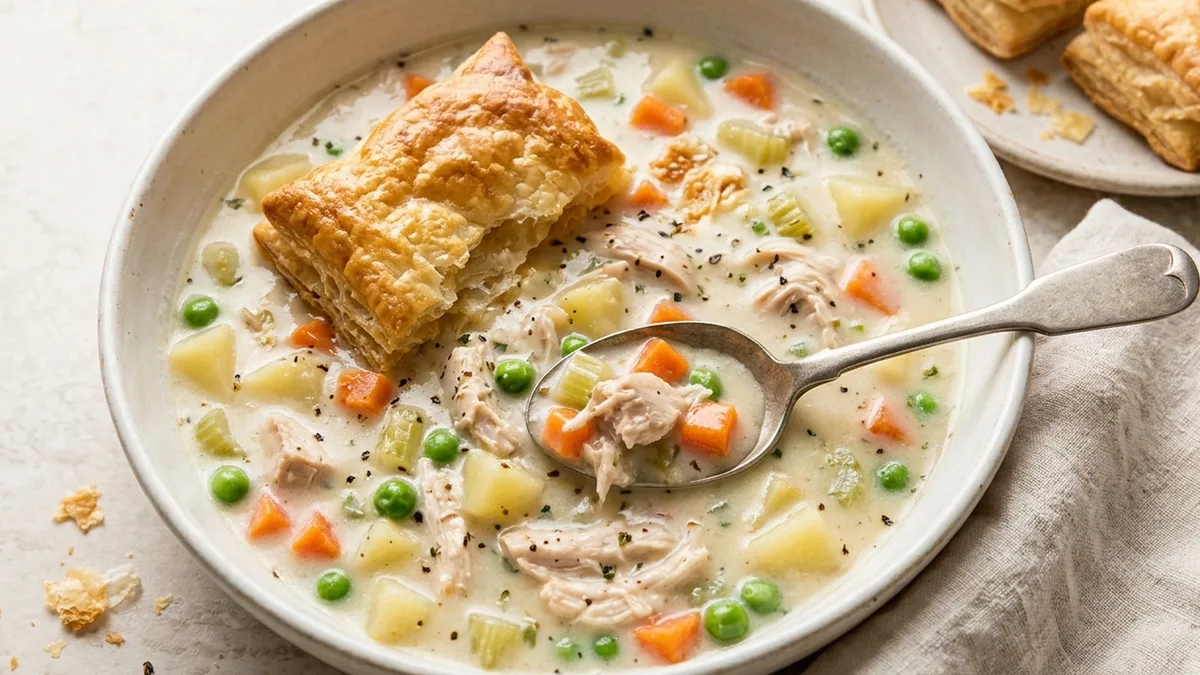
Stir the soup gently and check its consistency: It should be creamy and spoonable, with tender vegetables and shredded chicken throughout. The broth should resemble a slightly loosened chicken pot pie filling rather than a thin chicken broth. Ladle the hot soup into six bowls, dividing it evenly. Top each serving with two golden puff pastry squares immediately before serving. Keep the pastry separate until the last moment so its layers remain crisp.