Place whole-milk ricotta in a fine-mesh strainer lined with cheesecloth or a clean lint-free kitchen towel. Set the strainer over a bowl and refrigerate for approximately 30 minutes to remove excess moisture. After draining, measure 1 cup (240 g) of ricotta for the filling. The ricotta should look thick and creamy rather than watery. If it still releases a large amount of liquid, allow it to drain a little longer. Removing excess moisture helps the cheesecake set properly.
Preheat the oven to 325°F (165°C). Line a 9 x 9-inch (23 x 23 cm) square baking pan with parchment paper, leaving overhang on two opposite sides. The parchment overhang will help you lift the chilled cheesecake out of the pan without damaging the crust. Lightly press the parchment into the corners so the paper sits flat.
In a medium mixing bowl, combine 1 1/2 cups (150 g) graham cracker crumbs, 2 tablespoons (25 g) granulated sugar, and 1/4 teaspoon (0.5 g) ground cinnamon. Pour in the 5 tablespoons (70 g) melted butter. Stir until all the crumbs are evenly moistened. The mixture should resemble damp sand and hold together when squeezed between your fingers. If there are dry pockets, continue mixing until the butter is distributed evenly.
Transfer the crumb mixture to the prepared baking pan. Spread it evenly across the bottom and press firmly using the flat bottom of a measuring cup or glass. Pay particular attention to the corners so the crust has an even thickness. Bake at 325°F (165°C) for approximately 10 minutes. The crust should look lightly golden and smell toasted. Remove it from the oven and place the pan on a wire rack while preparing the filling. Keep the oven at 325°F (165°C).
Place the 16 ounces (450 g) softened cream cheese in a large mixing bowl. Beat on medium-low speed for approximately 1 minute, until smooth and free of visible lumps. Add the 2/3 cup (135 g) granulated sugar. Continue mixing for another 1 to 2 minutes, scraping down the bowl as needed. The mixture should be creamy and uniform without large pockets of unmixed cream cheese. Avoid whipping at high speed, which can incorporate excess air and increase the risk of cracks.
Add the 1 cup (240 g) drained whole-milk ricotta to the cream cheese mixture. Mix on low speed until evenly incorporated. Scrape the sides and bottom of the bowl to ensure the ricotta is distributed throughout the filling. The mixture should look thick and creamy, although a slight ricotta texture is normal. Avoid overmixing once the ricotta has been incorporated.
Add the 2 large eggs one at a time, mixing on low speed just until each egg disappears into the batter. Add the 1 teaspoon (5 ml) vanilla extract and 1 teaspoon (2 g) fresh orange zest. Mix briefly until combined. The batter should appear smooth, thick, and slightly glossy. Stop mixing once the ingredients are incorporated to avoid adding unnecessary air.
Sprinkle the 2 tablespoons (16 g) all-purpose flour and 1/4 teaspoon (1.5 g) fine salt over the cheesecake mixture. Mix on low speed until no dry flour remains. Use a rubber spatula to scrape the bowl and fold the batter gently a few times. The flour helps provide a little additional structure to the ricotta-based filling without making it noticeably cakey.
Reserve 2 tablespoons (about 22 g) of the 1/2 cup (90 g) mini semisweet chocolate chips for the top. Gently fold the remaining chocolate chips into the cheesecake batter using a rubber spatula. Stir just enough to distribute the chocolate evenly. Avoid vigorous mixing, which can make the filling airy and encourage surface cracking during baking.
Pour the cheesecake filling over the warm, pre-baked graham cracker crust. Spread it gently into an even layer using an offset spatula or the back of a spoon. Smooth the surface without pressing down into the crust. Sprinkle the reserved 2 tablespoons (22 g) mini chocolate chips evenly across the top. Tap the pan gently against the counter once or twice to release any large trapped air bubbles.
Place the pan on the center oven rack: Bake at 325°F (165°C) for approximately 38 to 42 minutes. The cheesecake is ready when the outer edges appear set and slightly puffed, while the center still has a gentle wobble when the pan is carefully nudged. The middle should move as one soft section rather than ripple like liquid batter. Avoid baking until the entire surface becomes completely firm, as the filling will continue setting during cooling. If the center still looks wet and loose after 42 minutes, continue baking in 3-minute increments.
Turn off the oven and leave the cheesecake inside with the oven door slightly open for approximately 15 minutes. This helps the filling cool more gradually. Remove the pan from the oven and place it on a wire cooling rack. Let the cheesecake cool at room temperature for another 45 minutes. The filling should become firmer as it cools. Avoid placing a very hot cheesecake directly into the refrigerator.
Once the cheesecake has cooled, cover the pan and transfer it to the refrigerator. Chill for at least 4 hours, or until the center is completely cold and firm enough to slice. For the cleanest slices, refrigerating overnight is also a good option. The texture should be creamy and dense, with enough structure to hold its shape when cut.
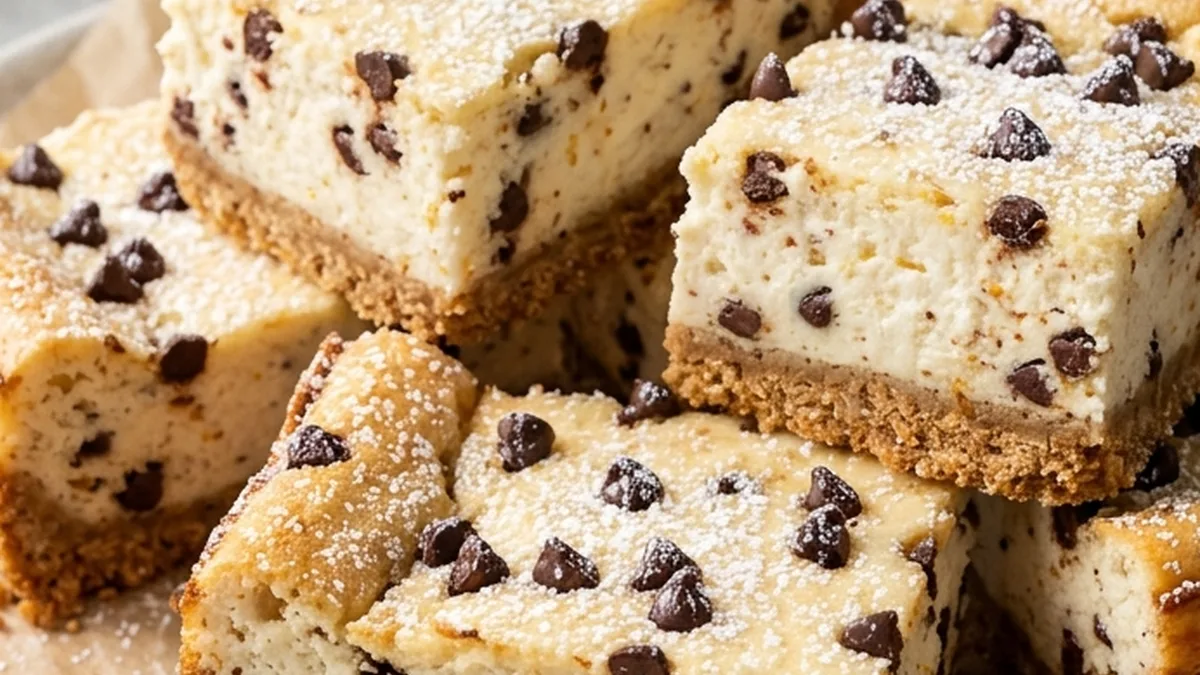
Once fully chilled, lift the cheesecake out of the pan using the parchment paper overhang. Place it on a cutting board. Use a sharp knife to cut the cheesecake into 16 equal bars, wiping the blade clean between cuts. If desired, dust the tops lightly with the optional 1 tablespoon (8 g) powdered sugar. Sprinkle the optional 2 tablespoons (22 g) additional mini chocolate chips over the bars for decoration. Add the powdered sugar shortly before serving so it does not dissolve into the moist cheesecake surface. Serve chilled for the smoothest, firmest texture.