Cannoli Cheesecake Bars combine the rich, creamy texture of cheesecake with the classic flavors of Italian cannoli. These dessert bars feature a buttery graham cracker crust topped with a smooth filling made from cream cheese, ricotta, vanilla, orange zest, and mini chocolate chips. The result is a creamy, lightly tangy cheesecake with delicate citrus notes, sweet chocolate pieces, and a crisp, buttery base.
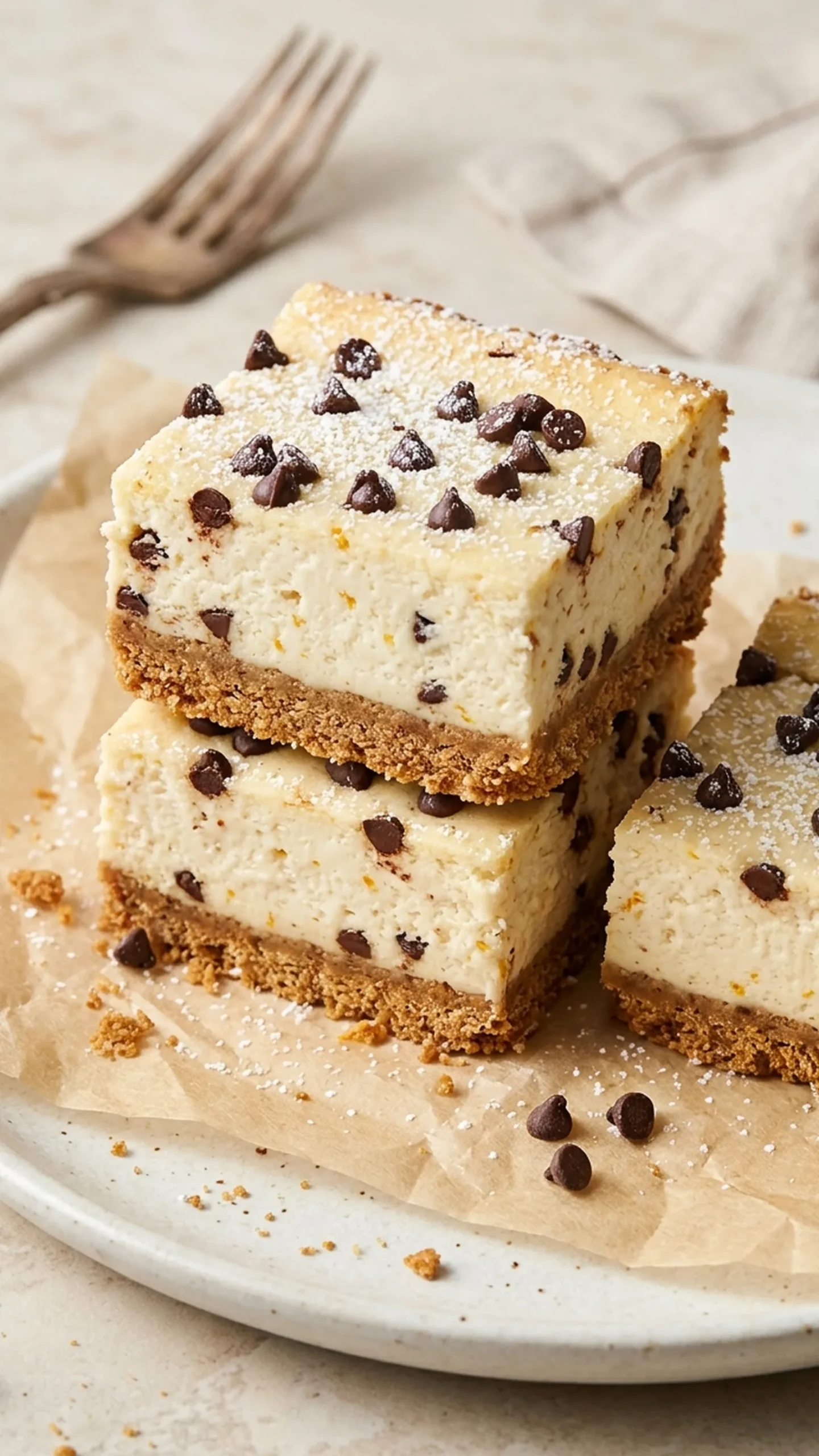
Unlike traditional cannoli, these bars don't require frying pastry shells or preparing individual fillings. They're baked in a 9 x 9-inch pan, then chilled until firm enough to slice into neat squares. A little cinnamon in the crust and a dusting of powdered sugar give them a cannoli-inspired finish. They're especially convenient for parties, holiday gatherings, and make-ahead desserts.
Why This Recipe Works
- Cream cheese provides a stable cheesecake base. Its smooth texture and fat content help the filling set while maintaining a rich, creamy consistency.
- Whole-milk ricotta adds traditional cannoli flavor. Well-drained ricotta contributes a delicate dairy sweetness and lighter texture without making the filling overly dense.
- A pre-baked graham cracker crust holds together better. Briefly baking the crust helps it firm up before the cheesecake filling is added, reducing the chance of a crumbly or soggy base.
- Mini chocolate chips distribute evenly. Their small size creates little pockets of chocolate throughout the cheesecake without weighing down the filling.
- Slow cooling and thorough chilling improve the texture. Allowing the bars to cool gradually helps reduce cracking, while refrigeration makes them firm enough to slice cleanly.
Equipment Needed
- 9 x 9-inch (23 x 23 cm) square baking pan, preferably metal
- Parchment paper
- Food processor or rolling pin for crushing graham crackers
- Electric hand mixer or stand mixer with paddle attachment
- Large mixing bowl
- Fine-mesh strainer
- Cheesecloth or clean lint-free kitchen towel for draining ricotta
- Rubber spatula
- Measuring cups and spoons
- Microplane or fine grater for orange zest
- Wire cooling rack
- Sharp knife for slicing
Ingredients List
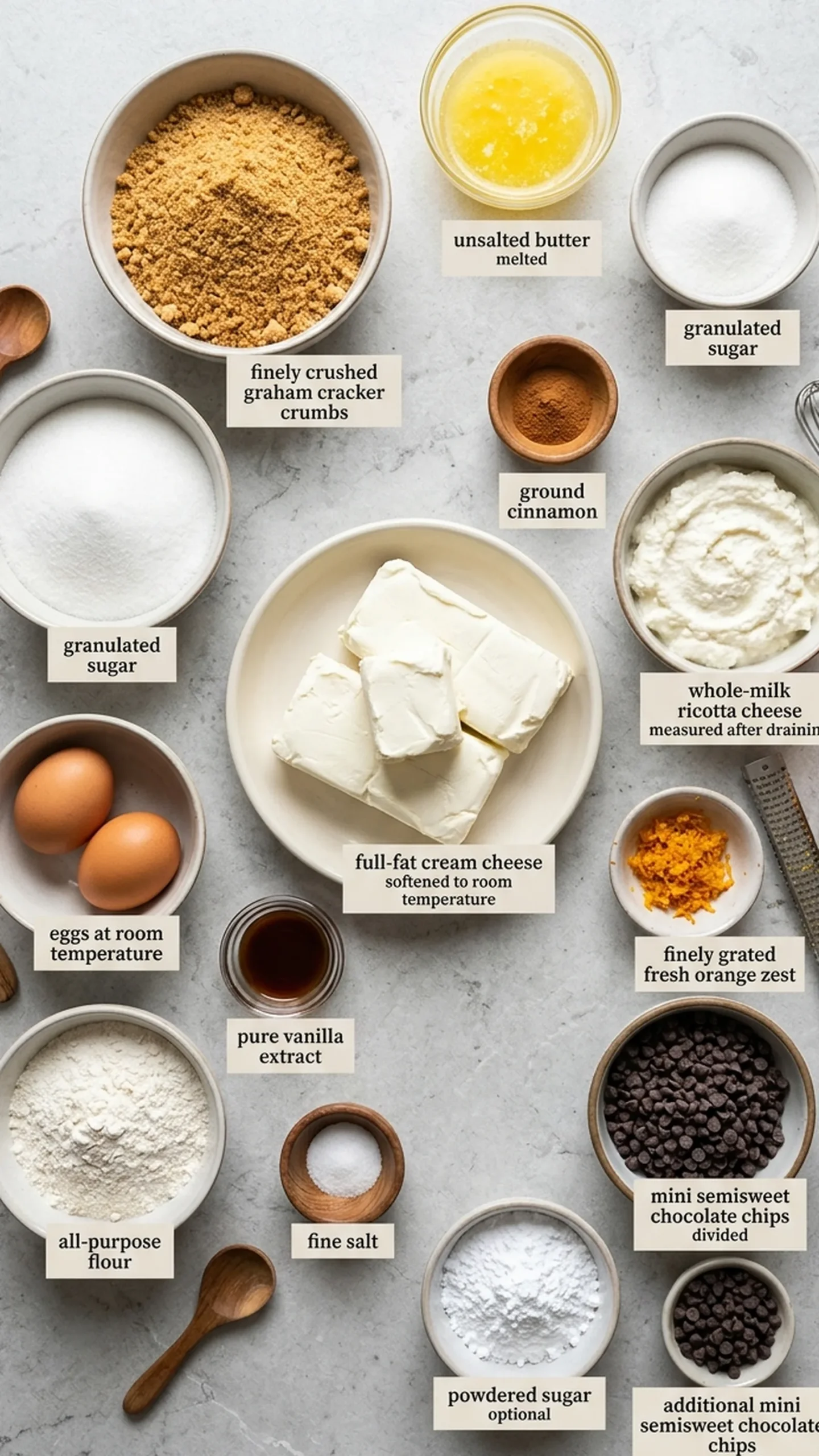
For the Graham Cracker Crust
- 1 1/2 cups (150 g) finely crushed graham cracker crumbs
- 5 tablespoons (70 g) unsalted butter, melted
- 2 tablespoons (25 g) granulated sugar
- 1/4 teaspoon (0.5 g) ground cinnamon
For the Cannoli Cheesecake Filling
- 16 ounces (450 g) full-fat cream cheese, softened to room temperature
- 1 cup (240 g) whole-milk ricotta cheese, measured after draining
- 2/3 cup (135 g) granulated sugar
- 2 large eggs (about 100 g without shells), at room temperature
- 1 teaspoon (5 ml) pure vanilla extract
- 1 teaspoon (2 g) finely grated fresh orange zest
- 2 tablespoons (16 g) all-purpose flour
- 1/4 teaspoon (1.5 g) fine salt
- 1/2 cup (90 g) mini semisweet chocolate chips, divided
Optional Topping
- 1 tablespoon (8 g) powdered sugar, optional, for dusting
- 2 tablespoons (22 g) additional mini semisweet chocolate chips, optional, for decorating
Ingredient Notes and Substitutions
- 1.
- Whole-Milk Ricotta: Cheese: Ricotta gives these cheesecake bars their distinctive cannoli-inspired flavor and a lighter, slightly textured filling. Use whole-milk ricotta for the creamiest result. Drain it thoroughly before measuring to remove excess whey, which can make the cheesecake watery or prevent it from setting properly. Part-skim ricotta can be substituted, but the filling may be slightly less rich and more prone to a grainy texture. Avoid using very wet ricotta without draining it first.
- 2.
- Full-Fat Cream: Cheese: Cream cheese provides richness, structure, and the familiar tangy flavor of cheesecake. Use full-fat brick-style cream cheese rather than whipped cream cheese or spreadable cream cheese from a tub. Reduced-fat cream cheese may produce a softer, less creamy filling. There is no equally reliable direct substitute for full-fat cream cheese in this recipe without changing the texture and setting behavior.
- 3.
- Graham Cracker Crumbs: Graham crackers create a buttery, slightly crisp base that supports the creamy cheesecake layer. Crushed vanilla wafer cookies or digestive biscuits can replace the graham cracker crumbs in the same weight. Vanilla wafers create a sweeter crust, while digestive biscuits give a more toasted, less sweet flavor. The crust should resemble damp sand after mixing with melted butter.
- 4.
- Mini Chocolate Chips: Mini chocolate chips add little pockets of chocolate throughout the cheesecake and resemble the chocolate-studded filling found in many cannoli desserts. Finely chopped semisweet chocolate can replace the mini chips in the same weight. The pieces may be less uniform and create larger chocolate pockets. Dark chocolate chips can also be used for a slightly less sweet, more intense chocolate flavor.
- 5.
- Fresh Orange: Zest: Orange zest adds a fragrant citrus note commonly associated with cannoli filling. Fresh lemon zest can replace orange zest in the same quantity, although it creates a sharper, more tart citrus flavor. For a cheesecake without citrus, the zest can be omitted, but the finished bars will have a simpler vanilla-ricotta flavor.
Step-by-Step Instructions
1. Drain the Ricotta
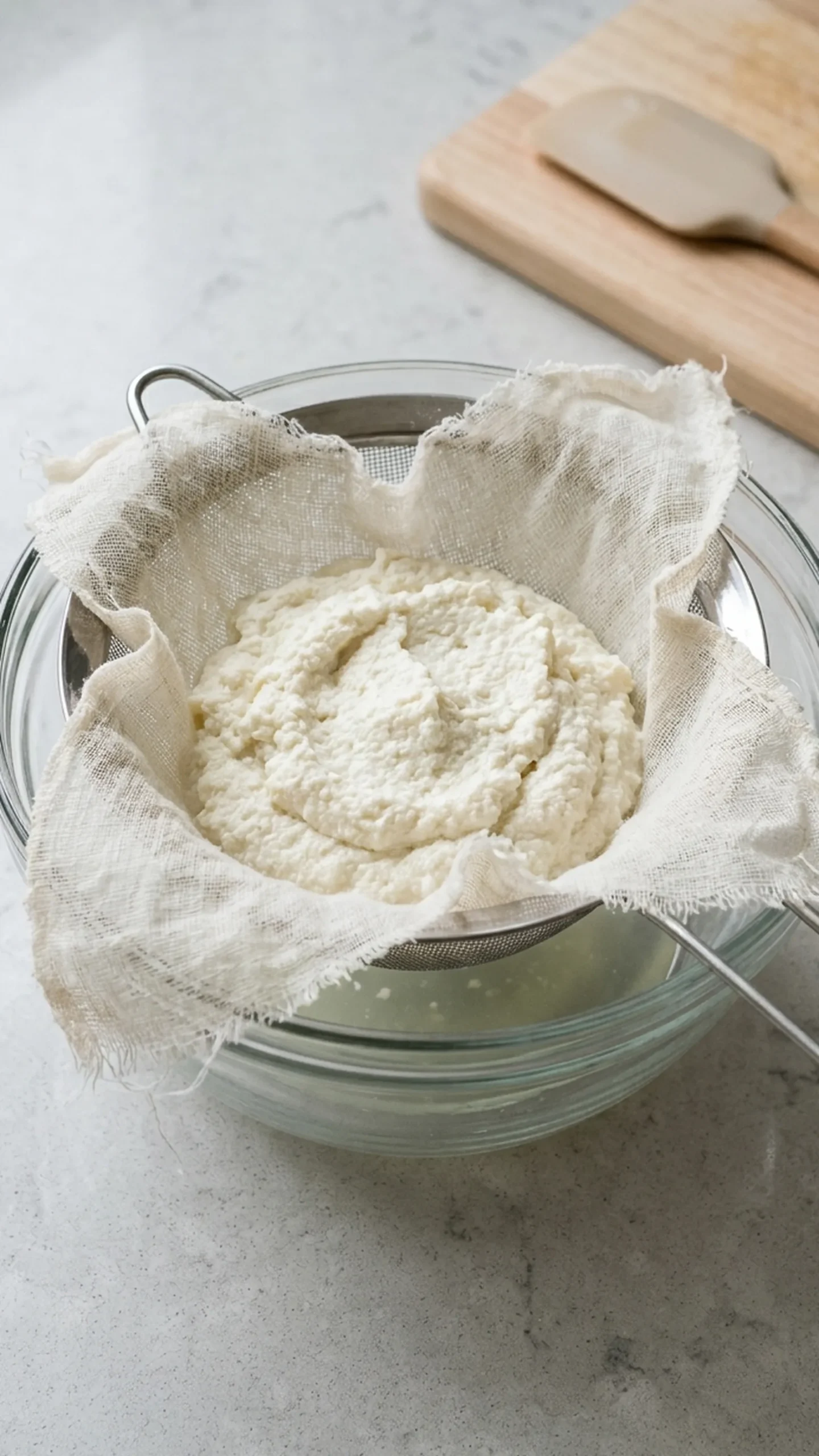
Place whole-milk ricotta in a fine-mesh strainer lined with cheesecloth or a clean lint-free kitchen towel.
Set the strainer over a bowl and refrigerate for approximately 30 minutes to remove excess moisture.
After draining, measure 1 cup (240 g) of ricotta for the filling.
The ricotta should look thick and creamy rather than watery.
If it still releases a large amount of liquid, allow it to drain a little longer. Removing excess moisture helps the cheesecake set properly.
2. Prepare the Baking Pan
Preheat the oven to 325°F (165°C).
Line a 9 x 9-inch (23 x 23 cm) square baking pan with parchment paper, leaving overhang on two opposite sides.
The parchment overhang will help you lift the chilled cheesecake out of the pan without damaging the crust.
Lightly press the parchment into the corners so the paper sits flat.
3. Make the Graham Cracker Crust
In a medium mixing bowl, combine 1 1/2 cups (150 g) graham cracker crumbs, 2 tablespoons (25 g) granulated sugar, and 1/4 teaspoon (0.5 g) ground cinnamon.
Pour in the 5 tablespoons (70 g) melted butter.
Stir until all the crumbs are evenly moistened.
The mixture should resemble damp sand and hold together when squeezed between your fingers.
If there are dry pockets, continue mixing until the butter is distributed evenly.
4. Press and Pre-Bake the Crust
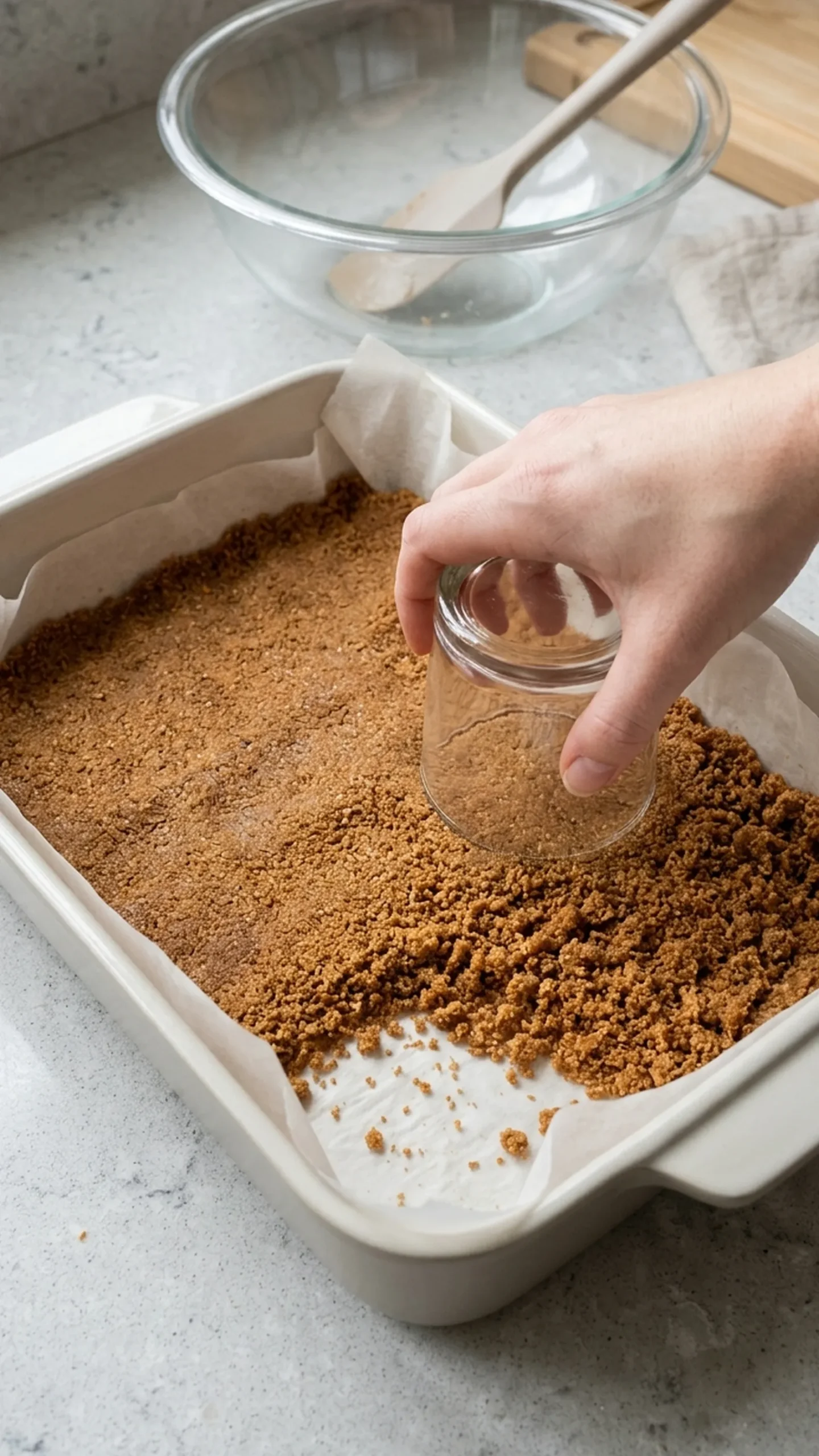
Transfer the crumb mixture to the prepared baking pan.
Spread it evenly across the bottom and press firmly using the flat bottom of a measuring cup or glass.
Pay particular attention to the corners so the crust has an even thickness.
Bake at 325°F (165°C) for approximately 10 minutes.
The crust should look lightly golden and smell toasted.
Remove it from the oven and place the pan on a wire rack while preparing the filling.
Keep the oven at 325°F (165°C).
5. Beat the Cream Cheese and Sugar
Place the 16 ounces (450 g) softened cream cheese in a large mixing bowl.
Beat on medium-low speed for approximately 1 minute, until smooth and free of visible lumps.
Add the 2/3 cup (135 g) granulated sugar.
Continue mixing for another 1 to 2 minutes, scraping down the bowl as needed.
The mixture should be creamy and uniform without large pockets of unmixed cream cheese.
Avoid whipping at high speed, which can incorporate excess air and increase the risk of cracks.
6. Add the Ricotta
Add the 1 cup (240 g) drained whole-milk ricotta to the cream cheese mixture.
Mix on low speed until evenly incorporated.
Scrape the sides and bottom of the bowl to ensure the ricotta is distributed throughout the filling.
The mixture should look thick and creamy, although a slight ricotta texture is normal.
Avoid overmixing once the ricotta has been incorporated.
7. Add the Eggs and Flavorings
Add the 2 large eggs one at a time, mixing on low speed just until each egg disappears into the batter.
Add the 1 teaspoon (5 ml) vanilla extract and 1 teaspoon (2 g) fresh orange zest.
Mix briefly until combined.
The batter should appear smooth, thick, and slightly glossy.
Stop mixing once the ingredients are incorporated to avoid adding unnecessary air.
8. Add the Flour and Salt
Sprinkle the 2 tablespoons (16 g) all-purpose flour and 1/4 teaspoon (1.5 g) fine salt over the cheesecake mixture.
Mix on low speed until no dry flour remains.
Use a rubber spatula to scrape the bowl and fold the batter gently a few times.
The flour helps provide a little additional structure to the ricotta-based filling without making it noticeably cakey.
9. Fold in the Chocolate Chips
Reserve 2 tablespoons (about 22 g) of the 1/2 cup (90 g) mini semisweet chocolate chips for the top.
Gently fold the remaining chocolate chips into the cheesecake batter using a rubber spatula.
Stir just enough to distribute the chocolate evenly.
Avoid vigorous mixing, which can make the filling airy and encourage surface cracking during baking.
10. Fill the Baking Pan
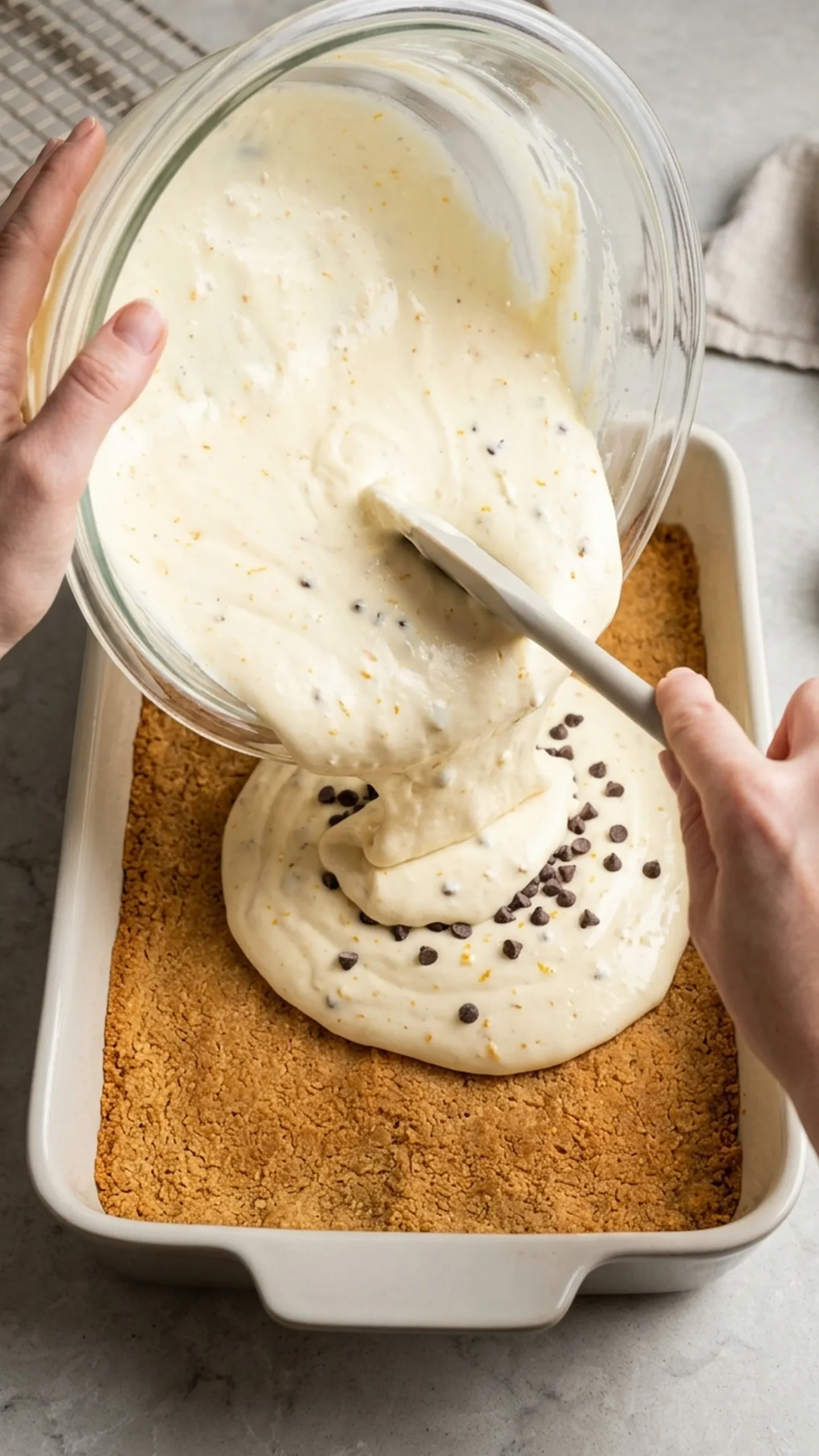
Pour the cheesecake filling over the warm, pre-baked graham cracker crust.
Spread it gently into an even layer using an offset spatula or the back of a spoon.
Smooth the surface without pressing down into the crust.
Sprinkle the reserved 2 tablespoons (22 g) mini chocolate chips evenly across the top.
Tap the pan gently against the counter once or twice to release any large trapped air bubbles.
11. Bake the Cheesecake Bars
Place the pan on the center oven rack.
Bake at 325°F (165°C) for approximately 38 to 42 minutes.
The cheesecake is ready when the outer edges appear set and slightly puffed, while the center still has a gentle wobble when the pan is carefully nudged.
The middle should move as one soft section rather than ripple like liquid batter.
Avoid baking until the entire surface becomes completely firm, as the filling will continue setting during cooling.
If the center still looks wet and loose after 42 minutes, continue baking in 3-minute increments.
12. Cool Gradually
Turn off the oven and leave the cheesecake inside with the oven door slightly open for approximately 15 minutes.
This helps the filling cool more gradually.
Remove the pan from the oven and place it on a wire cooling rack.
Let the cheesecake cool at room temperature for another 45 minutes.
The filling should become firmer as it cools.
Avoid placing a very hot cheesecake directly into the refrigerator.
13. Chill Until Firm
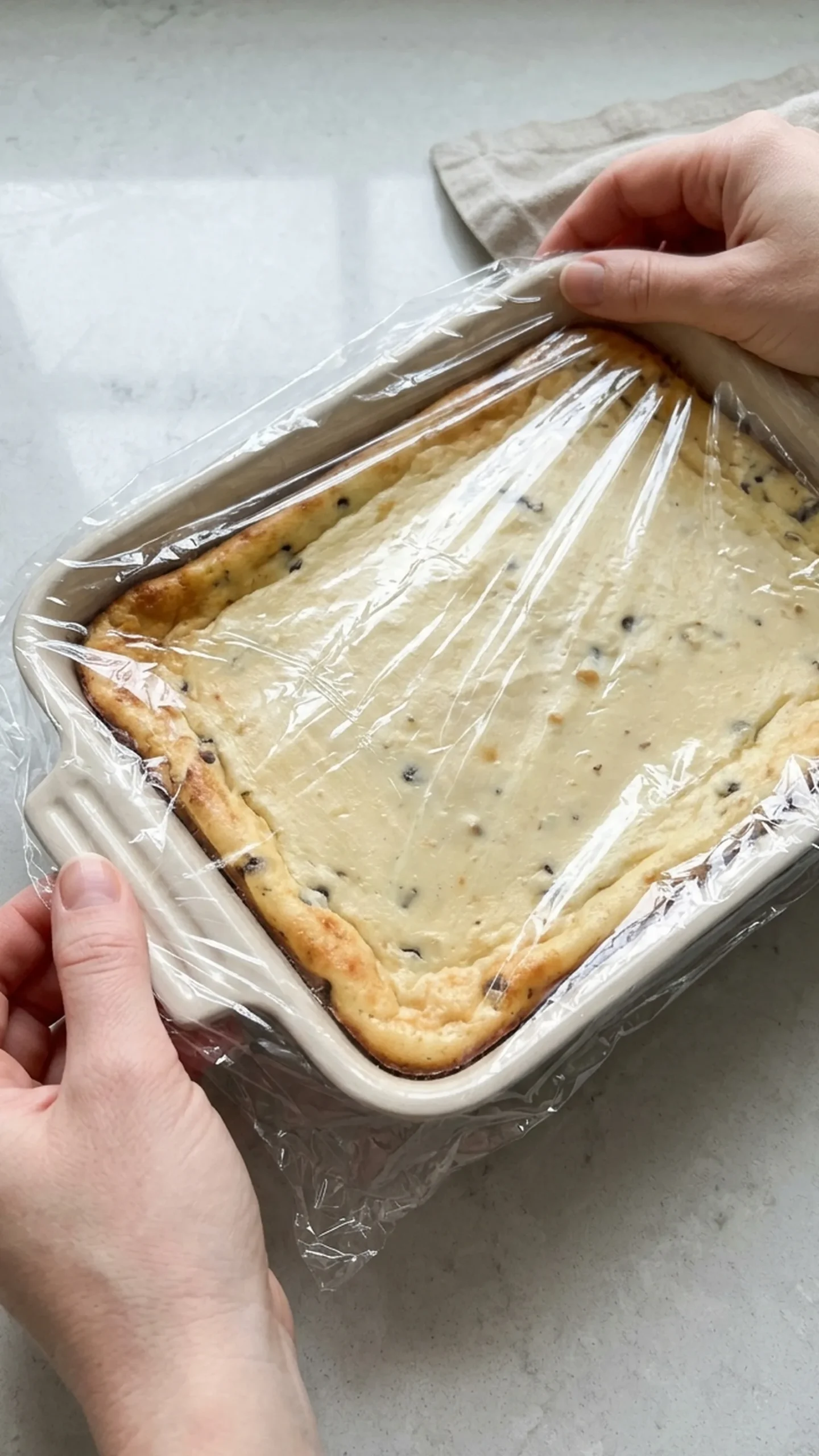
Once the cheesecake has cooled, cover the pan and transfer it to the refrigerator.
Chill for at least 4 hours, or until the center is completely cold and firm enough to slice.
For the cleanest slices, refrigerating overnight is also a good option.
The texture should be creamy and dense, with enough structure to hold its shape when cut.
14. Slice and Decorate
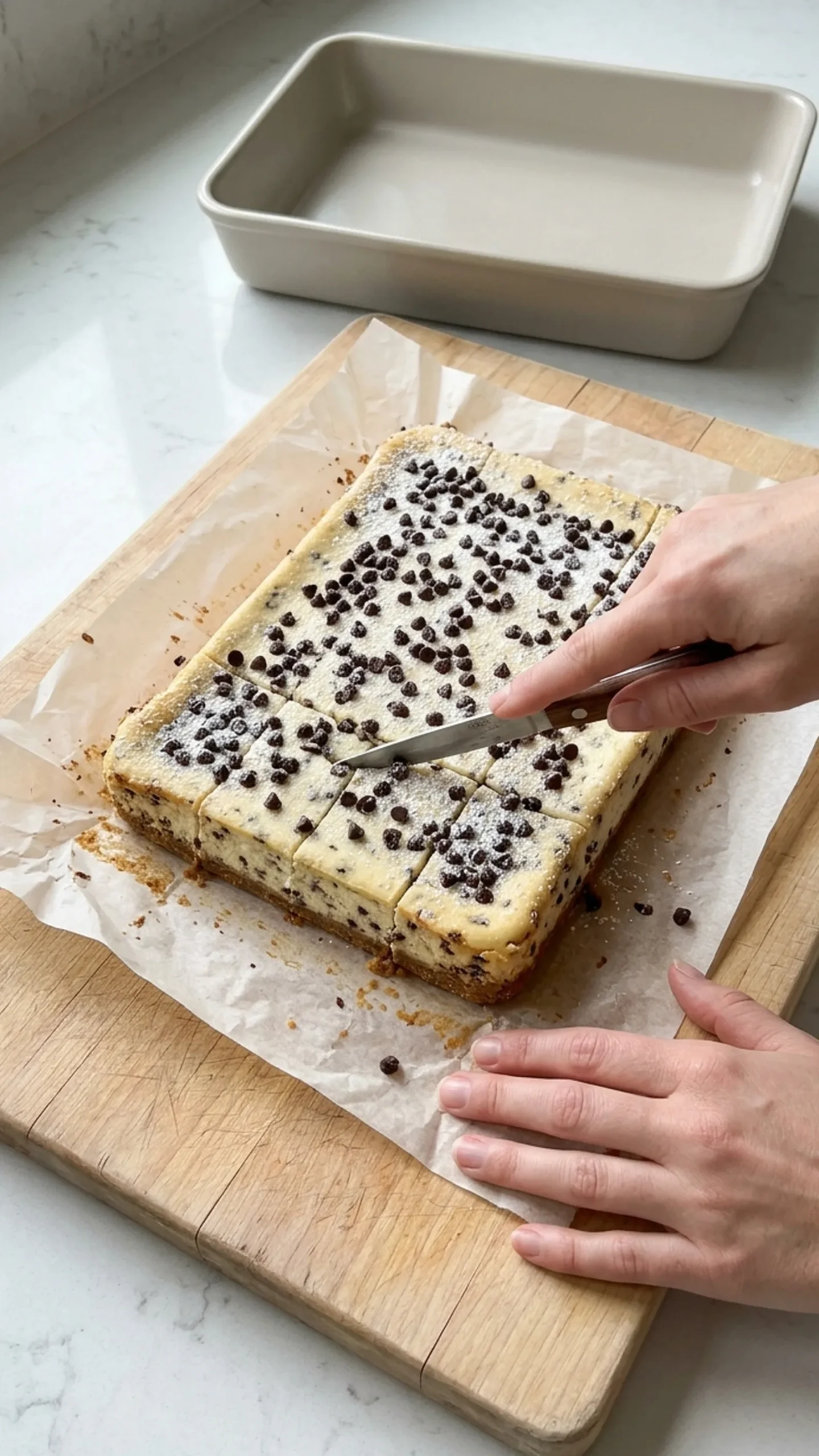
Once fully chilled, lift the cheesecake out of the pan using the parchment paper overhang.
Place it on a cutting board.
Use a sharp knife to cut the cheesecake into 16 equal bars, wiping the blade clean between cuts.
If desired, dust the tops lightly with the optional 1 tablespoon (8 g) powdered sugar.
Sprinkle the optional 2 tablespoons (22 g) additional mini chocolate chips over the bars for decoration.
Add the powdered sugar shortly before serving so it does not dissolve into the moist cheesecake surface.
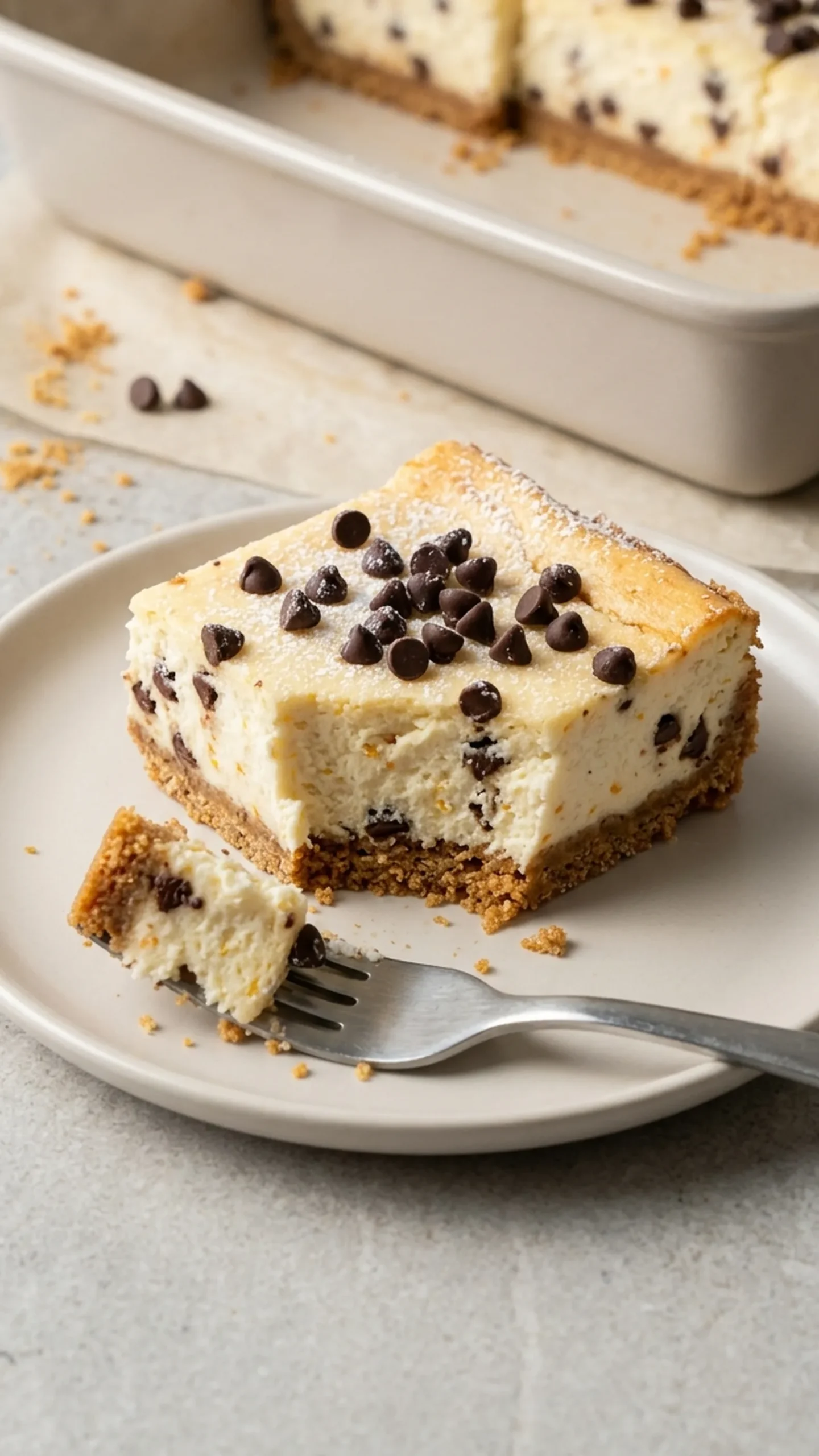
Serve chilled for the smoothest, firmest texture.
Storage, Freezing, and Make-Ahead Instructions
- Refrigerator Storage: Store Cannoli Cheesecake Bars in an airtight container in the refrigerator for up to 4 to 5 days. Place parchment paper between layers if stacking the bars. For the best presentation, wait until serving to add the optional powdered sugar. The cheesecake should remain refrigerated at 40°F (4°C) or below because it contains cream cheese, ricotta, and eggs. Avoid leaving the bars at room temperature for more than 2 hours.
- Freezing Instructions: These cheesecake bars can be frozen for up to 2 months for the best quality. Chill the cheesecake completely before slicing. Place the bars on a parchment-lined tray and freeze until firm, approximately 1 to 2 hours. Wrap each bar tightly in plastic wrap, then place the wrapped portions in a freezer-safe airtight container. Freeze without the optional powdered sugar garnish. The cheesecake filling may become slightly denser after thawing, but it should retain a creamy texture.
- Thawing Instructions: Transfer frozen cheesecake bars to the refrigerator and thaw overnight. Keep them covered while thawing to reduce condensation. Once thawed, add powdered sugar or additional chocolate chips shortly before serving. Do not thaw cheesecake bars at room temperature for an extended period.
- Make-Ahead Instructions: Cannoli Cheesecake Bars are well suited for making ahead because they require several hours of chilling. Prepare the cheesecake one day before serving and refrigerate it overnight in the baking pan. Keep the cheesecake covered after it has cooled. For the neatest presentation, lift it from the pan and slice it shortly before serving. Add any optional powdered sugar or decorative chocolate chips at the last minute.
FAQ
Can I make Cannoli Cheesecake Bars ahead of time?
Yes. These bars are an excellent make-ahead dessert because the filling needs several hours to chill and firm up. Prepare the cheesecake the day before serving, refrigerate it overnight, and slice it while cold. Wait until serving to add powdered sugar so the topping stays visible.
Why are my Cannoli Cheesecake Bars watery?
Excess moisture in the ricotta is a common cause of watery cheesecake filling. Drain the ricotta thoroughly before measuring it, and use full-fat brick-style cream cheese for better structure. The cheesecake also needs enough baking time to set around the edges and at least 4 hours of chilling before slicing.
Can I make these cheesecake bars without orange zest?
Yes. Orange zest adds a traditional cannoli-inspired citrus note, but it can be omitted if you prefer a simple vanilla and chocolate flavor. You can also replace it with the same amount of finely grated lemon zest for a brighter, slightly more tart finish.
Can I use a different pan size?
A 9 x 9-inch square pan provides the intended thickness for these cheesecake bars. An 8 x 8-inch pan will make the filling thicker and may require additional baking time. A 9 x 13-inch pan will produce thinner bars that generally bake more quickly. Adjust the baking time based on the appearance and movement of the center rather than relying only on the clock.
Can I freeze Cannoli Cheesecake Bars?
Yes. Chill and slice the cheesecake first, then freeze individual bars in airtight wrapping for up to 2 months. Thaw them overnight in the refrigerator before serving. Add powdered sugar after thawing to prevent it from dissolving into the surface.
Ingredients
Method
- Place whole-milk ricotta in a fine-mesh strainer lined with cheesecloth or a clean lint-free kitchen towel. Set the strainer over a bowl and refrigerate for approximately 30 minutes to remove excess moisture. After draining, measure 1 cup (240 g) of ricotta for the filling. The ricotta should look thick and creamy rather than watery. If it still releases a large amount of liquid, allow it to drain a little longer. Removing excess moisture helps the cheesecake set properly.
- Preheat the oven to 325°F (165°C). Line a 9 x 9-inch (23 x 23 cm) square baking pan with parchment paper, leaving overhang on two opposite sides. The parchment overhang will help you lift the chilled cheesecake out of the pan without damaging the crust. Lightly press the parchment into the corners so the paper sits flat.
- In a medium mixing bowl, combine 1 1/2 cups (150 g) graham cracker crumbs, 2 tablespoons (25 g) granulated sugar, and 1/4 teaspoon (0.5 g) ground cinnamon. Pour in the 5 tablespoons (70 g) melted butter. Stir until all the crumbs are evenly moistened. The mixture should resemble damp sand and hold together when squeezed between your fingers. If there are dry pockets, continue mixing until the butter is distributed evenly.
- Transfer the crumb mixture to the prepared baking pan. Spread it evenly across the bottom and press firmly using the flat bottom of a measuring cup or glass. Pay particular attention to the corners so the crust has an even thickness. Bake at 325°F (165°C) for approximately 10 minutes. The crust should look lightly golden and smell toasted. Remove it from the oven and place the pan on a wire rack while preparing the filling. Keep the oven at 325°F (165°C).
- Place the 16 ounces (450 g) softened cream cheese in a large mixing bowl. Beat on medium-low speed for approximately 1 minute, until smooth and free of visible lumps. Add the 2/3 cup (135 g) granulated sugar. Continue mixing for another 1 to 2 minutes, scraping down the bowl as needed. The mixture should be creamy and uniform without large pockets of unmixed cream cheese. Avoid whipping at high speed, which can incorporate excess air and increase the risk of cracks.
- Add the 1 cup (240 g) drained whole-milk ricotta to the cream cheese mixture. Mix on low speed until evenly incorporated. Scrape the sides and bottom of the bowl to ensure the ricotta is distributed throughout the filling. The mixture should look thick and creamy, although a slight ricotta texture is normal. Avoid overmixing once the ricotta has been incorporated.
- Add the 2 large eggs one at a time, mixing on low speed just until each egg disappears into the batter. Add the 1 teaspoon (5 ml) vanilla extract and 1 teaspoon (2 g) fresh orange zest. Mix briefly until combined. The batter should appear smooth, thick, and slightly glossy. Stop mixing once the ingredients are incorporated to avoid adding unnecessary air.
- Sprinkle the 2 tablespoons (16 g) all-purpose flour and 1/4 teaspoon (1.5 g) fine salt over the cheesecake mixture. Mix on low speed until no dry flour remains. Use a rubber spatula to scrape the bowl and fold the batter gently a few times. The flour helps provide a little additional structure to the ricotta-based filling without making it noticeably cakey.
- Reserve 2 tablespoons (about 22 g) of the 1/2 cup (90 g) mini semisweet chocolate chips for the top. Gently fold the remaining chocolate chips into the cheesecake batter using a rubber spatula. Stir just enough to distribute the chocolate evenly. Avoid vigorous mixing, which can make the filling airy and encourage surface cracking during baking.
- Pour the cheesecake filling over the warm, pre-baked graham cracker crust. Spread it gently into an even layer using an offset spatula or the back of a spoon. Smooth the surface without pressing down into the crust. Sprinkle the reserved 2 tablespoons (22 g) mini chocolate chips evenly across the top. Tap the pan gently against the counter once or twice to release any large trapped air bubbles.
- Place the pan on the center oven rack: Bake at 325°F (165°C) for approximately 38 to 42 minutes. The cheesecake is ready when the outer edges appear set and slightly puffed, while the center still has a gentle wobble when the pan is carefully nudged. The middle should move as one soft section rather than ripple like liquid batter. Avoid baking until the entire surface becomes completely firm, as the filling will continue setting during cooling. If the center still looks wet and loose after 42 minutes, continue baking in 3-minute increments.
- Turn off the oven and leave the cheesecake inside with the oven door slightly open for approximately 15 minutes. This helps the filling cool more gradually. Remove the pan from the oven and place it on a wire cooling rack. Let the cheesecake cool at room temperature for another 45 minutes. The filling should become firmer as it cools. Avoid placing a very hot cheesecake directly into the refrigerator.
- Once the cheesecake has cooled, cover the pan and transfer it to the refrigerator. Chill for at least 4 hours, or until the center is completely cold and firm enough to slice. For the cleanest slices, refrigerating overnight is also a good option. The texture should be creamy and dense, with enough structure to hold its shape when cut.
- Once fully chilled, lift the cheesecake out of the pan using the parchment paper overhang. Place it on a cutting board. Use a sharp knife to cut the cheesecake into 16 equal bars, wiping the blade clean between cuts. If desired, dust the tops lightly with the optional 1 tablespoon (8 g) powdered sugar. Sprinkle the optional 2 tablespoons (22 g) additional mini chocolate chips over the bars for decoration. Add the powdered sugar shortly before serving so it does not dissolve into the moist cheesecake surface. Serve chilled for the smoothest, firmest texture.