# Apple Cider Gingersnap Cookies
## Introduction
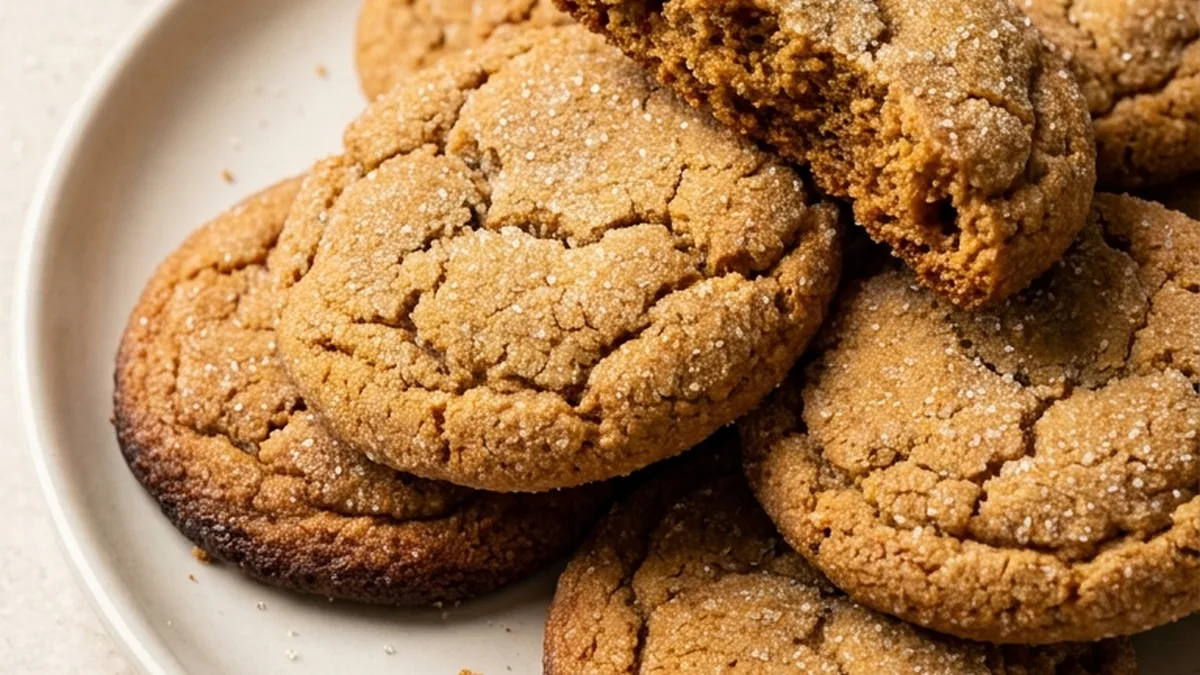
Apple Cider Gingersnap Cookies are crisp-edged, chewy-centered cookies flavored with apple cider, molasses, ginger, cinnamon, and cloves. The reduced cider gives the dough a concentrated apple flavor, while the warm spices and sugar coating create the classic crackled finish associated with gingersnaps.
The dough is chilled briefly before baking to make it easier to handle and help control spreading. A quick reduction of the apple cider adds flavor without putting too much liquid into the cookie dough, keeping the finished cookies pleasantly chewy in the center.
## Recipe Card Details
Prep Time: 20 minutes
Cook Time: 10 minutes
Additional Time: 45 minutes
Total Time: 1 hour 15 minutes
Yield: 24 cookies
Servings: 24
Category: Dessert
Cuisine: American
Cooking Method: Baking
Difficulty: Intermediate
Calories Per Serving: Not calculated
## Why This Recipe Works
* **Reduced apple cider concentrates flavor:** Simmering the cider removes excess water while intensifying its apple character.
* **Molasses provides classic gingersnap depth:** It adds dark caramel notes, color, moisture, and the characteristic flavor of a spiced molasses cookie.
* **Brown sugar keeps the centers tender:** Its moisture helps balance the crisp exterior and chewy middle.
* **Freshly measured spices give the cookies warmth:** Ginger, cinnamon, and cloves create a strong but balanced fall spice profile.
* **A sugar coating encourages crackling:** Rolling the dough in granulated sugar gives the baked cookies a lightly crisp exterior and attractive surface.
## Equipment Needed
* Small saucepan
* Large mixing bowl
* Medium mixing bowl
* Electric hand mixer or stand mixer
* Whisk
* Rubber spatula
* 2 baking sheets
* Parchment paper
* 1 1/2-tablespoon cookie scoop
* Wire cooling rack
## Ingredients List
### Apple Cider Reduction
* **1/2 cup apple cider (120 mL)** — simmered until reduced to about 2 tablespoons (30 mL), then cooled completely
### Cookie Dough
* **2 1/4 cups all-purpose flour (281 g)** — spooned and leveled
* **2 teaspoons ground ginger (4 g)** — divided
* **1 1/2 teaspoons ground cinnamon (4 g)** — divided
* **1/2 teaspoon ground cloves (1 g)** — warm spice
* **1/2 teaspoon baking soda (2.5 g)** — leavening
* **1/4 teaspoon fine salt (1.5 g)** — balances the sweetness
* **1/2 cup unsalted butter (113 g)** — softened
* **3/4 cup packed dark brown sugar (150 g)** — firmly packed
* **1/4 cup unsulphured molasses (80 g)** — not blackstrap
* **1 large egg (about 50 g without shell)** — preferably room temperature
* **1 teaspoon vanilla extract (5 mL)** — adds flavor
### Sugar Coating
* **1/3 cup granulated sugar (67 g)** — for rolling the dough
## Ingredient Notes and Substitutions
* **Apple cider:** Reducing cider concentrates its apple flavor while limiting the extra liquid added to the dough. Apple juice can be substituted, but the flavor will be lighter and less naturally spiced.
* **Molasses:** Unsulphured molasses provides the deep flavor and moisture typical of gingersnaps. Avoid blackstrap molasses, which is much more bitter and can overpower the spices.
* **Ground ginger:** Ginger gives these cookies their characteristic spicy warmth. Fresh ginger is not a direct substitute because it introduces additional moisture and a different flavor.
* **Dark brown sugar:** Its higher molasses content adds moisture and depth. Light brown sugar can replace it, but the cookies will have a slightly milder molasses flavor.
* **Apple cider reduction:** Do not skip the reduction if using cider. Adding the full 1/2 cup directly to the dough would introduce too much liquid and change the cookie’s structure.
## Step-by-Step Instructions
1. **Reduce the apple cider.**
Pour **1/2 cup apple cider** into a small saucepan. Bring it to a gentle simmer over medium heat and cook for about **10 to 12 minutes**, stirring occasionally, until reduced to approximately **2 tablespoons (30 mL)**. Transfer it to a small bowl and cool completely. It should be concentrated and syrupy but still pourable.
2. **Prepare the dry ingredients.**
In a medium bowl, whisk together the flour, **1 1/2 teaspoons ground ginger**, **1 teaspoon ground cinnamon**, cloves, baking soda, and salt. Set aside.
3. **Cream the butter and sugar.**
In a large bowl, beat the softened butter and brown sugar on medium speed for about **2 minutes**, until smooth and slightly fluffy. The mixture should look creamy rather than greasy.
4. **Add the wet ingredients.**
Beat in the molasses, egg, vanilla, and completely cooled cider reduction until evenly combined. Scrape down the sides of the bowl as needed. The mixture may look slightly loose, which is normal.
5. **Make the dough.**
Add the dry ingredients to the wet mixture. Mix on low speed just until the flour disappears, then finish with a rubber spatula if needed. The dough should be soft and slightly sticky but firm enough to scoop.
6. **Chill the dough.**
Cover the bowl and refrigerate for **30 minutes**. Chilling firms the butter and makes the dough easier to roll in sugar. If the dough is still difficult to handle, chill it for another 10 to 15 minutes.
7. **Prepare the sugar coating and oven.**
Preheat the oven to **350°F (175°C)**. Line two baking sheets with parchment paper. In a small bowl, combine the granulated sugar, remaining **1/2 teaspoon ground ginger**, and remaining **1/2 teaspoon ground cinnamon**.
8. **Shape the cookies.**
Scoop the chilled dough into about **24 portions**, approximately 1 1/2 tablespoons each. Roll each portion between your palms to form a ball, then coat it generously in the cinnamon-sugar mixture.
9. **Arrange the dough.**
Place the coated dough balls about **2 inches apart** on the prepared baking sheets. Do not flatten them; they will spread naturally during baking.
10. **Bake until crackled.**
Bake for **9 to 11 minutes**, one sheet at a time if your oven has uneven airflow. The cookies should have crackled tops, set edges, and centers that still look slightly soft. Avoid waiting for the centers to become completely firm in the oven.
11. **Cool and finish.**
Let the cookies cool on the baking sheet for **5 minutes**, then transfer them to a wire rack. They will firm around the edges while remaining pleasantly chewy in the center as they cool.
## Tips for Success
* Reduce the cider fully before adding it to the dough. Extra liquid can make the cookies spread too much.
* Cool the cider reduction completely before mixing it with the butter and egg.
* Use **unsulphured molasses rather than blackstrap** for a balanced, classic cookie flavor.
* If the dough becomes difficult to roll, refrigerate it for another 10 to 15 minutes.
* Bake just until the edges are set and the centers still look slightly soft for a chewy texture.
* Let the cookies cool on the baking sheet for several minutes before moving them because they are delicate while hot.
## Storage, Freezing, and Make-Ahead Instructions
Store completely cooled cookies in an airtight container at room temperature for up to **5 days**. Place parchment between layers if stacking them. For the best texture, keep the container tightly sealed so the cookies do not dry out.
The prepared dough can be refrigerated, covered, for up to **48 hours**. Let it stand at room temperature for about 10 minutes if it becomes too firm to scoop, then roll in the sugar coating and bake.
For longer storage, shape the dough into balls without the sugar coating and freeze them on a parchment-lined tray until firm. Transfer to a freezer-safe container or bag and freeze for up to **2 months**. Roll the frozen dough in the cinnamon-sugar mixture just before baking and add about **2 to 4 minutes** to the baking time.
Baked cookies can also be frozen for up to **2 months** in an airtight freezer-safe container. Thaw at room temperature before serving.
## FAQ
### Can I use apple juice instead of apple cider?
Yes. Apple juice can replace the cider, but reduce it in the same way. The finished cookies will have a milder apple flavor.
### Why do my gingersnap cookies spread too much?
The butter may have been too warm, or the dough may not have been chilled long enough. Make sure the dough is chilled until firm and the cider reduction is completely cool before mixing.
### Can I use blackstrap molasses?
It is not recommended. Blackstrap molasses has a much stronger, more bitter flavor than regular unsulphured molasses and can overwhelm the apple and spices.
### Can I make these cookies ahead of time?
Yes. The dough can be refrigerated for up to 48 hours before baking. You can also freeze shaped, uncoated dough balls for up to 2 months.
### Should Apple Cider Gingersnap Cookies be crisp or chewy?
They can have both textures. These cookies are designed to have lightly crisp, crackled edges with softer, chewy centers. Baking them a minute or two longer will produce a firmer cookie.
## SEO and Pinterest Metadata
SEO Title: Apple Cider Gingersnap Cookies
Meta Description: Apple Cider Gingersnap Cookies combine reduced apple cider, molasses, ginger, cinnamon, and cloves for chewy centers, crisp edges, and a crackled sugar coating.
Suggested URL Slug: apple-cider-gingersnap-cookies
Primary Keyword: Apple Cider Gingersnap Cookies
Secondary Keywords: apple cider cookies, gingersnap cookies, apple cider dessert, fall cookie recipe, spiced apple cookies, molasses cookies, chewy gingersnap cookies
Pinterest Title: Apple Cider Gingersnap Cookies
Pinterest Description: These Apple Cider Gingersnap Cookies combine concentrated apple cider, molasses, ginger, cinnamon, and cloves for crisp edges and chewy centers. A cinnamon-sugar coating gives them a crackled finish and cozy fall flavor.
Image Alt Text: Crackled apple cider gingersnap cookies coated in cinnamon sugar on a parchment-lined baking sheet
Recipe Category: Dessert
Recipe Cuisine: American
Cooking Method: Baking
Ingredients
Method
- Pour 1/2 cup apple cider into a small saucepan. Bring it to a gentle simmer over medium heat and cook for about 10 to 12 minutes, stirring occasionally, until reduced to approximately 2 tablespoons (30 mL). Transfer it to a small bowl and cool completely. It should be concentrated and syrupy but still pourable.
- In a medium bowl, whisk together the flour, 1 1/2 teaspoons ground ginger, 1 teaspoon ground cinnamon, cloves, baking soda, and salt. Set aside.
- In a large bowl, beat the softened butter and brown sugar on medium speed for about 2 minutes, until smooth and slightly fluffy. The mixture should look creamy rather than greasy.
- Beat in the molasses, egg, vanilla, and completely cooled cider reduction until evenly combined. Scrape down the sides of the bowl as needed. The mixture may look slightly loose, which is normal.
- Add the dry ingredients to the wet mixture: Mix on low speed just until the flour disappears, then finish with a rubber spatula if needed. The dough should be soft and slightly sticky but firm enough to scoop.
- Cover the bowl and refrigerate for 30 minutes. Chilling firms the butter and makes the dough easier to roll in sugar. If the dough is still difficult to handle, chill it for another 10 to 15 minutes.
- Preheat the oven to 350°F (175°C). Line two baking sheets with parchment paper. In a small bowl, combine the granulated sugar, remaining 1/2 teaspoon ground ginger, and remaining 1/2 teaspoon ground cinnamon.
- Scoop the chilled dough into about 24 portions, approximately 1 1/2 tablespoons each. Roll each portion between your palms to form a ball, then coat it generously in the cinnamon-sugar mixture.
- Place the coated dough balls about 2 inches apart on the prepared baking sheets. Do not flatten them; they will spread naturally during baking.
- Bake for 9 to 11 minutes, one sheet at a time if your oven has uneven airflow. The cookies should have crackled tops, set edges, and centers that still look slightly soft. Avoid waiting for the centers to become completely firm in the oven.
- Let the cookies cool on the baking sheet for 5 minutes, then transfer them to a wire rack. They will firm around the edges while remaining pleasantly chewy in the center as they cool.