Garlic Herb Roasted Chicken with Baby Potatoes is a comforting oven-roasted dinner featuring juicy, golden-brown chicken, tender baby potatoes, fragrant garlic, and a savory blend of fresh herbs. Everything cooks together in one roasting pan, allowing the potatoes to absorb the seasoned chicken juices while developing lightly crisp, golden edges.
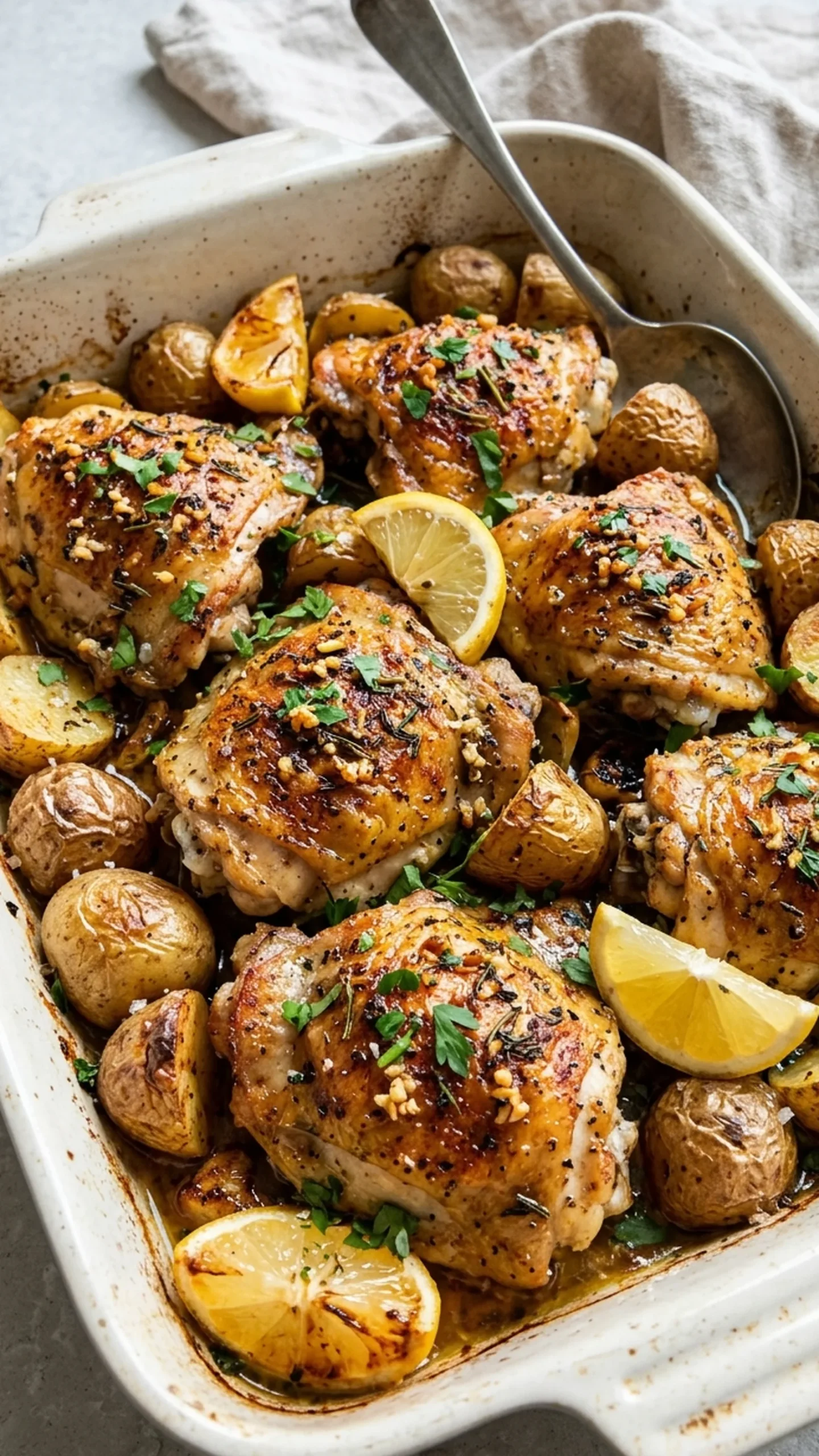
This recipe uses bone-in, skin-on chicken thighs for rich flavor and moist meat, along with baby potatoes that roast beautifully without peeling. A simple mixture of olive oil, garlic, rosemary, thyme, lemon, and seasonings brings the dish together. With minimal preparation and a hands-off roasting method, it's a practical choice for weeknight dinners or a relaxed weekend meal.
Why This Recipe Works
- Bone-in, skin-on chicken thighs retain moisture. The bones help moderate heat transfer, while the skin protects the meat and becomes golden and crisp during roasting.
- Baby potatoes roast alongside the chicken. Their creamy interiors contrast with lightly browned edges, and they absorb flavor from the garlic, herbs, and chicken drippings.
- Fresh garlic and herbs create a savory coating. Rosemary and thyme complement the chicken without overpowering it, while olive oil helps distribute the seasonings evenly.
- High oven heat encourages browning. Roasting at 425°F (220°C) helps the chicken skin develop color while giving the potatoes a tender center and lightly crisp exterior.
- A short resting period keeps the chicken juicy. Allowing the meat to rest before serving reduces moisture loss when it is cut.
Equipment Needed
- Large rimmed roasting pan or baking sheet, approximately 13 x 18 inches (33 x 46 cm)
- Large mixing bowl for seasoning the potatoes
- Small mixing bowl for preparing the garlic-herb mixture
- Sharp kitchen knife and cutting board
- Measuring spoons
- Instant-read meat thermometer
- Kitchen tongs or a sturdy spatula
Ingredients List
For the Chicken and Potatoes
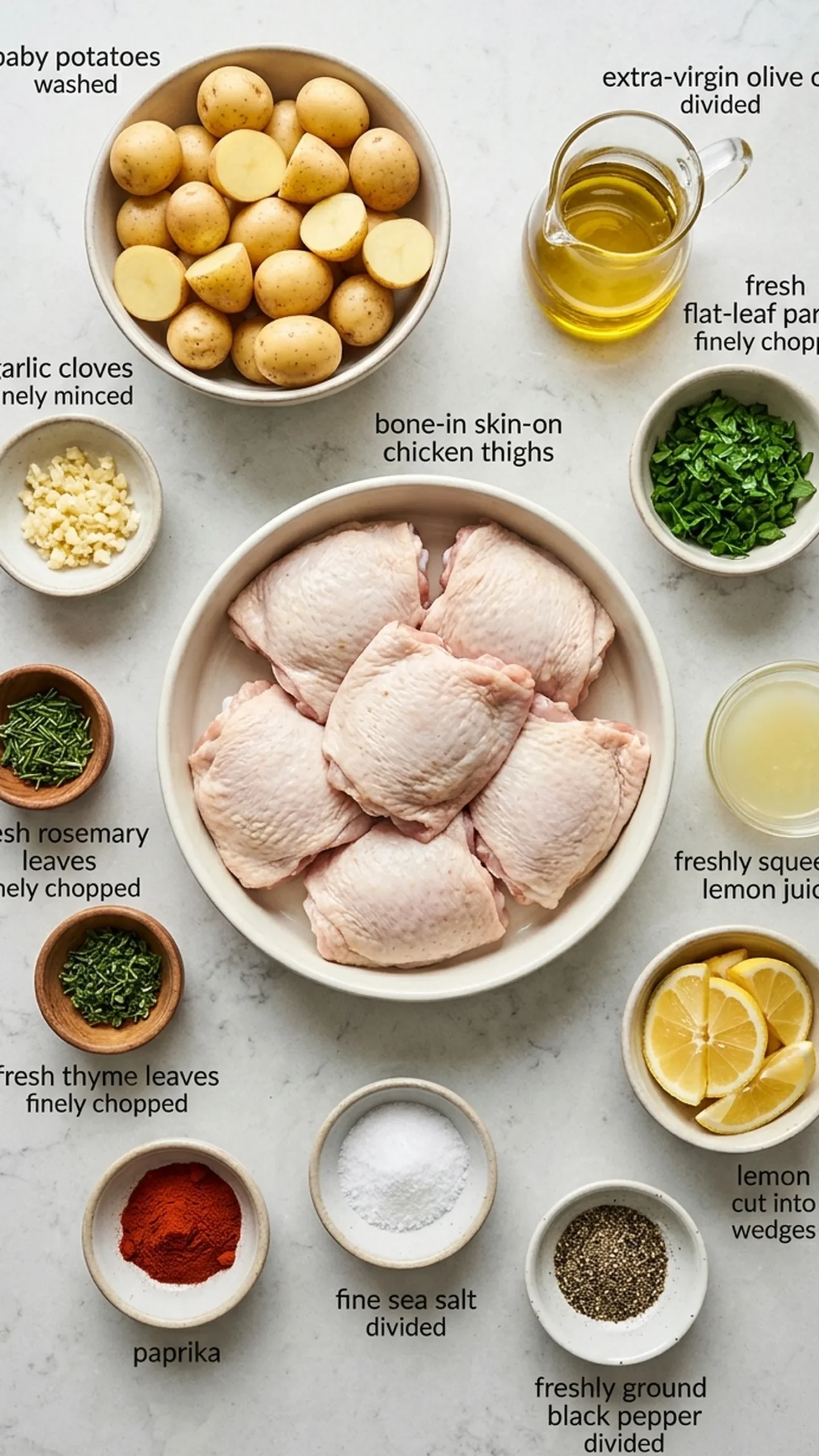
- 6 bone-in, skin-on chicken thighs (about 2 1/2 pounds / 1.13 kg total), trimmed of excess fat and patted dry
- 1 1/2 pounds (680 g) baby potatoes, washed, dried, and halved if large
- 1/4 cup (60 ml) extra-virgin olive oil, divided
- 6 garlic cloves (about 18 g), finely minced
- 1 tablespoon (about 3 g) fresh rosemary leaves, finely chopped
- 1 tablespoon (about 3 g) fresh thyme leaves, finely chopped
- 1 teaspoon (2 g) paprika
- 1 1/2 teaspoons (9 g) fine sea salt, divided
- 1/2 teaspoon (1 g) freshly ground black pepper, divided
- 2 tablespoons (30 ml) freshly squeezed lemon juice
Optional Garnish
- 2 tablespoons (about 8 g) fresh flat-leaf parsley, finely chopped, optional
- 1 medium lemon (about 120 g), cut into wedges, optional, for serving
Ingredient Notes and Substitutions
- Bone-In, Skin-On Chicken: Thighs: Chicken thighs are particularly suitable for roasting because their higher fat content helps them remain moist as the skin browns. The bone also helps protect the meat from drying out. Bone-in chicken drumsticks can be used as an alternative, although their shape and thickness may change the cooking time. Boneless, skinless chicken thighs cook faster and will not develop the same crispy exterior. They should not be substituted without adjusting the roasting schedule.
- Baby Potatoes: Baby potatoes have thin skins and a naturally creamy texture. They hold their shape during roasting and do not require peeling. Small Yukon Gold potatoes are a good substitute when cut into similarly sized pieces. Russet potatoes can also be used, but their higher starch content creates a fluffier interior, and the pieces may break apart more easily.
- Extra-Virgin Olive Oil: Olive oil helps the seasonings adhere to the chicken and potatoes while encouraging even browning. Avocado oil is a suitable replacement in the same quantity. It has a more neutral flavor and works well at the roasting temperature. Avoid reducing the oil substantially, as the potatoes may brown unevenly or stick to the pan.
- Fresh Rosemary and Thyme: Rosemary adds a distinctive woodsy aroma, while thyme provides a softer, earthy flavor. Together, they balance the richness of the chicken. Dried herbs can replace fresh herbs, but use approximately one-third of the fresh herb volume because dried herbs are more concentrated. The finished dish will have a slightly different aroma and less fresh herbal character.
- Garlic and Lemon Juice: Fresh garlic gives the chicken and potatoes their savory flavor, while lemon juice adds acidity that balances the olive oil and chicken drippings. Garlic powder can replace fresh garlic in a pinch, although it produces a less pronounced roasted-garlic flavor. Fresh lemon juice is preferable, but bottled lemon juice can be used in the same quantity if necessary. Its flavor may be less bright.
Step-by-Step Instructions
Step 1: Preheat the Oven and Prepare the Pan
Preheat your oven to 425°F (220°C).
Position an oven rack in the middle of the oven to encourage even cooking.
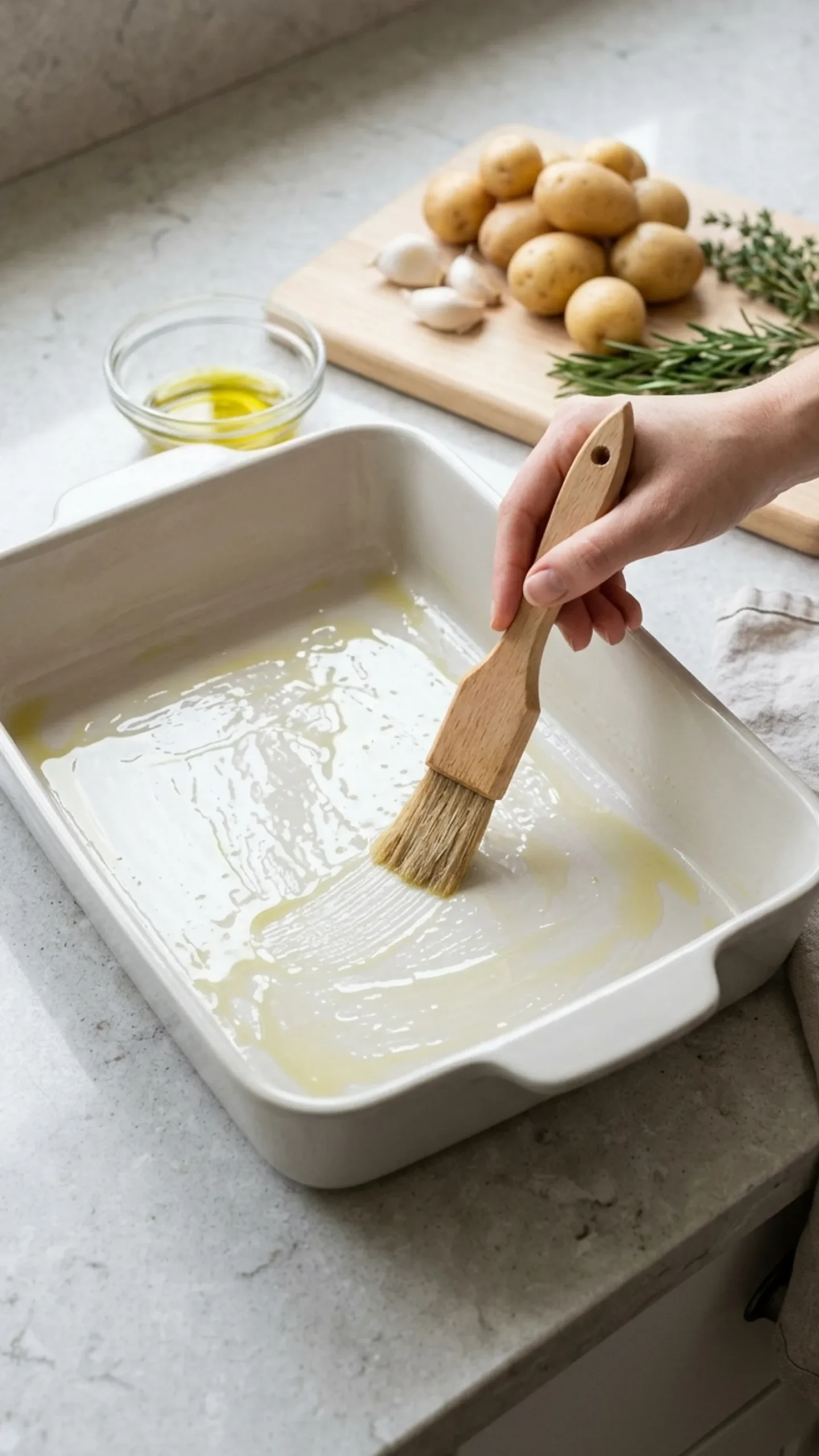
Prepare a large rimmed roasting pan or baking sheet, approximately 13 x 18 inches (33 x 46 cm). A lightly oiled metal pan works particularly well for developing browned potato edges.
Make sure the pan is large enough to hold the chicken and potatoes in a relatively even layer without excessive crowding.
Step 2: Prepare the Chicken
Remove 6 bone-in, skin-on chicken thighs (about 2 1/2 pounds / 1.13 kg total) from their packaging.
Pat the chicken thoroughly dry with paper towels, paying particular attention to the skin.
Dry skin is important because surface moisture must evaporate before browning can begin.
Trim away any large, loose pieces of excess fat, but leave the skin intact.
Set the chicken aside on a clean plate while preparing the remaining ingredients.
Step 3: Prepare the Baby Potatoes
Wash and thoroughly dry 1 1/2 pounds (680 g) baby potatoes.
Leave very small potatoes whole and halve larger potatoes so the pieces are relatively uniform.
Place the potatoes in a large mixing bowl.
Add 1 tablespoon (15 ml) of the olive oil, 1/2 teaspoon (3 g) of the fine sea salt, and 1/4 teaspoon (0.5 g) of the freshly ground black pepper.
Toss until the potatoes are evenly coated.
The surfaces should look lightly glossy rather than heavily coated in oil.
Step 4: Make the Garlic-Herb Mixture
In a small bowl, combine:
- The remaining 3 tablespoons (45 ml) extra-virgin olive oil
- 6 garlic cloves (about 18 g), finely minced
- 1 tablespoon (about 3 g) finely chopped fresh rosemary
- 1 tablespoon (about 3 g) finely chopped fresh thyme
- 1 teaspoon (2 g) paprika
- The remaining 1 teaspoon (6 g) fine sea salt
- The remaining 1/4 teaspoon (0.5 g) freshly ground black pepper
- 2 tablespoons (30 ml) freshly squeezed lemon juice
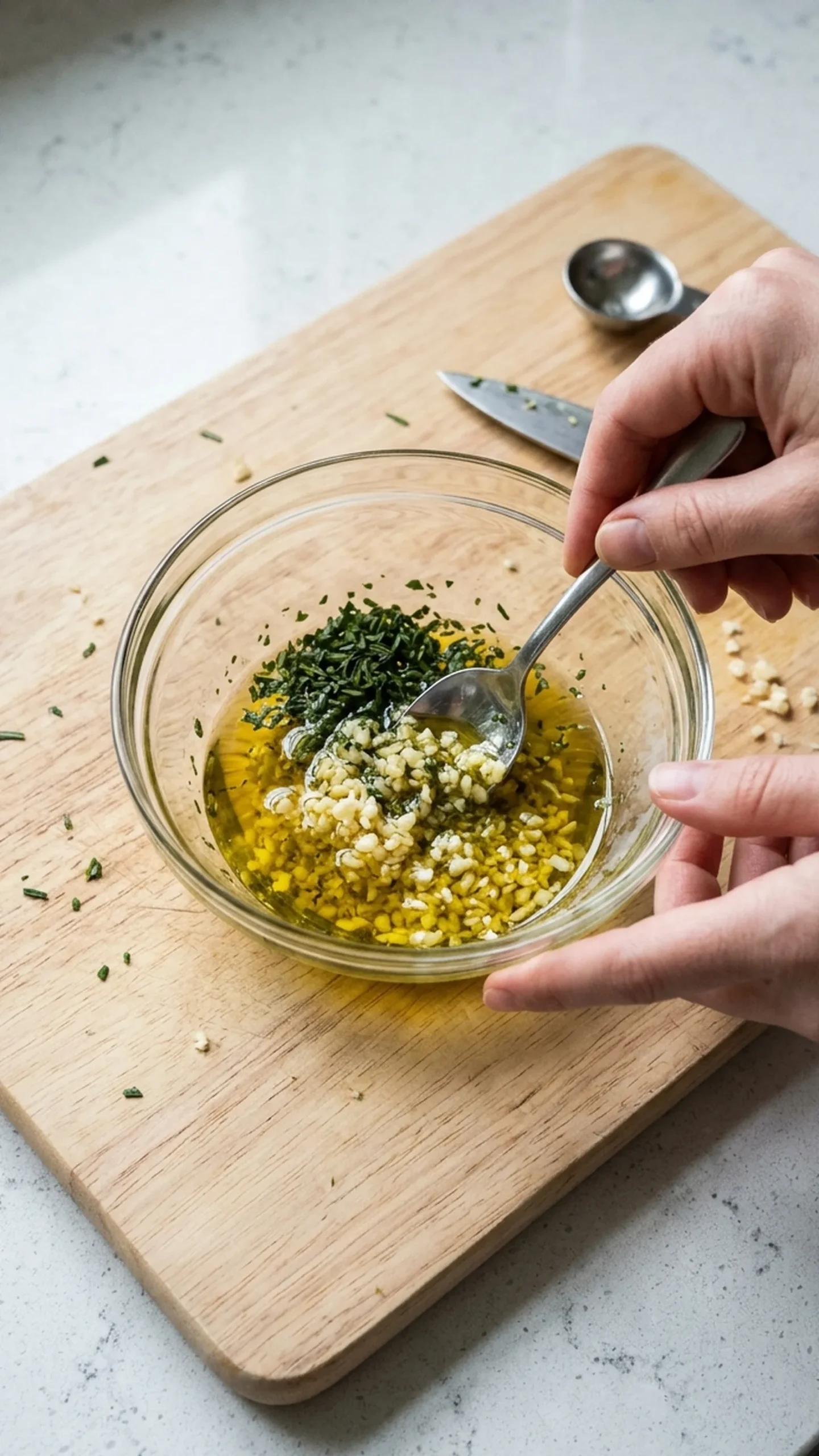
Stir until the herbs, garlic, and seasonings are evenly distributed.
The mixture should look like a loose, aromatic dressing with visible flecks of herbs and paprika. Stir again immediately before using because the lemon juice and oil may separate.
Step 5: Season the Chicken
Place the chicken thighs in a large bowl or on a clean work surface.
Spoon the garlic-herb mixture over the chicken, distributing it evenly among the pieces.
Rub the mixture over the tops and sides of the thighs. Gently work a little seasoning underneath the skin where possible without tearing it.
Keep the skin covering the meat so it can protect the chicken during roasting.
The chicken should be evenly coated, with visible herbs and a light sheen of oil.
Step 6: Arrange Everything in the Roasting Pan
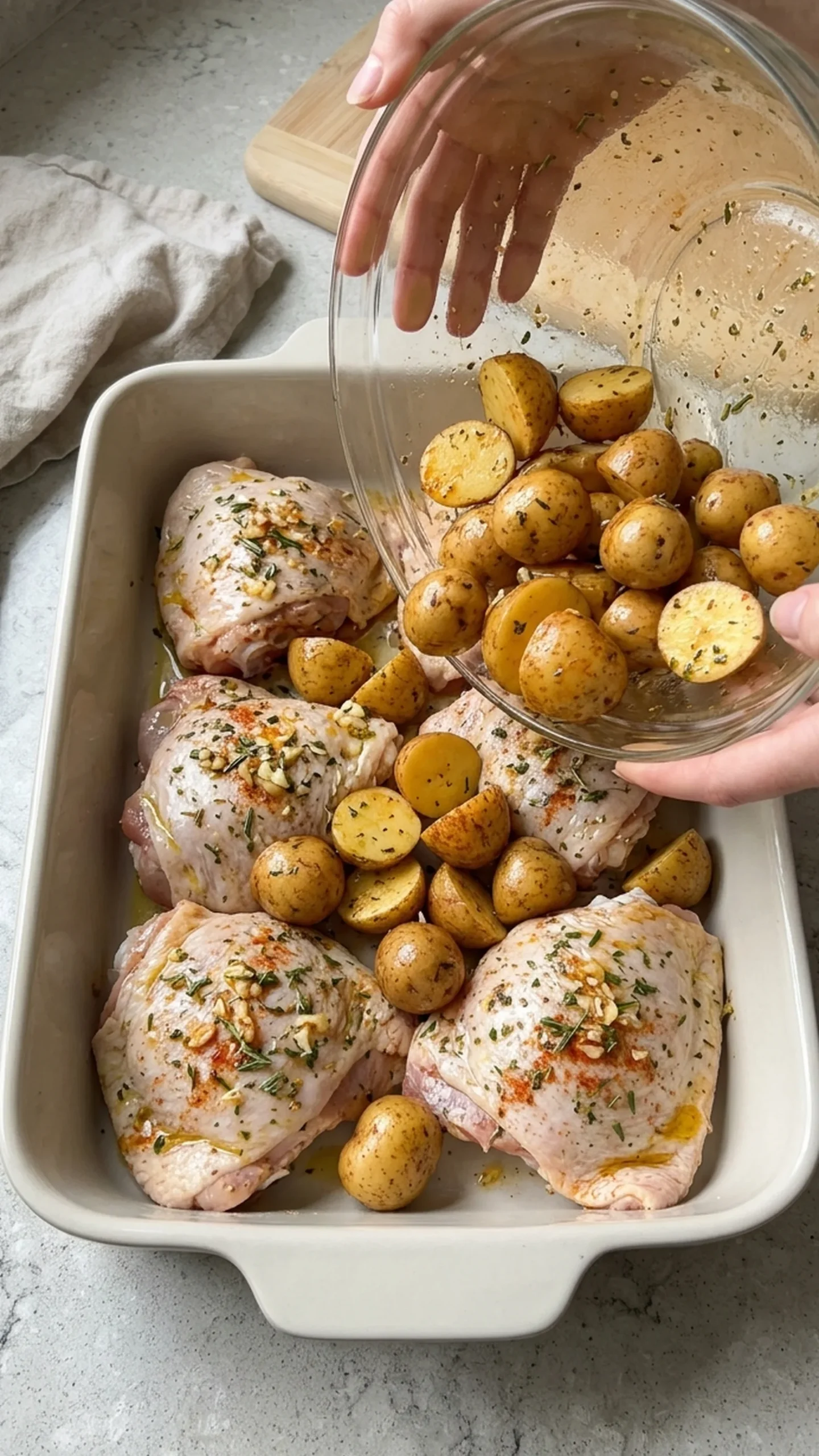
Transfer the seasoned potatoes to the prepared roasting pan.
Spread them into a single layer, placing the cut sides against the metal pan whenever possible.
Arrange the chicken thighs among the potatoes, skin-side up.
Leave some space between the chicken pieces so hot air can circulate.
Avoid stacking potatoes underneath the chicken, as this can cause them to steam rather than roast.
If the pan looks crowded, use an additional rimmed baking sheet rather than piling the ingredients together.
Step 7: Roast Until Golden and Tender
Place the roasting pan on the middle oven rack.
Roast at 425°F (220°C) for approximately 45–50 minutes.
About halfway through cooking, carefully turn the potatoes with a spatula, keeping the chicken skin facing upward.
As the chicken roasts, its skin should gradually become golden brown, while the potatoes develop browned edges and tender centers.
Check the chicken with an instant-read thermometer inserted into the thickest part of a thigh without touching the bone.
The chicken must reach a minimum internal temperature of 165°F (74°C). Dark meat may become more tender when cooked to approximately 175–185°F (79–85°C), provided it remains juicy.
If the chicken reaches its desired temperature before the potatoes are tender, transfer it to a clean plate and continue roasting the potatoes until a fork slides easily through their centers.
If the potatoes are browning too quickly, move them toward the center of the pan or loosely cover the most browned areas with foil.
Step 8: Check the Final Texture
Before removing the pan from the oven, check both components.
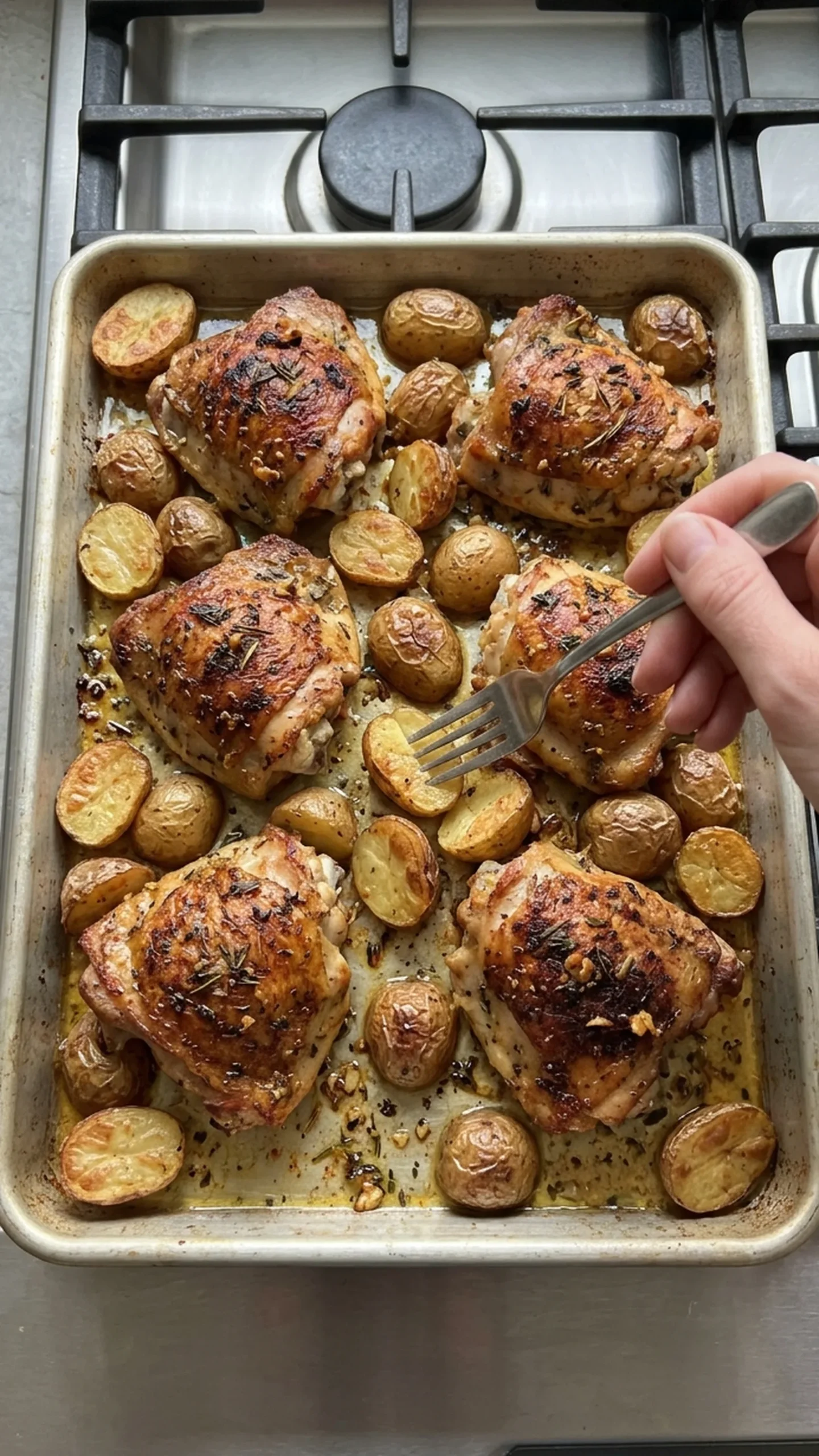
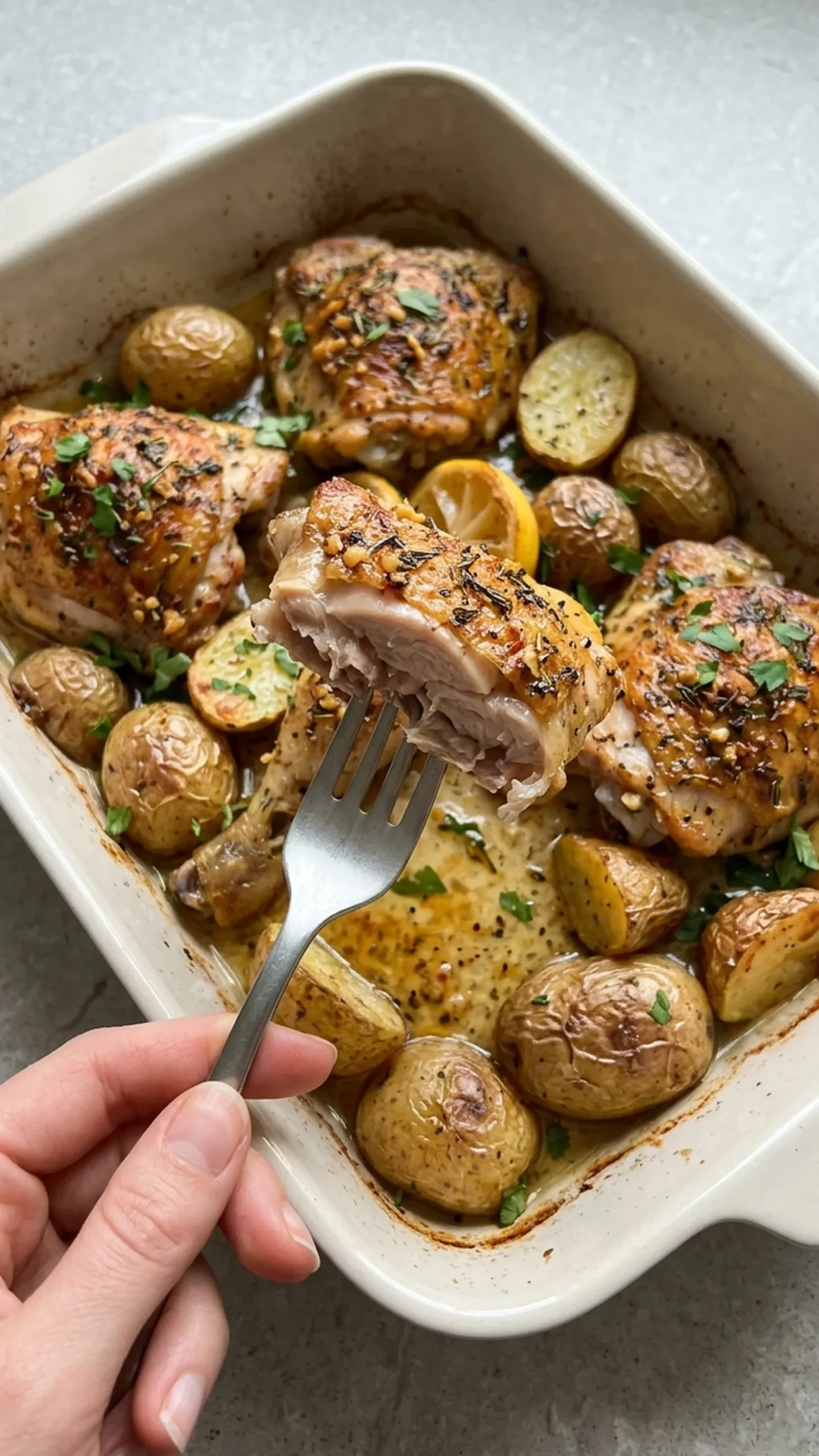
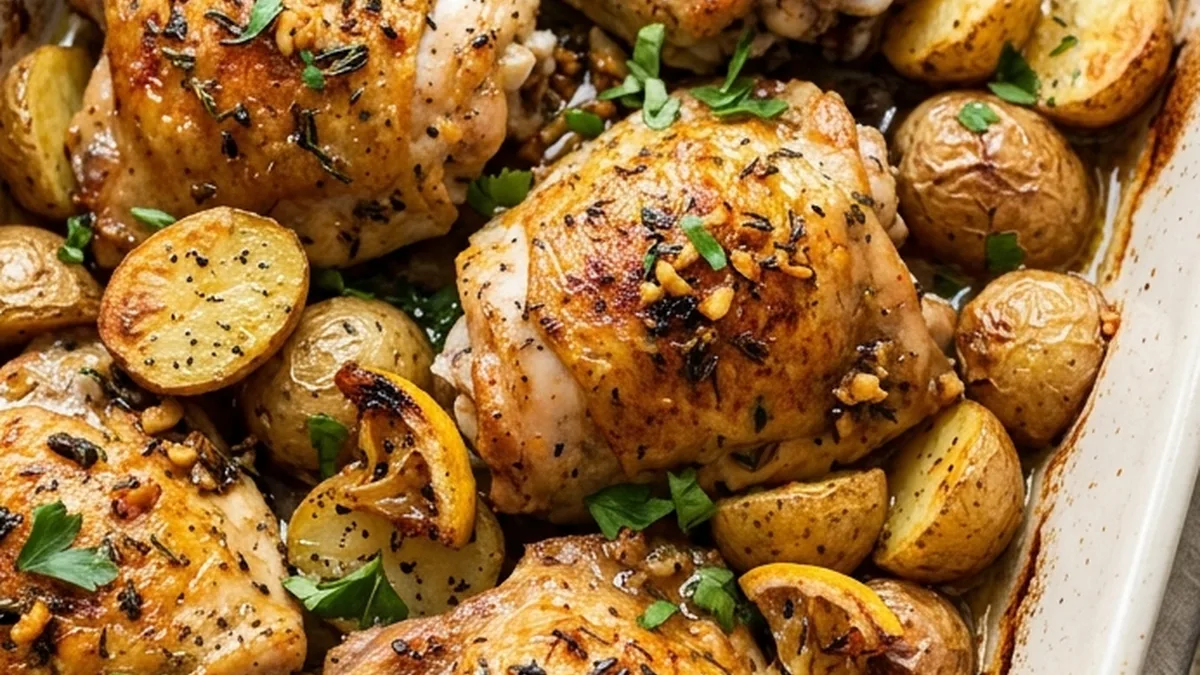
The chicken skin should be golden, with some darker roasted spots around the edges. The meat should be fully cooked according to the thermometer reading.
The potatoes should be tender throughout, with lightly crisp, golden-brown surfaces.
If the chicken is cooked but the skin needs additional color, briefly use the oven's broiler while watching closely. Garlic and herbs can burn quickly under direct heat.
Step 9: Rest the Chicken
Remove the roasting pan from the oven.
Allow the chicken to rest for 10 minutes before serving.
Resting gives the juices time to redistribute through the meat.
The potatoes can remain in the warm roasting pan during this period, where they will continue absorbing some of the savory pan juices.
Avoid tightly covering the chicken, which can trap steam and soften the skin.
Step 10: Garnish and Serve
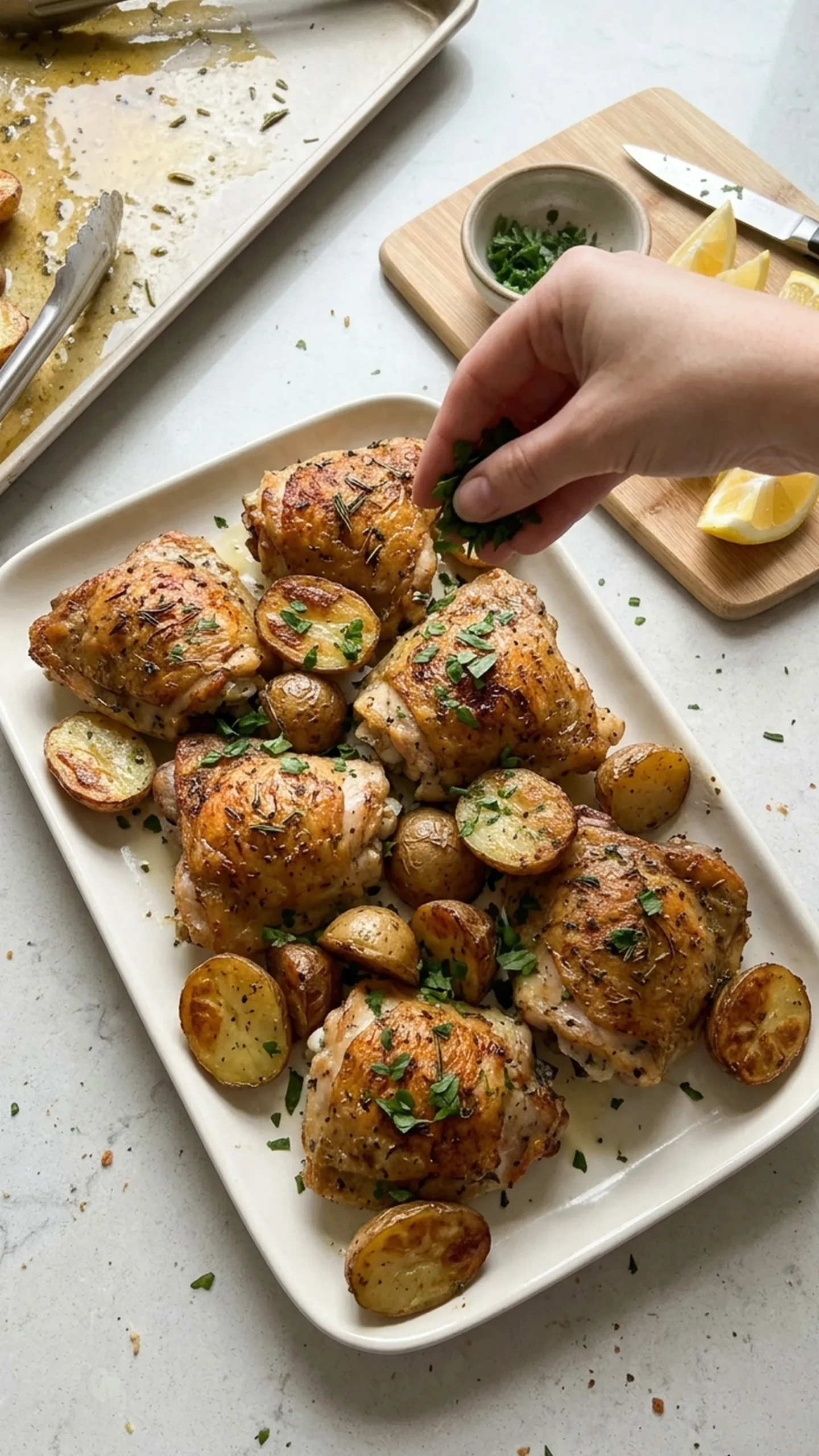
Arrange the roasted chicken thighs and baby potatoes on a serving platter or individual plates.
Spoon a little of the flavorful pan juices over the potatoes, leaving the chicken skin mostly uncovered to preserve its crispness.
If desired, sprinkle with 2 tablespoons (about 8 g) finely chopped fresh flat-leaf parsley.
Serve with wedges from 1 medium lemon (about 120 g), if using, for a fresh citrus finish.
Serve warm while the potatoes are tender and the chicken skin is still crisp.
Storage, Freezing, and Make-Ahead Instructions
- Refrigeration: Allow leftover chicken and potatoes to cool briefly, then transfer them to shallow, airtight containers. Refrigerate within 2 hours of cooking. Store in the refrigerator at 40°F (4°C) or below for up to 3–4 days. For the best texture, keep the chicken and potatoes in separate containers when practical. This prevents the potatoes from absorbing excessive moisture and becoming soggy.
- Freezing: Cooked chicken thighs can be frozen for up to 3 months for good quality. Allow the chicken to cool, then wrap individual portions securely and place them in freezer-safe containers or bags. The roasted potatoes can also be frozen, although their texture may become softer or slightly grainy after thawing. Freeze the potatoes separately from the chicken when possible. Label each container with the freezing date.
- Thawing: Thaw frozen chicken and potatoes overnight in the refrigerator. Avoid thawing cooked chicken at room temperature. For better texture, reheat thawed potatoes in the oven rather than the microwave.
- Reheating: Preheat the oven to 350°F (175°C). Place the chicken and potatoes in an oven-safe dish or on a rimmed baking sheet. Cover the chicken loosely with foil during the initial reheating period to help prevent moisture loss. Reheat until the chicken reaches an internal temperature of 165°F (74°C). Remove the foil near the end of reheating to help the skin regain some crispness. The potatoes can be spread out separately to encourage their edges to brown again.
- Make-Ahead Preparation: The garlic-herb mixture can be prepared up to 24 hours ahead and stored in an airtight container in the refrigerator. The baby potatoes can be washed ahead of time, but it is preferable to cut and season them shortly before roasting to prevent discoloration and excess moisture. The chicken can be coated with the garlic-herb mixture and refrigerated in a covered, food-safe container for up to 24 hours before cooking. Keep the chicken refrigerated until ready to roast, and discard any marinade that has contacted raw chicken unless it is thoroughly cooked. For the crispiest skin and best potato texture, roast the dish shortly before serving.
FAQ
Can I use boneless chicken thighs instead of bone-in thighs?
Yes, but boneless chicken thighs generally cook faster than bone-in pieces. Because the potatoes may require more roasting time, start roasting the potatoes first, then add the boneless chicken later. Always verify that the chicken reaches an internal temperature of 165°F (74°C).
How do I know when the chicken is fully cooked?
The most reliable method is to insert an instant-read thermometer into the thickest part of the chicken thigh without touching the bone. The internal temperature must reach at least 165°F (74°C). For especially tender dark meat, a somewhat higher finished temperature can be desirable. Skin color and clear juices alone are not reliable indicators of food safety.
Why are my roasted potatoes soft instead of crispy?
Soft potatoes are often caused by overcrowding, excess surface moisture, or insufficient contact with the hot pan. Dry the potatoes before seasoning, spread them in a single layer, and position their cut sides against the metal. A large rimmed baking sheet generally produces better browning than a small, deep baking dish.
Can I make Garlic Herb Roasted Chicken with Baby Potatoes ahead of time?
Yes. You can prepare the garlic-herb mixture and season the chicken up to 24 hours in advance, keeping everything refrigerated. For the best texture, prepare the potatoes and roast the dish shortly before serving. Fully cooked leftovers can also be refrigerated and reheated thoroughly.
Can I use a different roasting pan?
Yes, provided the pan is large enough to hold the chicken and potatoes without stacking them. A large metal roasting pan or rimmed baking sheet is preferable because it promotes evaporation and browning. A deep ceramic or glass baking dish may retain more moisture, resulting in softer potatoes and less crispy chicken skin. Use only cookware rated for the specified oven temperature.
Ingredients
Method
- Preheat your oven to 425°F (220°C). Position an oven rack in the middle of the oven to encourage even cooking. Prepare a large rimmed roasting pan or baking sheet, approximately 13 x 18 inches (33 x 46 cm). A lightly oiled metal pan works particularly well for developing browned potato edges. Make sure the pan is large enough to hold the chicken and potatoes in a relatively even layer without excessive crowding.
- Remove 6 bone-in, skin-on chicken thighs (about 2 1/2 pounds / 1.13 kg total) from their packaging. Pat the chicken thoroughly dry with paper towels, paying particular attention to the skin. Dry skin is important because surface moisture must evaporate before browning can begin. Trim away any large, loose pieces of excess fat, but leave the skin intact. Set the chicken aside on a clean plate while preparing the remaining ingredients.
- Wash and thoroughly dry 1 1/2 pounds (680 g) baby potatoes. Leave very small potatoes whole and halve larger potatoes so the pieces are relatively uniform. Place the potatoes in a large mixing bowl. Add 1 tablespoon (15 ml) of the olive oil, 1/2 teaspoon (3 g) of the fine sea salt, and 1/4 teaspoon (0.5 g) of the freshly ground black pepper. Toss until the potatoes are evenly coated. The surfaces should look lightly glossy rather than heavily coated in oil.
- In a small bowl, combine: The remaining 3 tablespoons (45 ml) extra-virgin olive oil 6 garlic cloves (about 18 g), finely minced 1 tablespoon (about 3 g) finely chopped fresh rosemary 1 tablespoon (about 3 g) finely chopped fresh thyme 1 teaspoon (2 g) paprika The remaining 1 teaspoon (6 g) fine sea salt The remaining 1/4 teaspoon (0.5 g) freshly ground black pepper 2 tablespoons (30 ml) freshly squeezed lemon juice Stir until the herbs, garlic, and seasonings are evenly distributed. The mixture should look like a loose, aromatic dressing with visible flecks of herbs and paprika. Stir again immediately before using because the lemon juice and oil may separate.
- Place the chicken thighs in a large bowl or on a clean work surface. Spoon the garlic-herb mixture over the chicken, distributing it evenly among the pieces. Rub the mixture over the tops and sides of the thighs. Gently work a little seasoning underneath the skin where possible without tearing it. Keep the skin covering the meat so it can protect the chicken during roasting. The chicken should be evenly coated, with visible herbs and a light sheen of oil.
- Transfer the seasoned potatoes to the prepared roasting pan. Spread them into a single layer, placing the cut sides against the metal pan whenever possible. Arrange the chicken thighs among the potatoes, skin-side up. Leave some space between the chicken pieces so hot air can circulate. Avoid stacking potatoes underneath the chicken, as this can cause them to steam rather than roast. If the pan looks crowded, use an additional rimmed baking sheet rather than piling the ingredients together.
- Place the roasting pan on the middle oven rack. Roast at 425°F (220°C) for approximately 45–50 minutes. About halfway through cooking, carefully turn the potatoes with a spatula, keeping the chicken skin facing upward. As the chicken roasts, its skin should gradually become golden brown, while the potatoes develop browned edges and tender centers. Check the chicken with an instant-read thermometer inserted into the thickest part of a thigh without touching the bone. The chicken must reach a minimum internal temperature of 165°F (74°C). Dark meat may become more tender when cooked to approximately 175–185°F (79–85°C), provided it remains juicy. If the chicken reaches its desired temperature before the potatoes are tender, transfer it to a clean plate and continue roasting the potatoes until a fork slides easily through their centers. If the potatoes are browning too quickly, move them toward the center of the pan or loosely cover the most browned areas with foil.
- Before removing the pan from the oven, check both components. The chicken skin should be golden, with some darker roasted spots around the edges. The meat should be fully cooked according to the thermometer reading. The potatoes should be tender throughout, with lightly crisp, golden-brown surfaces. If the chicken is cooked but the skin needs additional color, briefly use the oven's broiler while watching closely. Garlic and herbs can burn quickly under direct heat.
- Remove the roasting pan from the oven: Allow the chicken to rest for 10 minutes before serving. Resting gives the juices time to redistribute through the meat. The potatoes can remain in the warm roasting pan during this period, where they will continue absorbing some of the savory pan juices. Avoid tightly covering the chicken, which can trap steam and soften the skin.
- Arrange the roasted chicken thighs and baby potatoes on a serving platter or individual plates. Spoon a little of the flavorful pan juices over the potatoes, leaving the chicken skin mostly uncovered to preserve its crispness. If desired, sprinkle with 2 tablespoons (about 8 g) finely chopped fresh flat-leaf parsley. Serve with wedges from 1 medium lemon (about 120 g), if using, for a fresh citrus finish. Serve warm while the potatoes are tender and the chicken skin is still crisp.