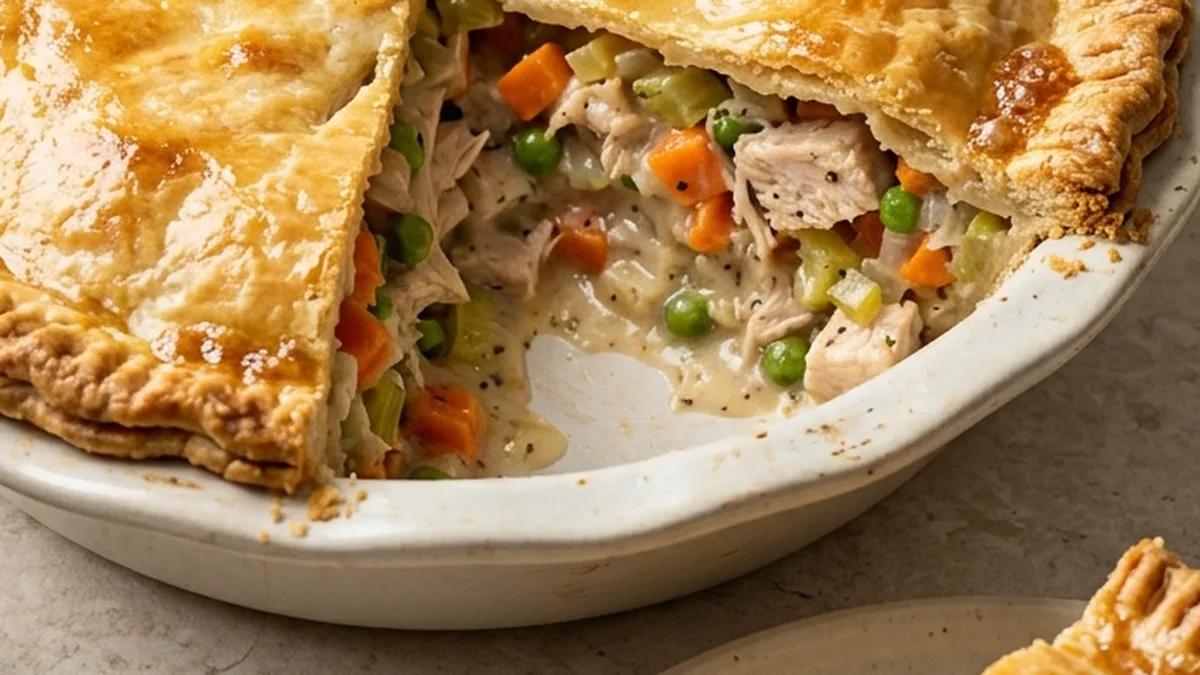
Turkey Pot Pie is a comforting American classic made with tender pieces of cooked turkey, colorful vegetables, and a rich, savory gravy tucked beneath a flaky, golden pastry crust. The creamy filling brings together carrots, peas, celery, and onion in a smooth, herb-seasoned sauce, while the buttery crust adds a crisp contrast to every spoonful.
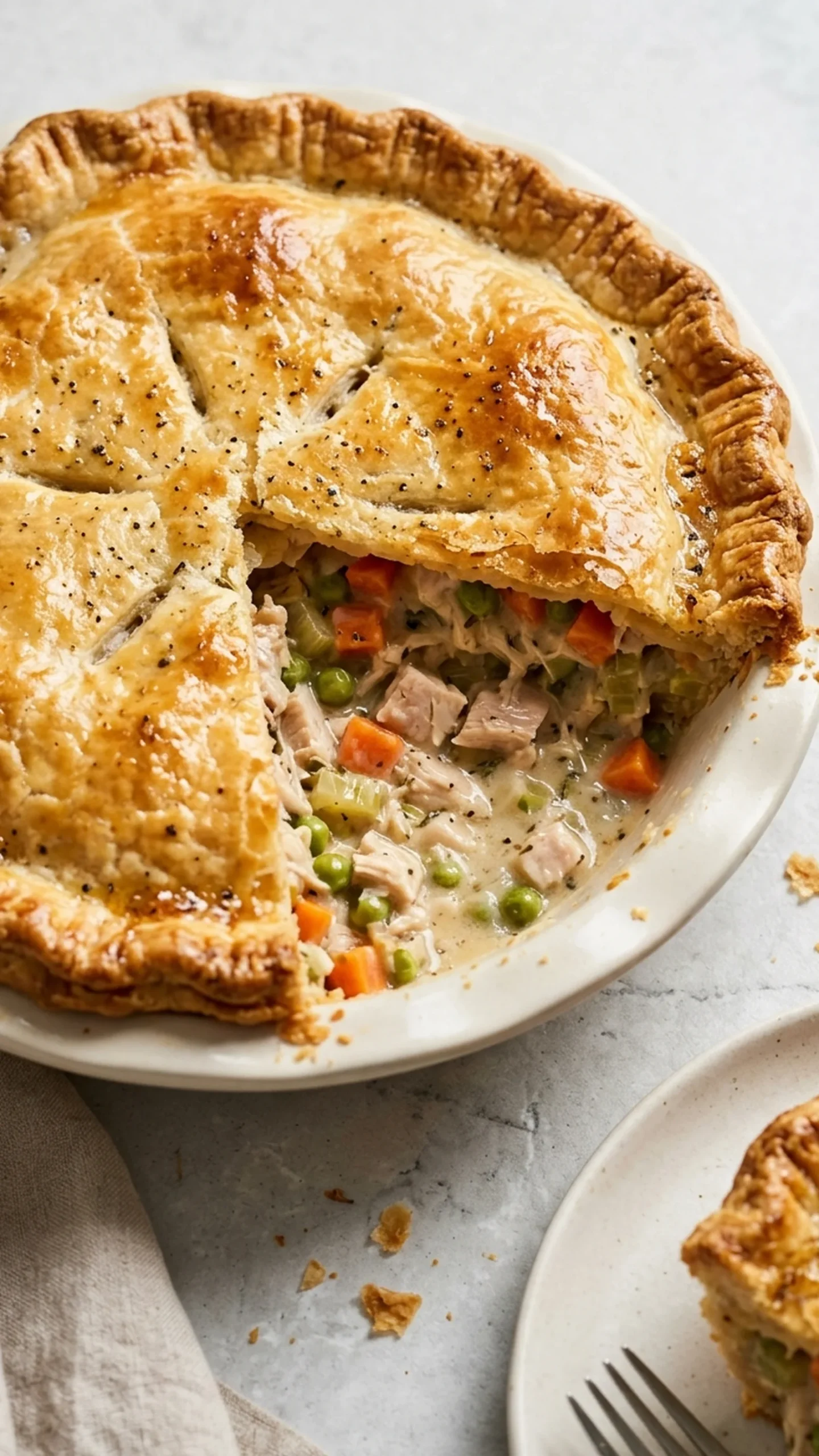
This homemade Turkey Pot Pie uses a single top crust rather than a double crust, keeping preparation straightforward and allowing the filling to stay creamy without a soggy bottom pastry. It's also a practical way to use leftover roasted turkey, especially after a holiday meal. With a store-bought pie crust and a filling prepared on the stovetop, most of the work is done before the pie goes into the oven.
Why This Recipe Works
A single top crust stays flaky: Leaving out the bottom crust eliminates the risk of pastry becoming soggy beneath the creamy filling.
A butter-and-flour roux thickens the gravy: Cooking flour in melted butter creates a smooth base that helps the filling hold together without becoming overly stiff.
Cooked turkey keeps preparation simple: Using already-cooked turkey reduces stovetop cooking time and prevents the meat from spending too long in the oven.
Chicken broth and milk create a balanced sauce. Broth contributes savory depth, while milk adds creaminess without making the filling excessively heavy.
A short resting period improves serving: Allowing the baked pie to stand before cutting gives the gravy time to thicken slightly, making portions easier to serve.
Equipment Needed
- 9-inch (23 cm) deep-dish pie plate, approximately 2 inches (5 cm) deep, with at least a 6-cup (1.4 L) capacity
- Large skillet or saucepan, preferably 12 inches (30 cm) wide
- Wooden spoon or silicone spatula
- Whisk for making a smooth gravy
- Rolling pin, if the refrigerated pie crust needs reshaping
- Pastry brush for applying the egg wash
- Sharp knife for cutting steam vents
- Rimmed baking sheet to catch any bubbling filling
- Instant-read food thermometer
Ingredients List
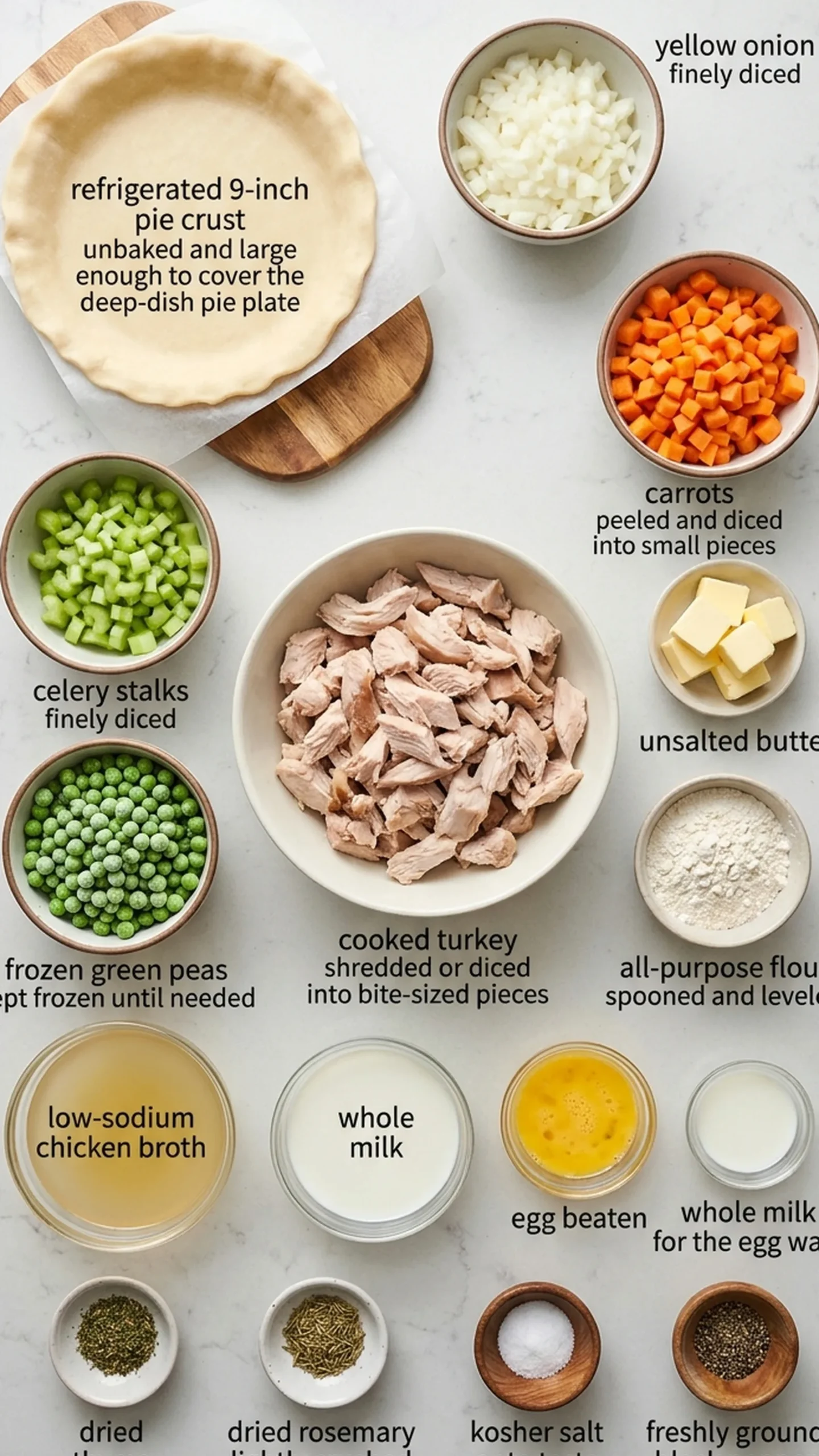
For the Turkey and Vegetable Filling
- 3 cups (about 420 g) cooked turkey, shredded or diced into bite-sized pieces
- 3 tablespoons (42 g) unsalted butter
- 1 medium yellow onion (about 150 g), finely diced
- 2 medium carrots (about 130 g), peeled and diced into small pieces
- 2 medium celery stalks (about 100 g), finely diced
- 1/3 cup (40 g) all-purpose flour, spooned and leveled
- 2 cups (480 ml) low-sodium chicken broth
- 3/4 cup (180 ml) whole milk
- 1 cup (140 g) frozen green peas, kept frozen until needed
- 1 teaspoon dried thyme
- 1/2 teaspoon dried rosemary, lightly crushed
- 1/2 teaspoon kosher salt, or to taste
- 1/4 teaspoon freshly ground black pepper
For the Golden Pastry Crust
- 1 refrigerated 9-inch (23 cm) pie crust (about 7 ounces/200 g), unbaked and large enough to cover the deep-dish pie plate
- 1 large egg (about 50 g without shell), beaten, for the egg wash
- 1 tablespoon (15 ml) whole milk, for the egg wash
Ingredient Notes and Substitutions
Cooked Turkey: Cooked turkey is the main protein in this Turkey Pot Pie. Leftover roasted turkey works particularly well because it already has a developed savory flavor. Both white and dark turkey meat can be used. Dark meat generally stays more moist during baking, while breast meat produces a leaner filling. Substitution: Cooked, shredded chicken can replace turkey in the same quantity. The texture will be similar, although the finished dish will have a slightly different flavor.
Refrigerated Pie Crust: A refrigerated pie crust creates a crisp, buttery topping without the additional work of making pastry from scratch. Choose a crust that can be rolled out and placed over the filling. It should be large enough to cover the pie plate with a little overhang. Substitution: Homemade pie dough can be used in the same weight. All-butter dough may have a richer flavor, but it can soften quickly if handled while warm. Puff pastry is another option, although its greater rise and layered structure may require adjustments to baking time.
Chicken Broth: Chicken broth forms the savory foundation of the gravy. A low-sodium variety makes it easier to control the final seasoning. Substitution: Turkey broth or turkey stock can replace chicken broth in the same quantity. Turkey stock may provide a deeper roasted flavor, particularly when made from a roasted turkey carcass.
Whole Milk: Whole milk adds creaminess while keeping the gravy lighter than a heavy-cream-based sauce. Substitution: Half-and-half can replace whole milk in the same quantity for a richer, slightly thicker filling. Unsweetened, unflavored oat milk may also work, although the gravy may taste slightly sweeter and have a different consistency.
All-Purpose Flour: All-purpose flour thickens the broth and milk into a gravy that coats the turkey and vegetables. The flour needs to cook briefly with the butter and vegetables before liquid is added. This reduces the raw flour taste and helps prevent lumps. Substitution: A gluten-free all-purpose flour blend formulated for thickening sauces may work, but the consistency can vary between brands. There is no universally reliable one-to-one substitute that guarantees exactly the same gravy texture.
Step-by-Step Instructions
1. Prepare the Oven and Baking Dish
Preheat the oven to 400°F (200°C).
Position an oven rack in the lower-middle section so the pastry can brown without sitting too close to the upper heating element.
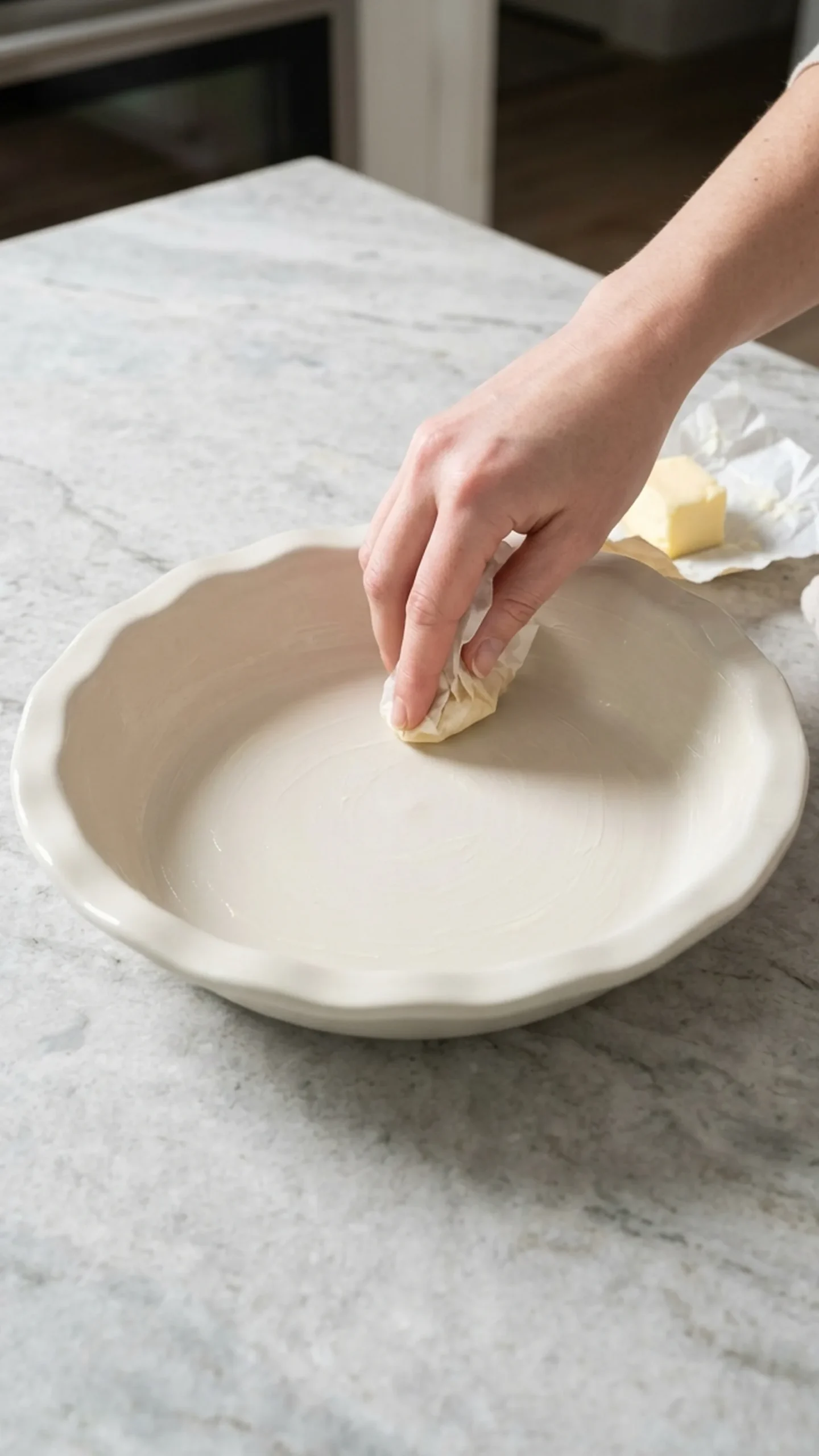
Set a 9-inch (23 cm) deep-dish pie plate on a rimmed baking sheet. The baking sheet will catch any filling that bubbles over during baking.
Keep the refrigerated pie crust chilled while preparing the filling.
2. Soften the Vegetables
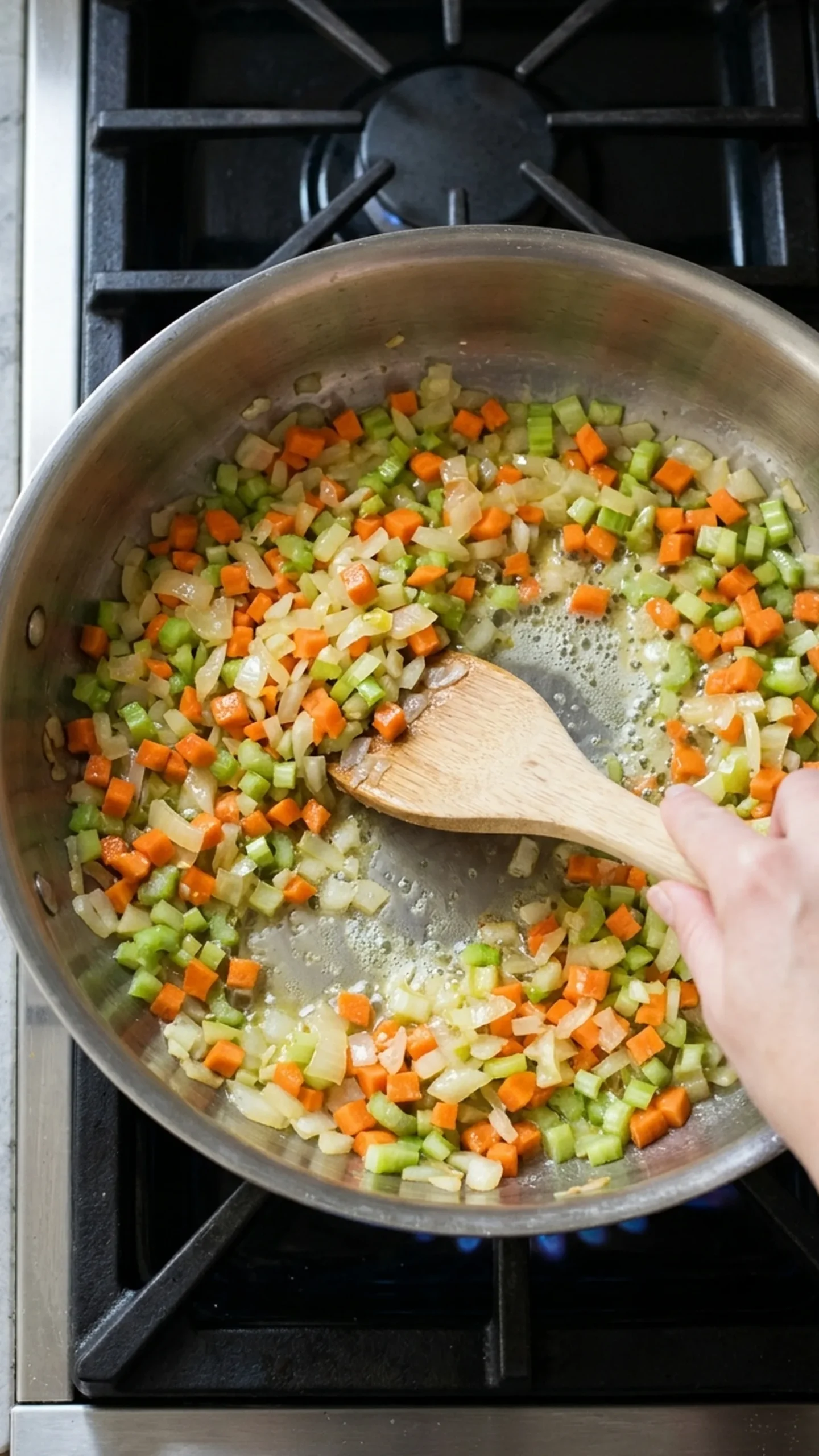
Place a large skillet or saucepan over medium heat.
Add the 3 tablespoons (42 g) unsalted butter and let it melt until gently foaming.
Add the diced yellow onion, carrots, and celery. Cook for approximately 6–8 minutes, stirring occasionally, until the onion becomes translucent and the carrots begin to soften.
The vegetables should look glossy and tender around the edges, but they do not need to be completely cooked at this stage.
Avoid browning the vegetables heavily, as the goal is a mild, savory base for the gravy.
3. Make the Roux
Sprinkle the 1/3 cup (40 g) all-purpose flour over the softened vegetables.
Stir continuously for approximately 1–2 minutes, making sure the flour coats the vegetables and absorbs the melted butter.
The mixture should look slightly thick and pasty, with no visible pockets of dry flour.
Keep the heat at medium or reduce it slightly if the flour begins to brown too quickly. A pale roux is preferable because it thickens the gravy without introducing a toasted flavor.
4. Build the Creamy Gravy
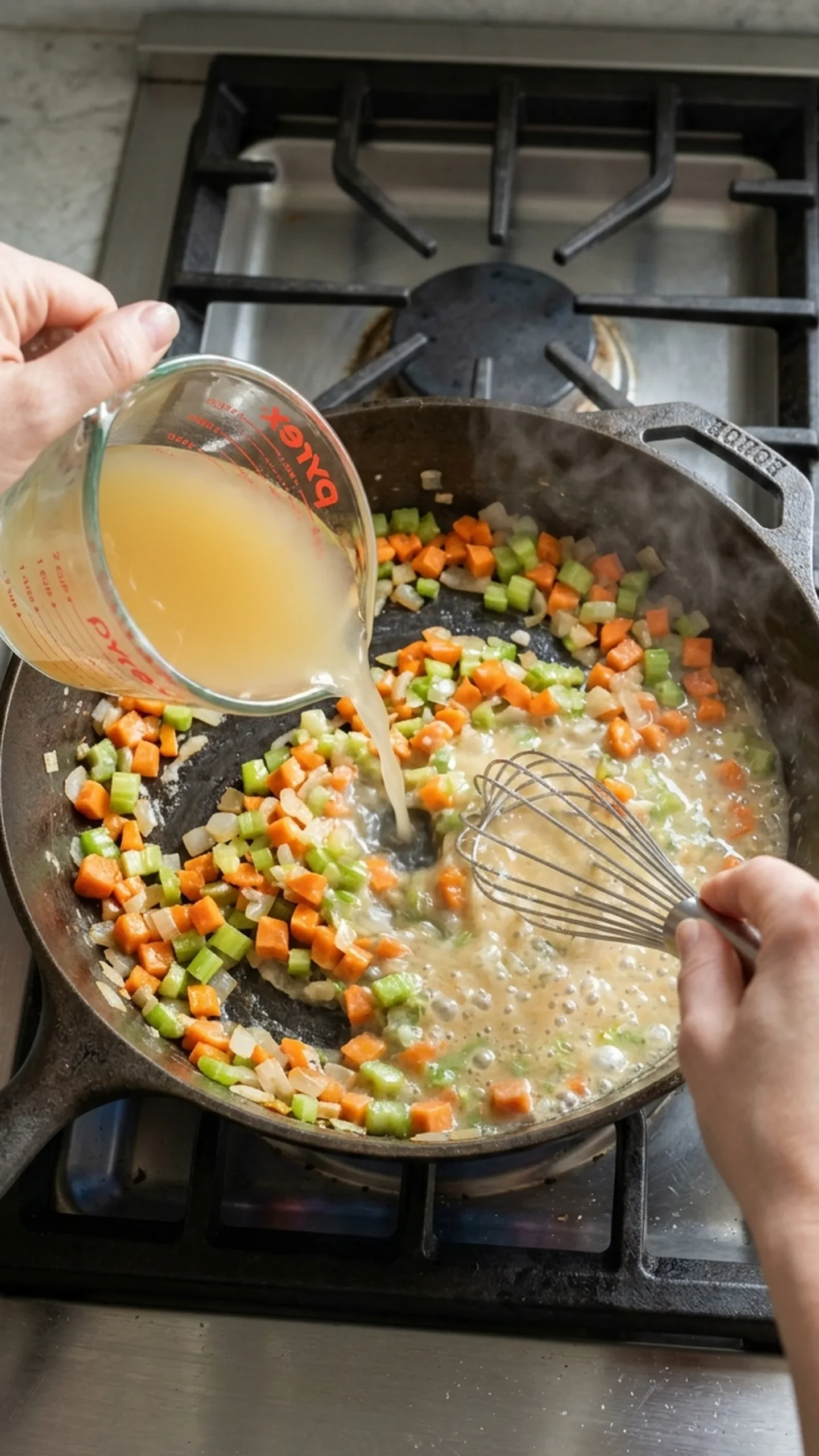
Slowly pour in the 2 cups (480 ml) low-sodium chicken broth while whisking or stirring continuously.
Begin with a small amount of broth to loosen the flour mixture, then gradually add the remaining broth.
Pour in the 3/4 cup (180 ml) whole milk and stir until the mixture is smooth.
Bring the sauce to a gentle simmer over medium heat. Cook for approximately 3–4 minutes, stirring frequently, until it thickens enough to coat the back of a spoon.
The gravy should be creamy and spoonable rather than stiff or watery.
If small lumps appear, whisk firmly while the sauce simmers. If the mixture seems thin, allow it to simmer gently until it thickens.
5. Season the Filling
Add the 1 teaspoon dried thyme, 1/2 teaspoon dried rosemary, 1/2 teaspoon kosher salt, and 1/4 teaspoon freshly ground black pepper.
Stir thoroughly to distribute the seasonings throughout the gravy.
Taste the sauce and adjust the salt if needed, keeping in mind that the turkey and broth may already contain seasoning.
The gravy should taste savory and gently herbal, without the rosemary overpowering the other ingredients.
6. Add the Turkey and Peas
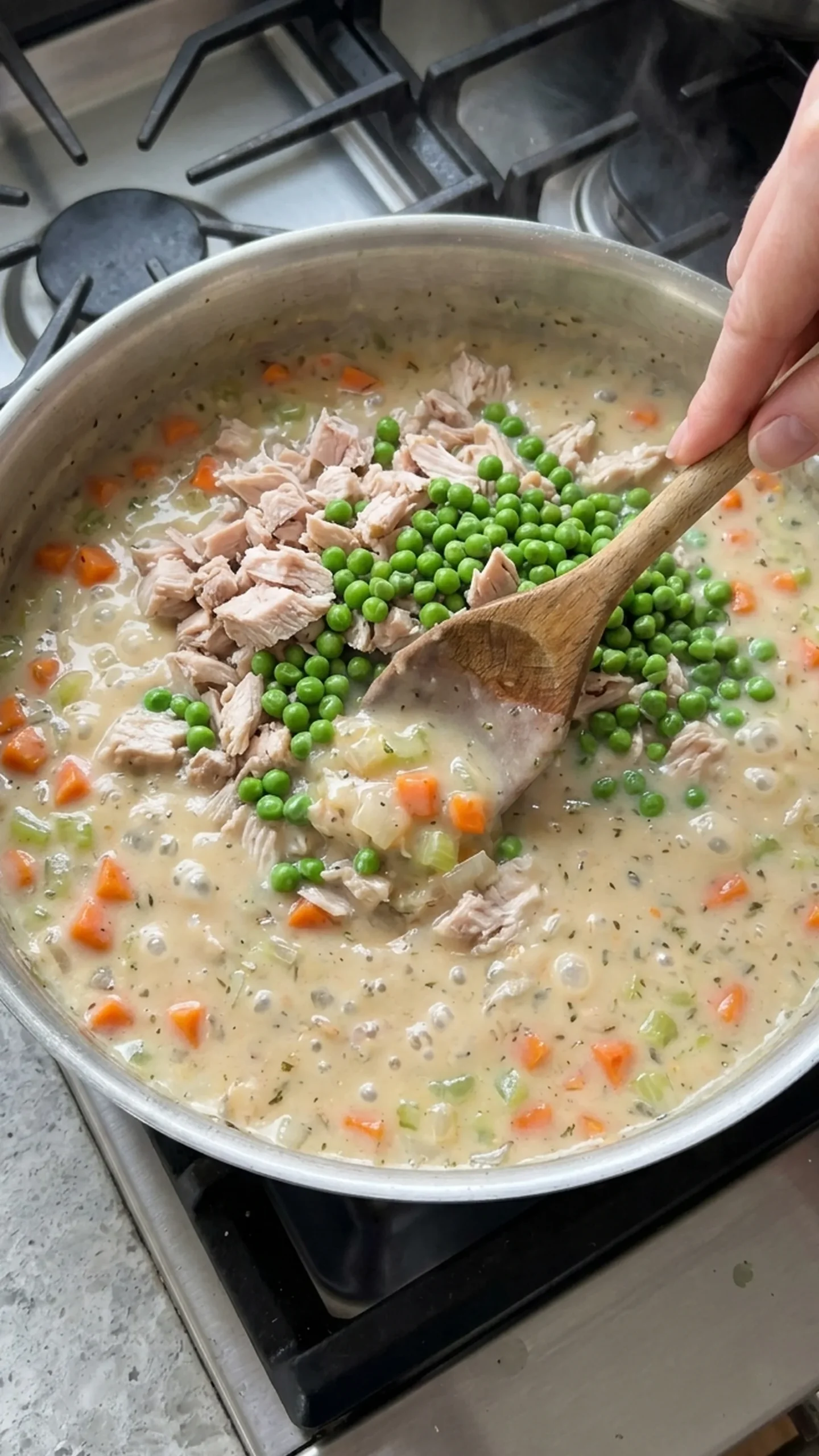
Fold the 3 cups (about 420 g) cooked turkey and 1 cup (140 g) frozen green peas into the gravy.
Stir gently until the turkey and peas are evenly coated.
Cook for approximately 2–3 minutes over medium-low heat, just until the turkey is warmed through and the peas are no longer icy.
The filling should look thick, creamy, and generously packed with vegetables and turkey.
Remove the skillet from the heat.
7. Transfer the Filling to the Pie Plate
Carefully spoon the warm turkey filling into the prepared 9-inch (23 cm) deep-dish pie plate.
Spread it evenly, making sure the turkey and vegetables are distributed throughout the dish.
Leave a little space beneath the rim so the filling has room to bubble during baking.
If the filling reaches the very top of the dish, avoid forcing it all beneath the crust. Overfilling can cause the gravy to spill over and interfere with the pastry seal.
8. Add the Pastry Crust
Unroll the refrigerated pie crust and gently position it over the filled pie plate.
Center the pastry so it covers the filling evenly.
Trim any excessive overhang, leaving enough dough to fold and press around the rim of the dish.
Crimp the edges with your fingers or press them gently with a fork.
Using a sharp knife, cut several small slits in the center of the pastry to allow steam to escape.
The pastry should sit loosely over the filling rather than being stretched tightly. Stretching can cause it to shrink or tear during baking.
9. Brush with Egg Wash
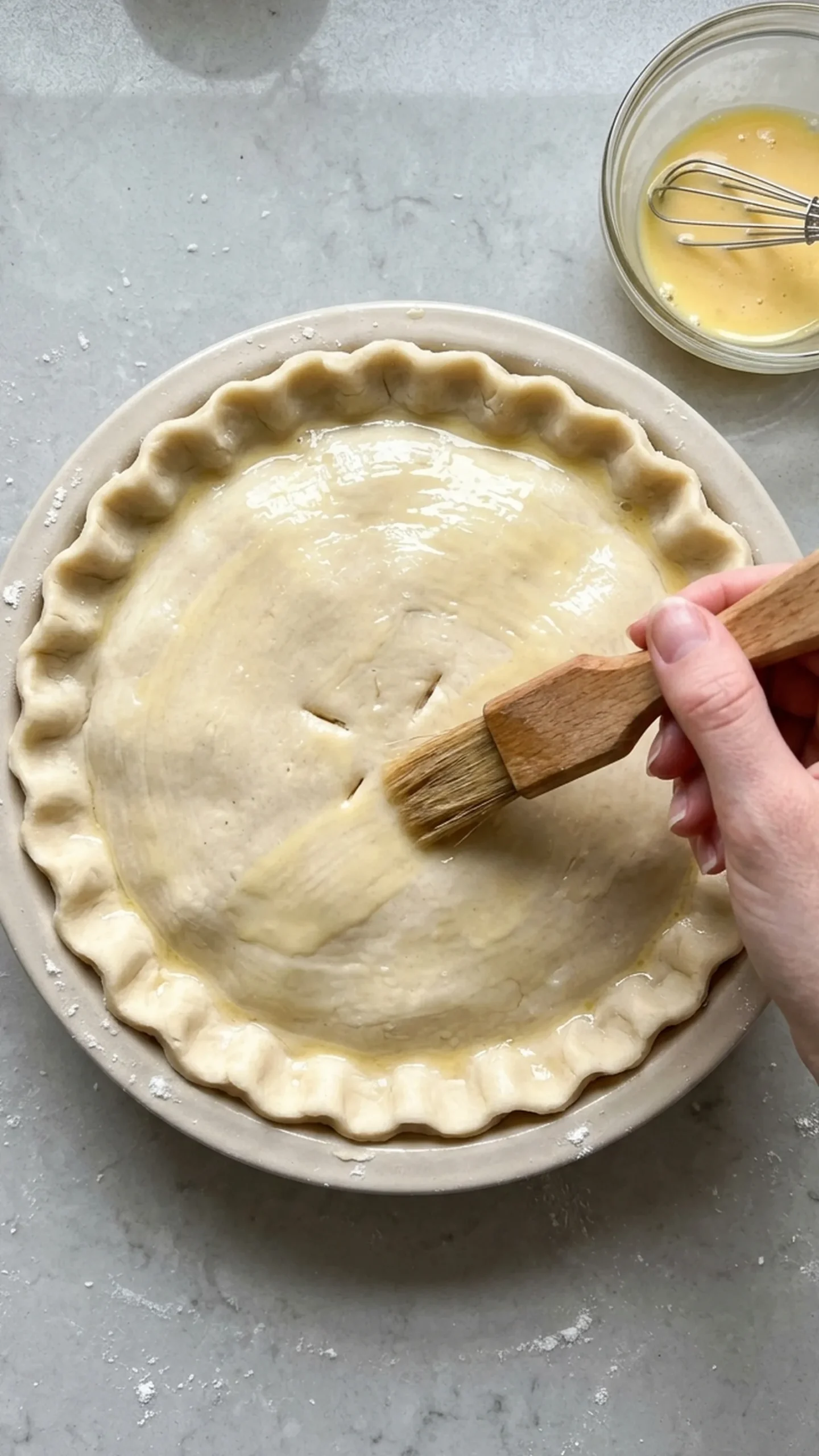
In a small bowl, whisk together the 1 large egg and 1 tablespoon (15 ml) whole milk until evenly combined.
Using a pastry brush, apply a thin, even layer of egg wash across the top crust.
Pay particular attention to the crimped edges, but avoid allowing large amounts of egg wash to collect around the rim.
The egg wash encourages an attractive golden-brown finish and gives the pastry a subtle sheen.
10. Bake Until Golden and Bubbling
Transfer the pie, still on its rimmed baking sheet, to the preheated oven.
Bake at 400°F (200°C) for approximately 30–35 minutes, or until the pastry is deeply golden and the filling bubbles visibly through the steam vents.
The crust should look crisp and evenly browned rather than pale or doughy.
Check the pie toward the end of baking. If the edges become too dark before the center is fully browned, protect them loosely with a pie shield or a strip of aluminum foil.
The filling should reach 165°F (74°C) in the center before serving.
11. Rest Before Serving
Remove the Turkey Pot Pie from the oven and place it on a heatproof surface.
Allow it to rest for 15 minutes before cutting or spooning into portions.
During this time, the bubbling gravy will settle and thicken slightly, helping the filling stay creamy rather than running immediately across the plate.
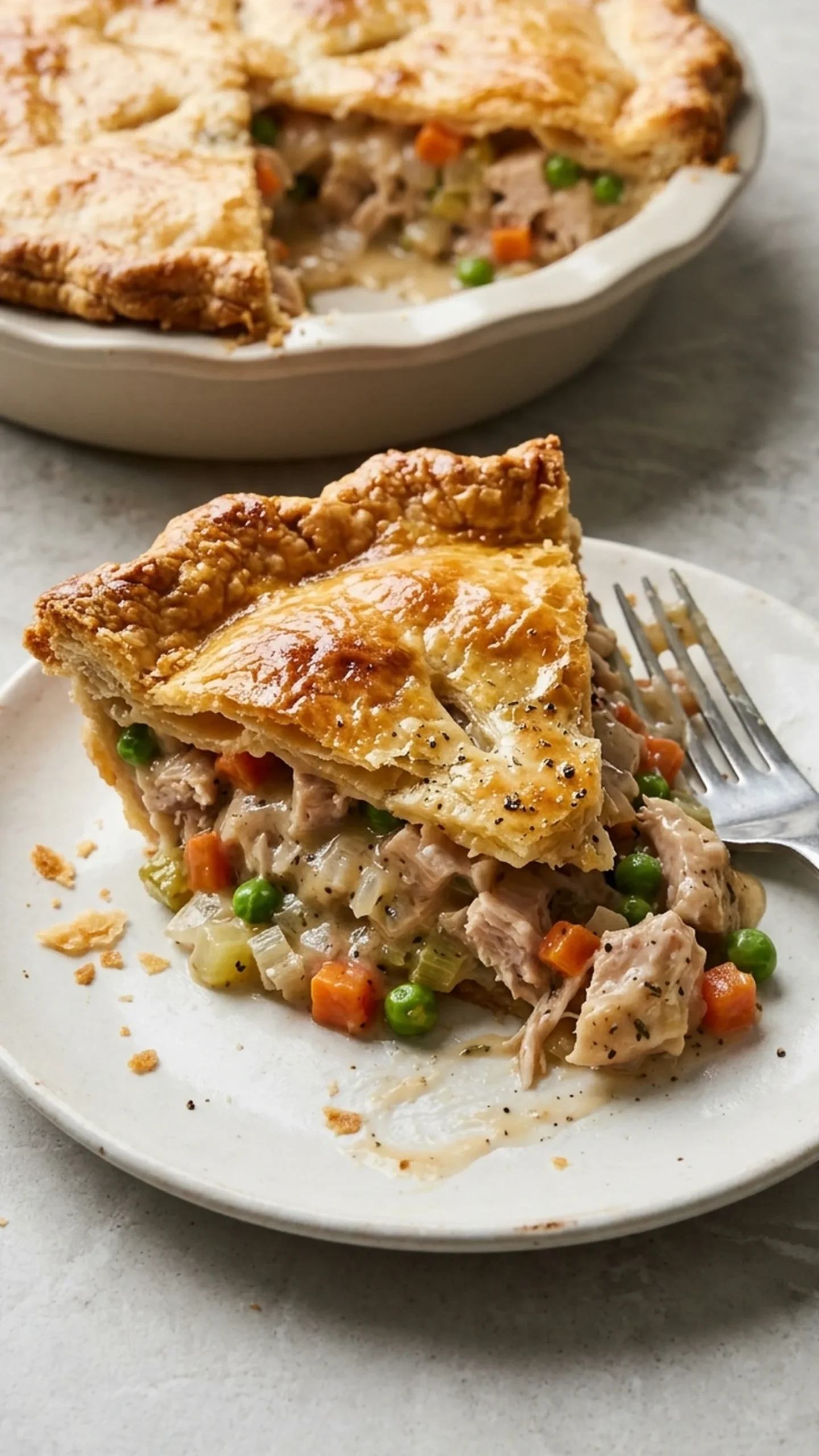
Serve warm, making sure each portion includes flaky crust, tender turkey, vegetables, and plenty of gravy.
Storage, Freezing, and Make-Ahead Instructions
Refrigerator Storage: Allow leftover Turkey Pot Pie to cool slightly, then refrigerate it promptly. Do not leave it at room temperature for longer than 2 hours. Transfer leftovers to airtight containers or cover the pie plate tightly. Store in the refrigerator at 40°F (4°C) or below for up to 3–4 days, provided the cooked turkey was freshly prepared when the pie was assembled. If using turkey that has already been refrigerated for several days, count its previous storage time toward the total safe storage period. The pastry will gradually soften as it absorbs moisture from the filling, but the flavor and creamy texture should remain pleasant.
Freezing Instructions: Turkey Pot Pie can be frozen after baking, although the crust may lose some of its crispness when thawed. For convenient portions, divide the cooled pie into individual servings. Wrap each portion tightly in freezer-safe packaging and place it inside an airtight freezer container. Freeze for up to 2–3 months for the best quality. Label the container with the freezing date. For thawing, transfer the frozen portions to the refrigerator and allow them to thaw completely before reheating. The gravy may separate slightly after freezing because it contains milk and flour. Gentle reheating helps restore a smoother consistency.
Reheating Instructions: For the crispest crust, reheat refrigerated Turkey Pot Pie in an oven preheated to 350°F (175°C). Place the pie or individual portions in an oven-safe dish and cover loosely with foil if the pastry is already deeply browned. Heat until the filling reaches 165°F (74°C) in the center. Remove the foil near the end of reheating if the crust needs to crisp up. Microwave reheating is also possible, but the pastry will become softer. Use a microwave-safe dish and heat until the filling is steaming hot and reaches 165°F (74°C).
Make-Ahead Instructions: The filling can be prepared ahead of time and refrigerated in an airtight container for up to 24 hours before assembling the pie. Allow the filling to cool promptly before refrigerating. When ready to bake, gently reheat the filling on the stovetop until hot, transfer it to the pie plate, and add the chilled pastry crust. Brush with egg wash just before baking. This approach keeps the pastry from sitting directly on the moist filling for an extended period, helping preserve a flakier finished crust.
FAQ
Can I make Turkey Pot Pie ahead of time?
Yes. Prepare the filling up to 24 hours ahead and refrigerate it in an airtight container. When ready to bake, reheat the filling, transfer it to the pie plate, and cover it with the chilled pastry. Assemble the pie shortly before baking for the best crust texture.
Can I use leftover Thanksgiving turkey?
Absolutely. Leftover roasted turkey is an excellent choice for this recipe. Both white and dark meat work well, and a combination provides a balance of texture and flavor. Use turkey that has been refrigerated promptly and is still within its safe storage period.
Why is my Turkey Pot Pie filling runny?
A runny filling usually means the flour-based gravy did not thicken sufficiently before the pie went into the oven. The sauce should coat the back of a spoon and cling to the vegetables. Also, avoid cutting the pie immediately after baking because the filling needs its resting period to settle.
Can I use puff pastry instead of regular pie crust?
Yes, puff pastry can be used as a topping, but it will produce a taller, lighter, more layered crust. Keep it cold, cut steam vents, and follow the pastry manufacturer's baking guidance. The filling must still reach 165°F (74°C), and the pastry should be fully cooked and golden before serving.
How do I keep the bottom of Turkey Pot Pie from getting soggy?
This recipe uses only a top crust, so there is no bottom pastry to become soggy. For the best texture, make sure the gravy is properly thickened before assembling the pie and avoid placing the pastry over the filling too far in advance. Baking until the crust is fully golden also helps maintain a crisp surface.
Readers who cook this dish also love making Slow Cooker Chicken Pot Pie Soup, No Bake Christmas Peppermint Pie, Turkey Cranberry Meatballs, and Cranberry Turkey Ramen.

Turkey Pot Pie
Ingredients
Method
- Preheat the oven to 400°F (200°C). Position an oven rack in the lower-middle section so the pastry can brown without sitting too close to the upper heating element. Set a 9-inch (23 cm) deep-dish pie plate on a rimmed baking sheet. The baking sheet will catch any filling that bubbles over during baking. Keep the refrigerated pie crust chilled while preparing the filling.
- Place a large skillet or saucepan over medium heat. Add the 3 tablespoons (42 g) unsalted butter and let it melt until gently foaming. Add the diced yellow onion, carrots, and celery. Cook for approximately 6–8 minutes, stirring occasionally, until the onion becomes translucent and the carrots begin to soften. The vegetables should look glossy and tender around the edges, but they do not need to be completely cooked at this stage. Avoid browning the vegetables heavily, as the goal is a mild, savory base for the gravy.
- Sprinkle the 1/3 cup (40 g) all-purpose flour over the softened vegetables. Stir continuously for approximately 1–2 minutes, making sure the flour coats the vegetables and absorbs the melted butter. The mixture should look slightly thick and pasty, with no visible pockets of dry flour. Keep the heat at medium or reduce it slightly if the flour begins to brown too quickly. A pale roux is preferable because it thickens the gravy without introducing a toasted flavor.
- Slowly pour in the 2 cups (480 ml) low-sodium chicken broth while whisking or stirring continuously. Begin with a small amount of broth to loosen the flour mixture, then gradually add the remaining broth. Pour in the 3/4 cup (180 ml) whole milk and stir until the mixture is smooth. Bring the sauce to a gentle simmer over medium heat. Cook for approximately 3–4 minutes, stirring frequently, until it thickens enough to coat the back of a spoon. The gravy should be creamy and spoonable rather than stiff or watery. If small lumps appear, whisk firmly while the sauce simmers. If the mixture seems thin, allow it to simmer gently until it thickens.
- Add the 1 teaspoon dried thyme, 1/2 teaspoon dried rosemary, 1/2 teaspoon kosher salt, and 1/4 teaspoon freshly ground black pepper. Stir thoroughly to distribute the seasonings throughout the gravy. Taste the sauce and adjust the salt if needed, keeping in mind that the turkey and broth may already contain seasoning. The gravy should taste savory and gently herbal, without the rosemary overpowering the other ingredients.
- Fold the 3 cups (about 420 g) cooked turkey and 1 cup (140 g) frozen green peas into the gravy. Stir gently until the turkey and peas are evenly coated. Cook for approximately 2–3 minutes over medium-low heat, just until the turkey is warmed through and the peas are no longer icy. The filling should look thick, creamy, and generously packed with vegetables and turkey. Remove the skillet from the heat.
- Carefully spoon the warm turkey filling into the prepared 9-inch (23 cm) deep-dish pie plate. Spread it evenly, making sure the turkey and vegetables are distributed throughout the dish. Leave a little space beneath the rim so the filling has room to bubble during baking. If the filling reaches the very top of the dish, avoid forcing it all beneath the crust. Overfilling can cause the gravy to spill over and interfere with the pastry seal.
- Unroll the refrigerated pie crust and gently position it over the filled pie plate. Center the pastry so it covers the filling evenly. Trim any excessive overhang, leaving enough dough to fold and press around the rim of the dish. Crimp the edges with your fingers or press them gently with a fork. Using a sharp knife, cut several small slits in the center of the pastry to allow steam to escape. The pastry should sit loosely over the filling rather than being stretched tightly. Stretching can cause it to shrink or tear during baking.
- In a small bowl, whisk together the 1 large egg and 1 tablespoon (15 ml) whole milk until evenly combined. Using a pastry brush, apply a thin, even layer of egg wash across the top crust. Pay particular attention to the crimped edges, but avoid allowing large amounts of egg wash to collect around the rim. The egg wash encourages an attractive golden-brown finish and gives the pastry a subtle sheen.
- Transfer the pie, still on its rimmed baking sheet, to the preheated oven. Bake at 400°F (200°C) for approximately 30–35 minutes, or until the pastry is deeply golden and the filling bubbles visibly through the steam vents. The crust should look crisp and evenly browned rather than pale or doughy. Check the pie toward the end of baking. If the edges become too dark before the center is fully browned, protect them loosely with a pie shield or a strip of aluminum foil. The filling should reach 165°F (74°C) in the center before serving.
- Remove the Turkey Pot Pie from the oven and place it on a heatproof surface. Allow it to rest for 15 minutes before cutting or spooning into portions. During this time, the bubbling gravy will settle and thicken slightly, helping the filling stay creamy rather than running immediately across the plate. Serve warm, making sure each portion includes flaky crust, tender turkey, vegetables, and plenty of gravy.