This Garlic-Parmesan Smashed Potato Tower transforms tender baby potatoes into golden, crispy-edged stacks layered with garlic butter and freshly grated Parmesan cheese. Each tower combines the fluffy interior of a smashed potato with the savory crunch of roasted edges and a lightly browned cheese topping. The result is a flavorful, visually appealing side dish that pairs well with roasted meats, grilled chicken, or a simple green salad.
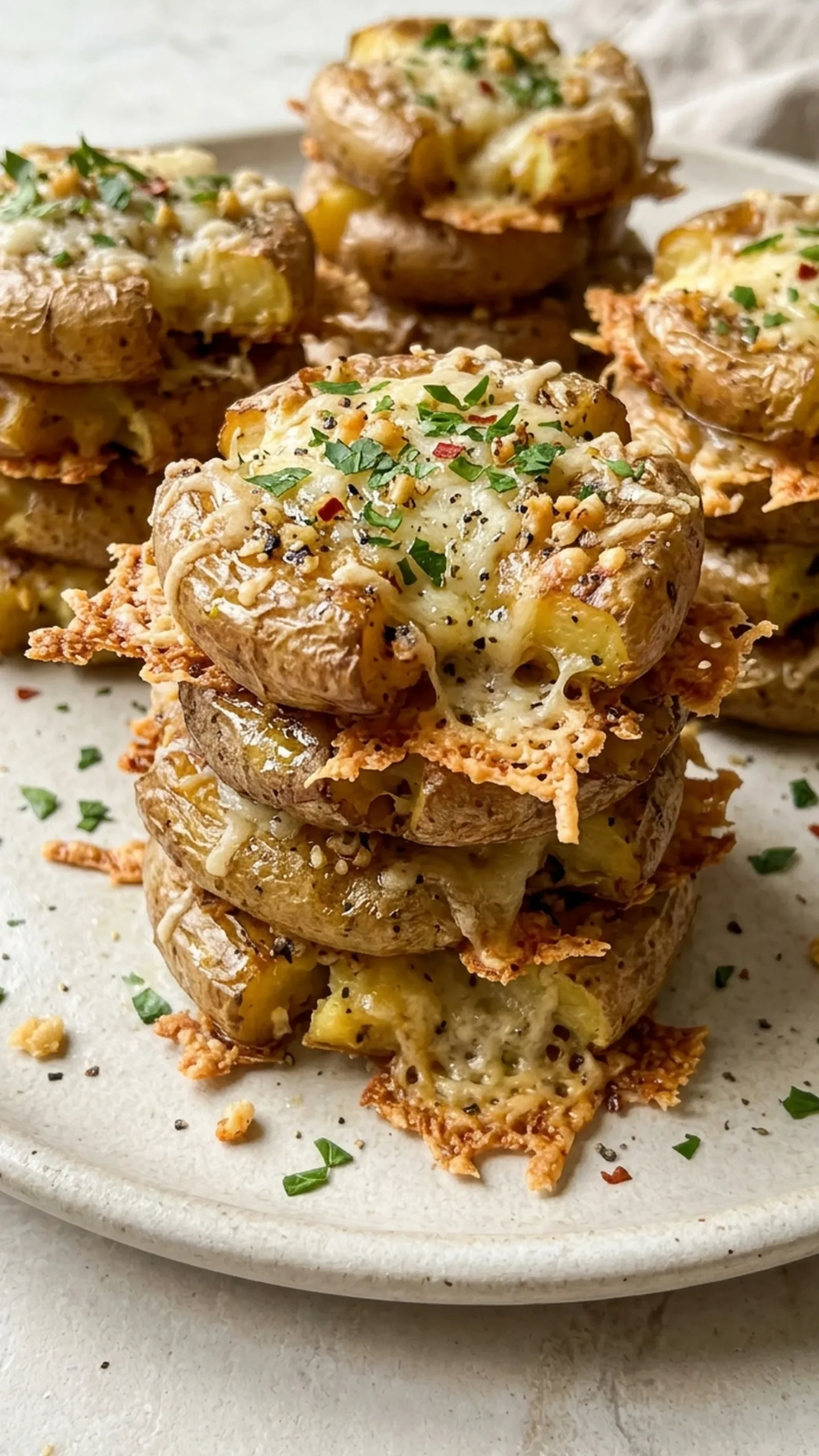
Unlike traditional smashed potatoes spread across a baking sheet, this version stacks flattened potatoes into individual towers. Boiling the potatoes first ensures tender centers, while roasting them separately develops crisp surfaces before stacking. A final trip to the oven melts the Parmesan and helps the layers hold together. The recipe uses everyday ingredients and requires no special molds.
Why This Recipe Works
- Boiling before roasting creates contrasting textures. The potatoes become tender enough to flatten without crumbling, while their exposed surfaces develop a crisp, golden crust in the oven.
- Small, similarly sized potatoes cook evenly. Using baby Yukon Gold potatoes helps maintain consistent tenderness and makes the flattened rounds easier to stack.
- Garlic-infused butter distributes flavor. Combining butter with olive oil and minced garlic coats the potatoes evenly and helps prevent isolated pieces of garlic from scorching.
- Parmesan adds structure and savory depth. Finely grated cheese melts between the layers and develops lightly crisp edges during the final bake.
- Roasting before stacking improves crispness. Giving each flattened potato direct contact with the hot baking sheet reduces the chance of soft, steamed layers inside the finished towers.
Equipment Needed
- Large pot, at least 5-quart (4.7-liter) capacity
- Colander for draining potatoes
- Large rimmed baking sheet, approximately 18 × 13 inches (46 × 33 cm)
- Parchment paper
- Sturdy flat-bottomed glass or measuring cup for smashing
- Small microwave-safe bowl or saucepan for melting butter
- Pastry brush
- Thin metal spatula for transferring and stacking potatoes
- Sharp knife and cutting board
Ingredients List
For the Smashed Potatoes
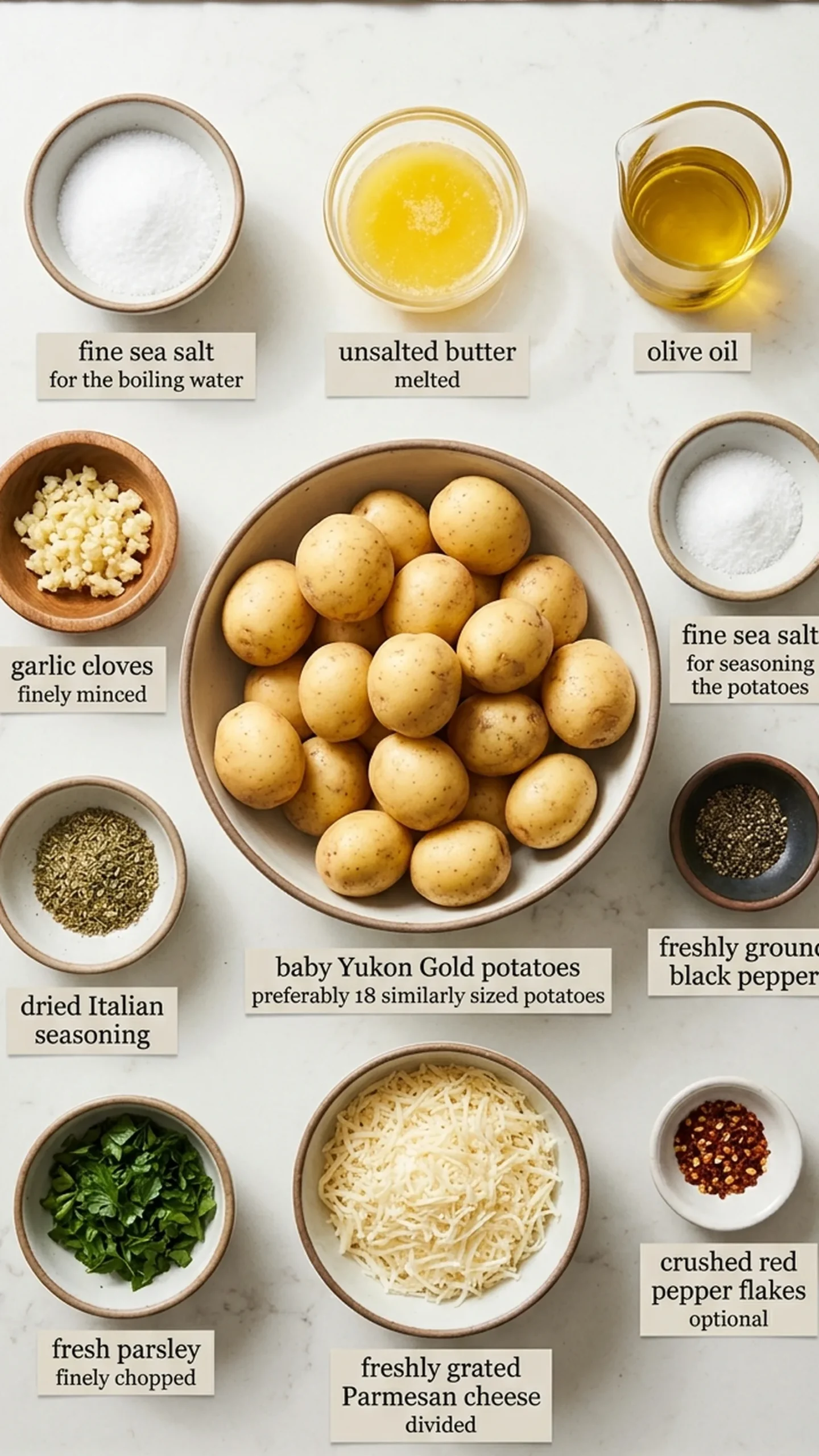
- 2 pounds (900 g) baby Yukon Gold potatoes, preferably 18 similarly sized potatoes, scrubbed clean
- 1 tablespoon (15 g) fine sea salt, for the boiling water
- 3 tablespoons (42 g) unsalted butter, melted
- 2 tablespoons (30 ml) olive oil
- 4 medium garlic cloves (about 12 g), finely minced
- 1/2 teaspoon (3 g) fine sea salt, for seasoning the potatoes
- 1/2 teaspoon (1 g) freshly ground black pepper
- 1 teaspoon (1 g) dried Italian seasoning
- 3/4 cup (75 g) freshly grated Parmesan cheese, divided
For Garnishing
- 2 tablespoons (8 g) fresh parsley, finely chopped, optional
- 1/4 teaspoon (0.5 g) crushed red pepper flakes, optional
Ingredient Notes and Substitutions
- Baby Yukon Gold Potatoes: Baby Yukon Gold potatoes have thin skins, naturally buttery flesh, and enough starch to create fluffy centers with crisp edges. Their small size also makes them convenient for stacking. Baby red potatoes can be substituted in the same weight. They hold their shape well but have a slightly waxier texture and may produce less fluffy interiors. Avoid very large baking potatoes, which are harder to portion into uniform individual towers.
- Unsalted Butter: Butter contributes richness and helps carry the garlic flavor throughout the potato layers. Using unsalted butter allows better control over the final seasoning. Salted butter can be substituted, but the added seasoning salt should be reduced to account for the salt already present in the butter.
- Olive Oil: Olive oil helps coat the uneven smashed surfaces and encourages browning during roasting. Combined with butter, it provides both flavor and a practical roasting fat. Avocado oil is a suitable substitute in the same quantity. It has a more neutral flavor, so the finished potatoes will taste slightly less fruity.
- Fresh Garlic: Freshly minced garlic gives the potatoes a pronounced savory aroma. Mixing it into the melted butter and oil distributes its flavor more evenly. Garlic powder can replace fresh garlic when necessary. Use approximately 1 teaspoon (3 g) garlic powder in place of the fresh cloves. The flavor will be more uniform and less pungent, without the small pieces of roasted garlic.
- Parmesan Cheese: Freshly grated Parmesan provides salty, nutty flavor and helps the layers adhere during the final bake. Fine shreds melt more evenly than coarse pieces. Pecorino Romano can be used in the same quantity, although it produces a sharper, saltier result. Pre-shredded Parmesan may not melt as smoothly because it often contains anti-caking ingredients.
Step-by-Step Instructions
Step 1: Prepare the Potatoes
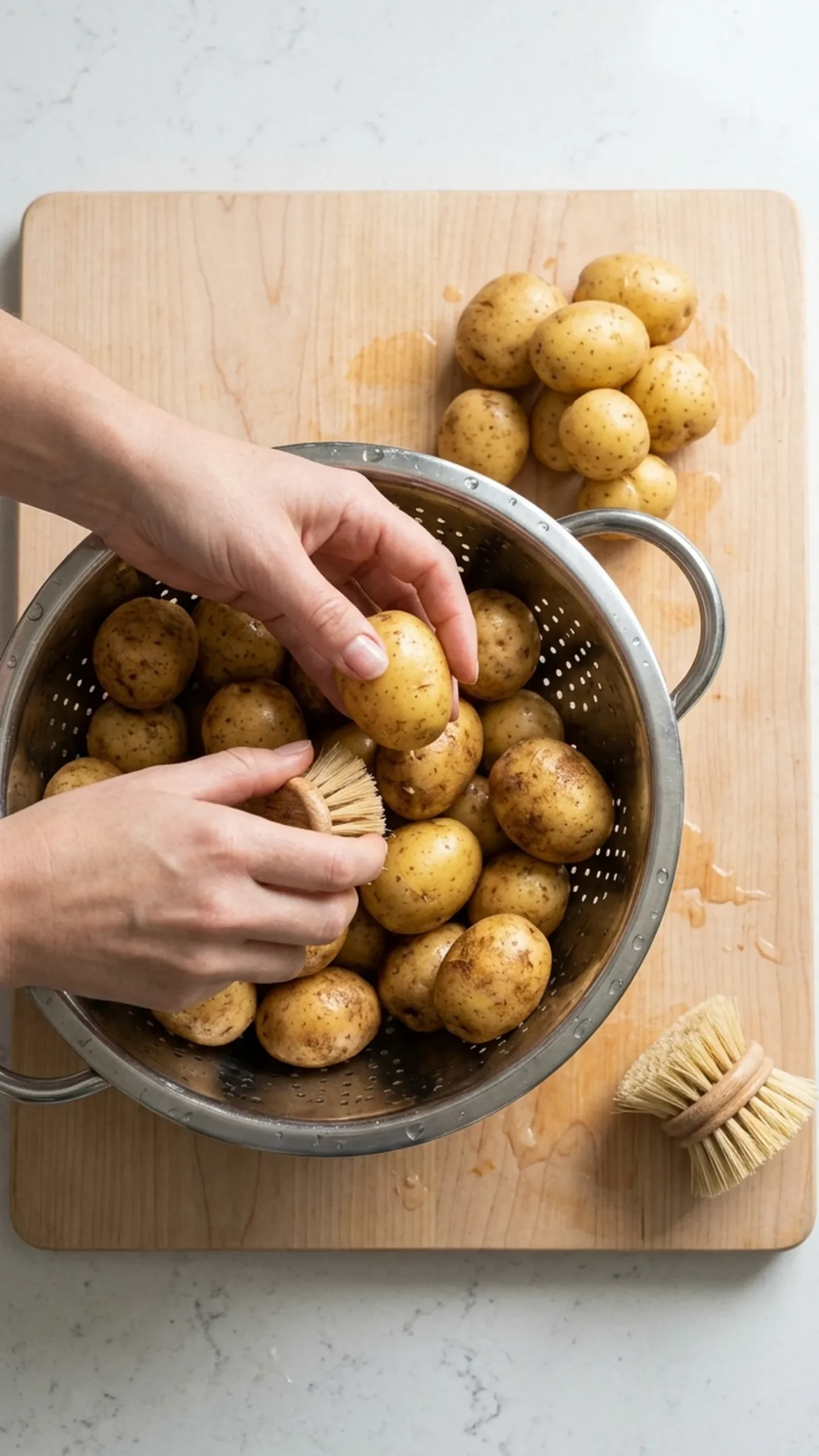
Wash and scrub the 2 pounds (900 g) baby Yukon Gold potatoes thoroughly, leaving the skins intact.
Choose potatoes of similar size so they cook evenly and form consistent layers. Aim for 18 potatoes, allowing three flattened potatoes per tower.
Discard any potatoes with significant soft spots or green areas.
Step 2: Boil Until Fork-Tender
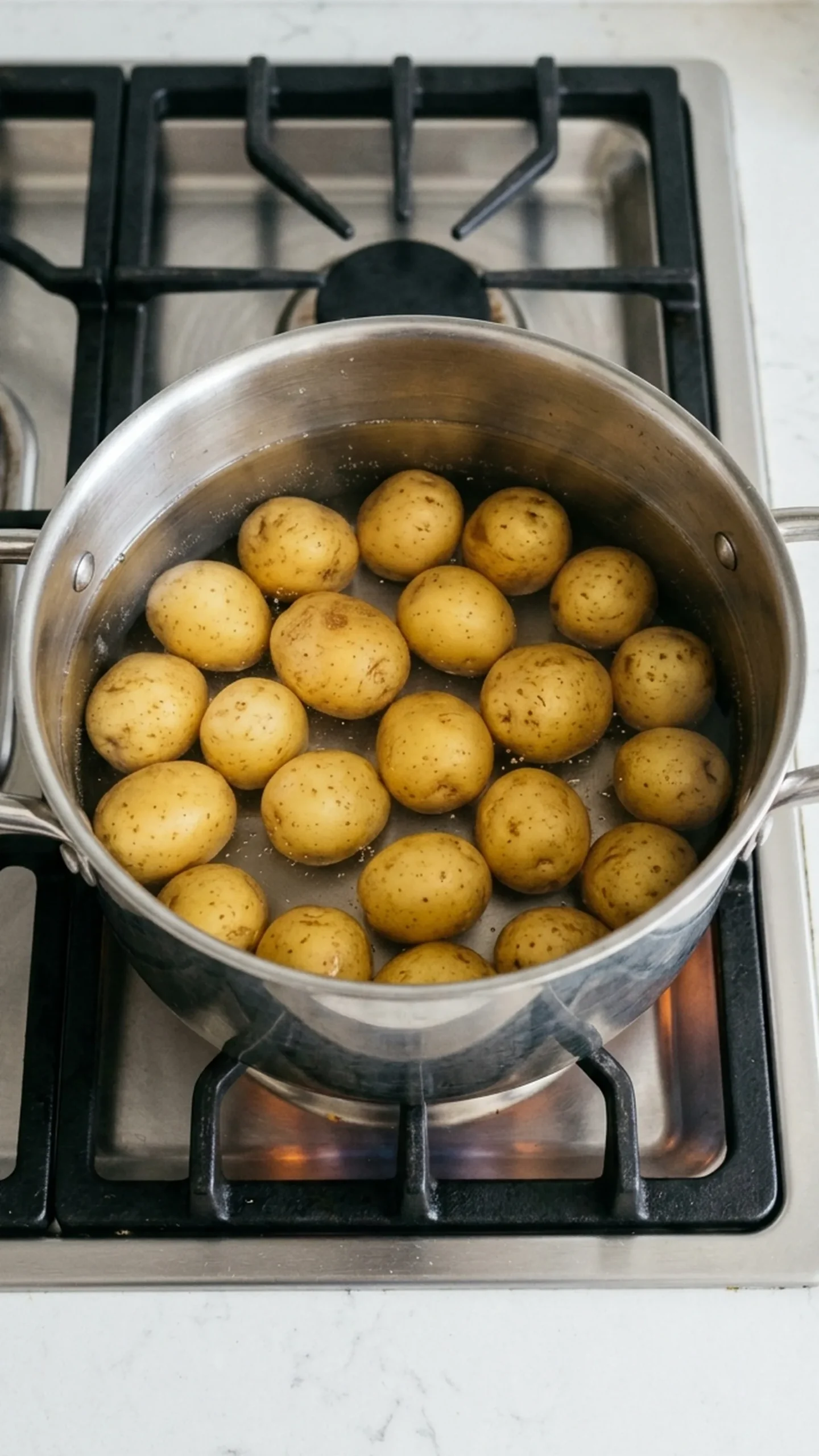
Place the potatoes in a large pot and add enough cold water to cover them by about 1 inch (2.5 cm).
Add the 1 tablespoon (15 g) fine sea salt reserved for the boiling water.
Bring to a boil over high heat, then reduce to a steady simmer over medium heat.
Cook for 18–20 minutes, or until a fork slides easily into the center of the largest potato without resistance.
The potatoes should be tender but not falling apart. Overcooked potatoes can break into loose pieces when smashed.
Drain thoroughly in a colander.
Step 3: Dry the Potatoes and Preheat the Oven
Allow the drained potatoes to steam-dry for 5 minutes.
This short drying period helps remove surface moisture, which improves browning during roasting.
Meanwhile, preheat the oven to 425°F (220°C).
Line an 18 × 13-inch (46 × 33 cm) rimmed baking sheet with parchment paper.
Step 4: Prepare the Garlic Butter Mixture
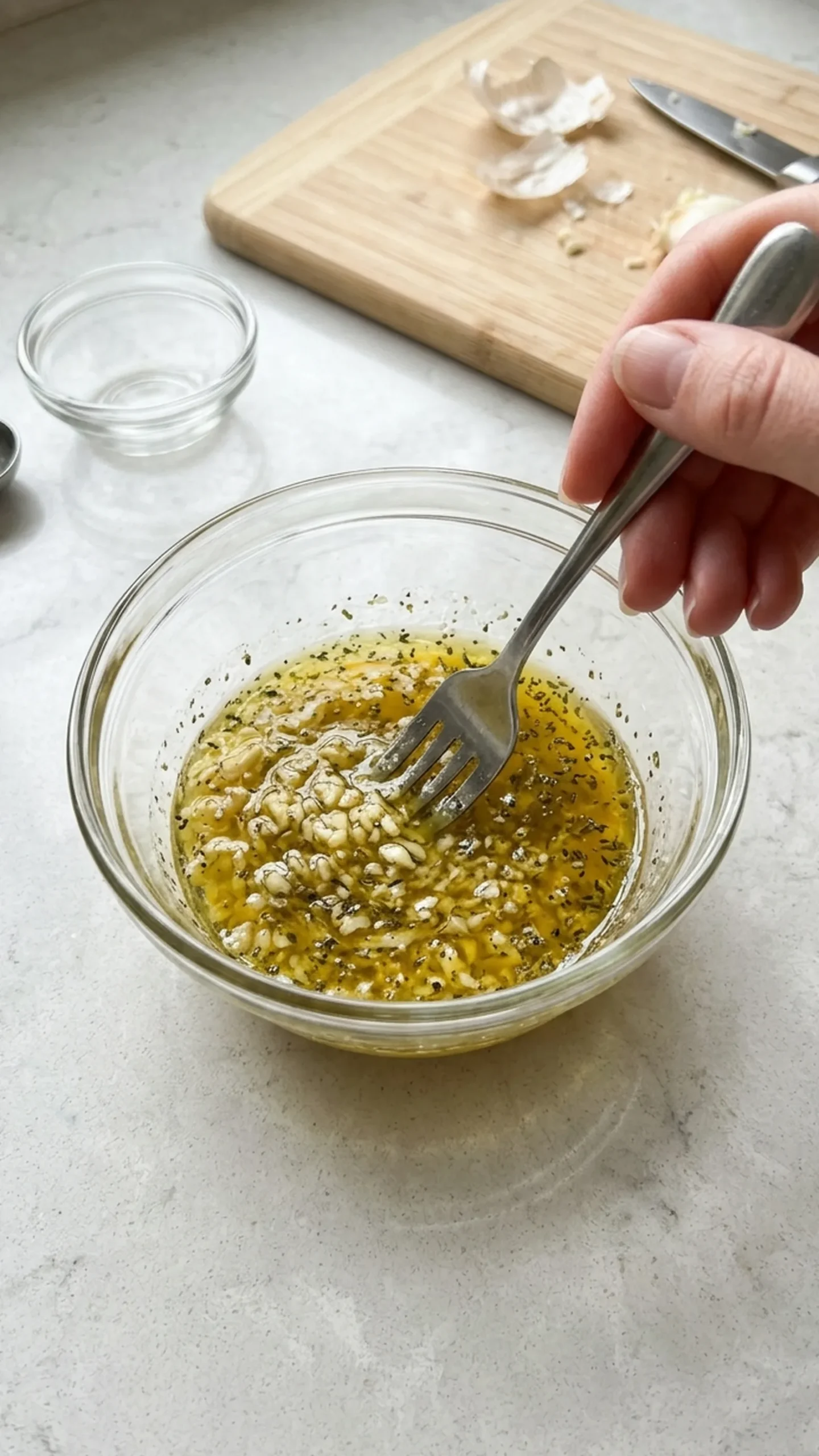
In a small bowl, combine:
- 3 tablespoons (42 g) melted unsalted butter
- 2 tablespoons (30 ml) olive oil
- 4 medium garlic cloves (about 12 g), finely minced
- 1/2 teaspoon (3 g) fine sea salt
- 1/2 teaspoon (1 g) freshly ground black pepper
- 1 teaspoon (1 g) dried Italian seasoning
Stir until the garlic and seasonings are evenly distributed.
The mixture should be fluid enough to brush over the potatoes. If the butter begins to solidify, warm it gently until liquid again.
Step 5: Smash the Potatoes
Arrange the boiled potatoes on the prepared baking sheet, leaving space between them.
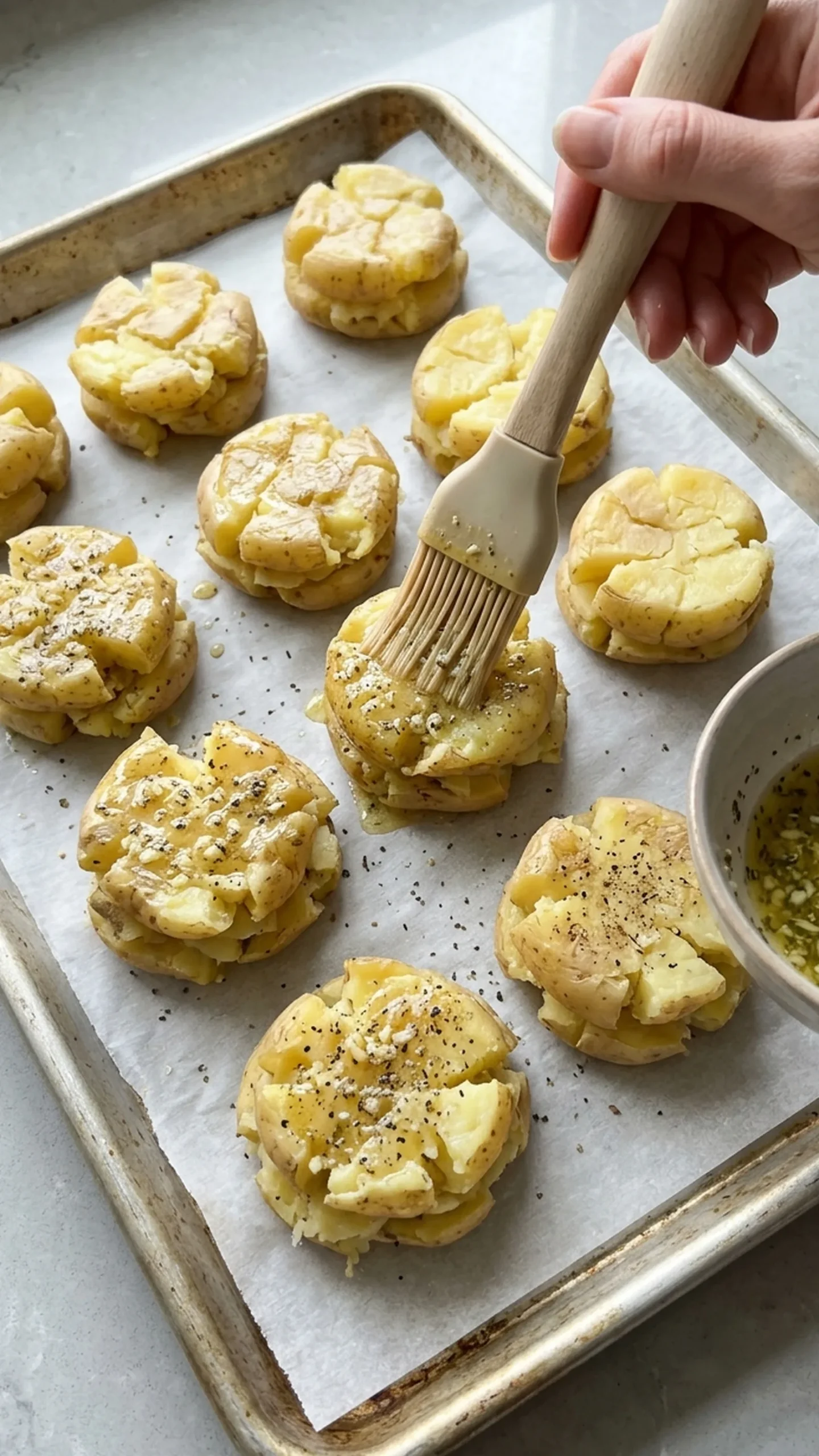
Using the flat bottom of a sturdy glass or measuring cup, gently press each potato into a round approximately 1/2 inch (1.3 cm) thick.
Apply steady pressure rather than striking the potatoes.
The skins should split slightly, exposing the fluffy interior and creating irregular edges that can crisp during roasting.
If a potato begins to crumble, stop pressing and gently push the pieces back together.
Step 6: Season the Flattened Potatoes
Brush the potatoes with approximately two-thirds of the garlic butter mixture, making sure some reaches the exposed interiors and cracked edges.
Reserve the remaining mixture for assembling the towers.
Spread the potatoes into an even layer without overlapping them.
Avoid leaving large pieces of minced garlic exposed on the baking sheet, where they can burn before the potatoes finish roasting.
Step 7: Roast Until Golden and Crisp
Place the baking sheet on the middle oven rack.
Roast at 425°F (220°C) for 25 minutes, until the bottoms are golden and the edges begin to crisp.
Carefully turn the potatoes using a thin metal spatula.
Continue roasting for another 10 minutes.
The finished rounds should have visibly browned edges, lightly crisp surfaces, and tender centers.
If the potatoes remain pale, check that they are not crowded or sitting in excess moisture.
Step 8: Assemble the Potato Towers
Remove the baking sheet from the oven and reduce the temperature to 400°F (205°C).
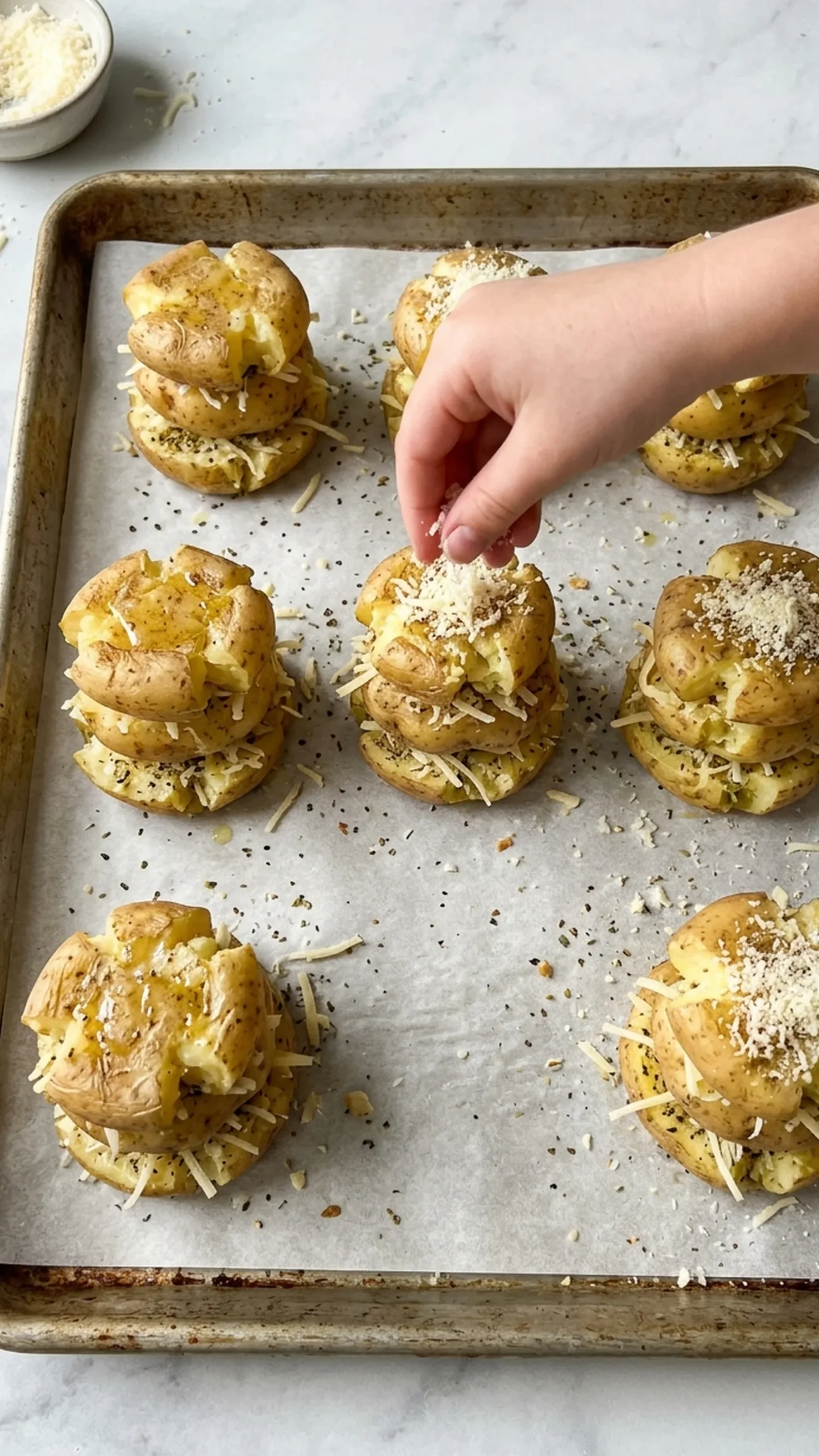
Carefully arrange the roasted potatoes into 6 towers, using 3 flattened potatoes per tower.
Build each tower directly on the baking sheet:
Step 1: Place one roasted potato round on the parchment.
Step 2: Sprinkle with a portion of the 3/4 cup (75 g) Parmesan cheese.
Step 3: Add a second potato round and another sprinkle of Parmesan.
Step 4: Finish with a third potato round and a final layer of Parmesan.
Distribute the cheese evenly among the towers, reserving a little for their tops.
Brush or drizzle the reserved garlic butter mixture over the assembled towers.
Keep the rounds centered so the stacks remain stable. Place larger rounds at the bottom when possible.
Step 9: Bake the Assembled Towers
Return the baking sheet to the oven.
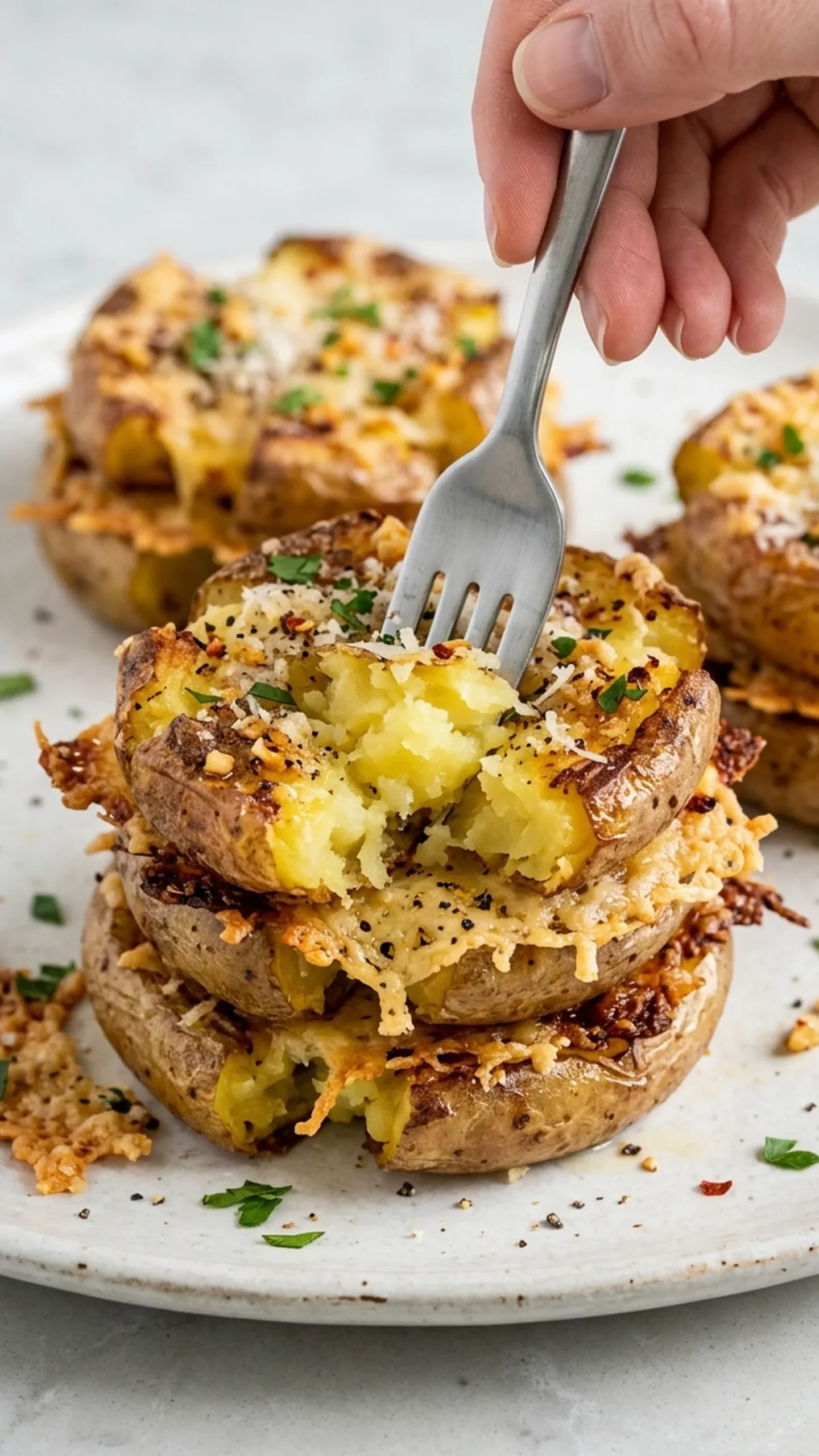
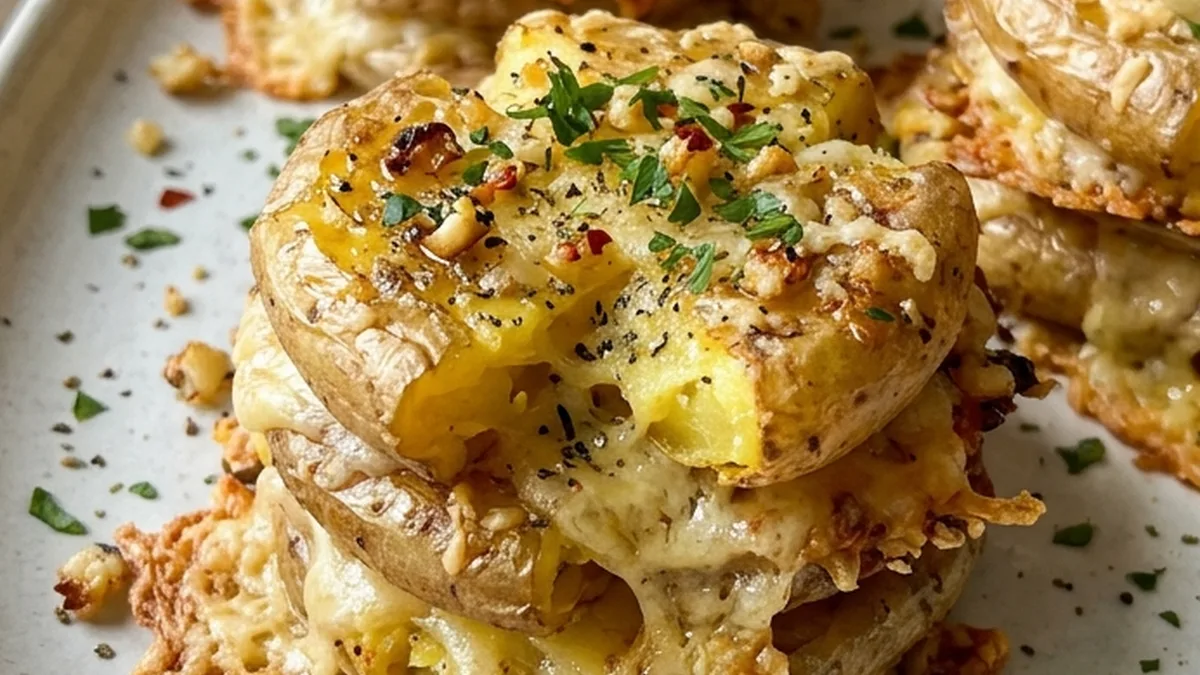
Bake at 400°F (205°C) for 10 minutes, until the Parmesan has melted and the exposed cheese develops lightly golden edges.
The towers should look cohesive, with visible layers and crisp potato edges.
If the cheese browns too quickly, move the baking sheet to a lower oven rack.
Avoid baking until the cheese becomes dark brown, which can give it a bitter flavor.
Step 10: Garnish and Serve
Remove the towers from the oven.
If desired, sprinkle with the 2 tablespoons (8 g) finely chopped fresh parsley and 1/4 teaspoon (0.5 g) crushed red pepper flakes.
Use a thin spatula to transfer each tower to a serving plate, supporting the base so the layers remain aligned.
Serve hot while the edges are crisp and the Parmesan is still warm.
Storage, Freezing, and Make-Ahead Instructions
- Refrigerator Storage: Allow leftover Garlic-Parmesan Smashed Potato Towers to cool slightly, then refrigerate within 2 hours of cooking. Place them in a shallow airtight container, ideally in a single layer, to prevent the towers from collapsing. Store in the refrigerator for up to 3–4 days. The potato centers will remain tender, although the crispy edges will soften during refrigeration.
- Freezing Instructions: The finished towers can be frozen, but their texture may become slightly softer after thawing. For easier storage, arrange the cooled towers on a parchment-lined tray and freeze until firm. Transfer them to a freezer-safe container, separating layers with parchment paper. Freeze for up to 2 months for better quality. Thaw overnight in the refrigerator before reheating.
- Reheating Instructions: For the best texture, reheat refrigerated towers in a preheated 375°F (190°C) oven for approximately 12–15 minutes, or until heated throughout. Place them on a parchment-lined baking sheet and leave space between each tower. For previously frozen and thawed towers, allow additional reheating time as needed. Reheat leftovers to an internal temperature of 165°F (74°C). Avoid using the microwave when crispness is important. It heats the potatoes quickly but tends to soften their edges.
- Make-Ahead Preparation: For a convenient make-ahead option, boil and drain the potatoes in advance. Allow them to cool, transfer them to an airtight container, and refrigerate for up to 24 hours. When ready to cook, flatten the chilled potatoes, prepare the garlic butter mixture, and continue with the roasting and stacking instructions. Chilled potatoes may require slightly longer roasting to develop the same golden crust. For the crispiest results, assemble and complete the final bake shortly before serving.
FAQ
Can I make Garlic-Parmesan Smashed Potato Tower ahead of time?
Yes. The easiest approach is to boil the potatoes up to 24 hours ahead, refrigerate them, and complete the smashing, roasting, and stacking shortly before serving. You can also prepare the finished towers in advance and reheat them, although freshly roasted potatoes will have crisper edges.
Why are my smashed potatoes not crispy?
Excess moisture is the most common cause. Potatoes that have not been drained and steam-dried properly may roast unevenly. Overcrowding the baking sheet can also trap steam. Make sure the potatoes have enough space and are roasted until their exposed edges become visibly golden before stacking.
Can I use regular potatoes instead of baby potatoes?
Yes, but the shape and texture may change. Choose small Yukon Gold potatoes whenever possible. Larger potatoes can be cut into thick rounds before boiling, but those pieces may not smash or hold together as neatly as whole baby potatoes. Cooking time will also depend on their size.
How do I keep the potato towers from falling apart?
Use similarly sized potato rounds, position the largest pieces at the bottom, and keep each layer centered. Finely grated Parmesan helps the layers adhere as it melts. Avoid moving the towers immediately after removing them from the oven, and use a wide, thin spatula to support the base during transfer.
Can I make these potato towers without Parmesan?
Yes, although the flavor and structure will change. Pecorino Romano is a suitable alternative with a sharper, saltier taste. For a milder version, finely shredded low-moisture mozzarella can be used, but it will create a softer, stretchier layer instead of Parmesan's lightly crisp finish.
Ingredients
Method
- Wash and scrub the 2 pounds (900 g) baby Yukon Gold potatoes thoroughly, leaving the skins intact. Choose potatoes of similar size so they cook evenly and form consistent layers. Aim for 18 potatoes, allowing three flattened potatoes per tower. Discard any potatoes with significant soft spots or green areas.
- Place the potatoes in a large pot and add enough cold water to cover them by about 1 inch (2.5 cm). Add the 1 tablespoon (15 g) fine sea salt reserved for the boiling water. Bring to a boil over high heat, then reduce to a steady simmer over medium heat. Cook for 18–20 minutes, or until a fork slides easily into the center of the largest potato without resistance. The potatoes should be tender but not falling apart. Overcooked potatoes can break into loose pieces when smashed. Drain thoroughly in a colander.
- Allow the drained potatoes to steam-dry for 5 minutes. This short drying period helps remove surface moisture, which improves browning during roasting. Meanwhile, preheat the oven to 425°F (220°C). Line an 18 × 13-inch (46 × 33 cm) rimmed baking sheet with parchment paper.
- In a small bowl, combine: 3 tablespoons (42 g) melted unsalted butter 2 tablespoons (30 ml) olive oil 4 medium garlic cloves (about 12 g), finely minced 1/2 teaspoon (3 g) fine sea salt 1/2 teaspoon (1 g) freshly ground black pepper 1 teaspoon (1 g) dried Italian seasoning Stir until the garlic and seasonings are evenly distributed. The mixture should be fluid enough to brush over the potatoes. If the butter begins to solidify, warm it gently until liquid again.
- Arrange the boiled potatoes on the prepared baking sheet, leaving space between them. Using the flat bottom of a sturdy glass or measuring cup, gently press each potato into a round approximately 1/2 inch (1.3 cm) thick. Apply steady pressure rather than striking the potatoes. The skins should split slightly, exposing the fluffy interior and creating irregular edges that can crisp during roasting. If a potato begins to crumble, stop pressing and gently push the pieces back together.
- Brush the potatoes with approximately two-thirds of the garlic butter mixture, making sure some reaches the exposed interiors and cracked edges. Reserve the remaining mixture for assembling the towers. Spread the potatoes into an even layer without overlapping them. Avoid leaving large pieces of minced garlic exposed on the baking sheet, where they can burn before the potatoes finish roasting.
- Place the baking sheet on the middle oven rack. Roast at 425°F (220°C) for 25 minutes, until the bottoms are golden and the edges begin to crisp. Carefully turn the potatoes using a thin metal spatula. Continue roasting for another 10 minutes. The finished rounds should have visibly browned edges, lightly crisp surfaces, and tender centers. If the potatoes remain pale, check that they are not crowded or sitting in excess moisture.
- Remove the baking sheet from the oven and reduce the temperature to 400°F (205°C). Carefully arrange the roasted potatoes into 6 towers, using 3 flattened potatoes per tower. Build each tower directly on the baking sheet:
- Place one roasted potato round on the parchment.
- Sprinkle with a portion of the 3/4 cup (75 g) Parmesan cheese.
- Add a second potato round and another sprinkle of Parmesan.
- Distribute the cheese evenly among the towers, reserving a little for their tops. Brush or drizzle the reserved garlic butter mixture over the assembled towers. Keep the rounds centered so the stacks remain stable. Place larger rounds at the bottom when possible.
- Return the baking sheet to the oven: Bake at 400°F (205°C) for 10 minutes, until the Parmesan has melted and the exposed cheese develops lightly golden edges. The towers should look cohesive, with visible layers and crisp potato edges. If the cheese browns too quickly, move the baking sheet to a lower oven rack. Avoid baking until the cheese becomes dark brown, which can give it a bitter flavor.
- Remove the towers from the oven: If desired, sprinkle with the 2 tablespoons (8 g) finely chopped fresh parsley and 1/4 teaspoon (0.5 g) crushed red pepper flakes. Use a thin spatula to transfer each tower to a serving plate, supporting the base so the layers remain aligned. Serve hot while the edges are crisp and the Parmesan is still warm.