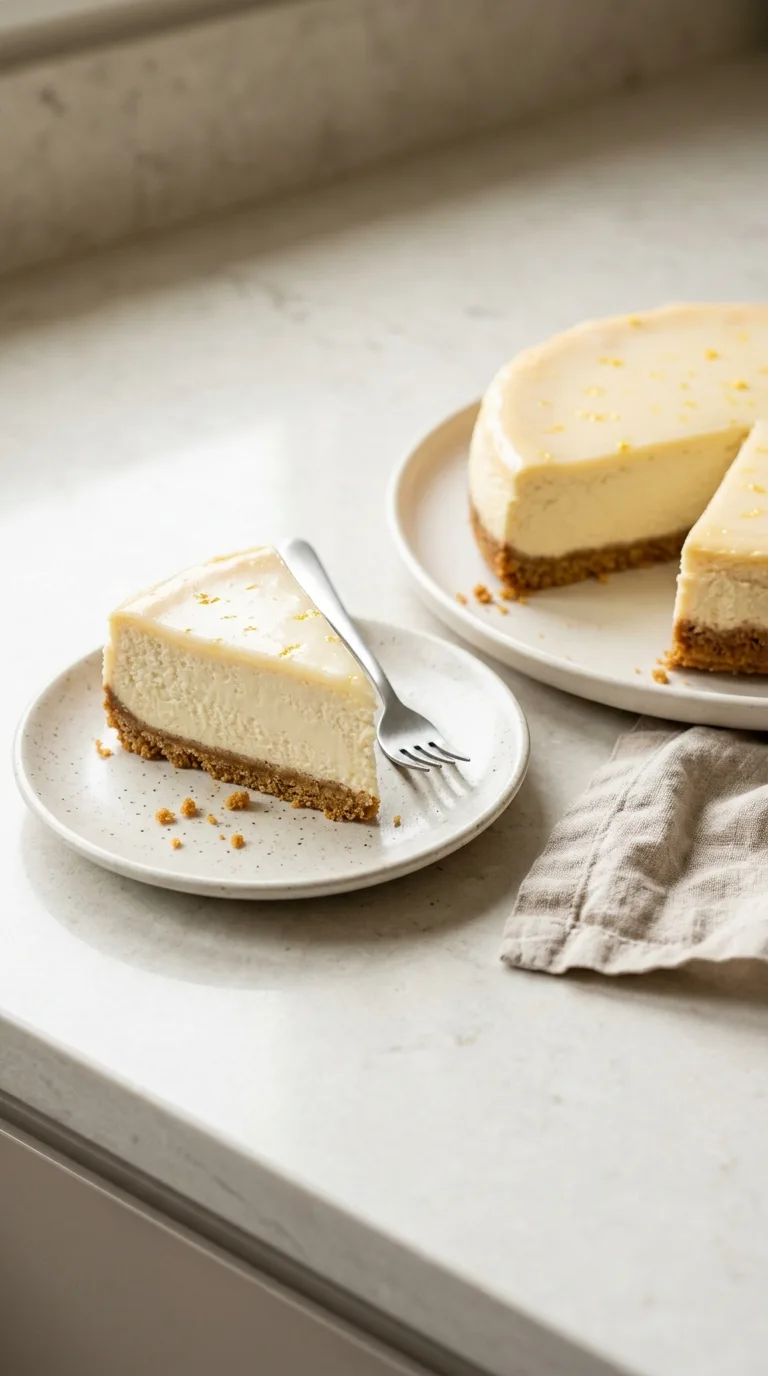
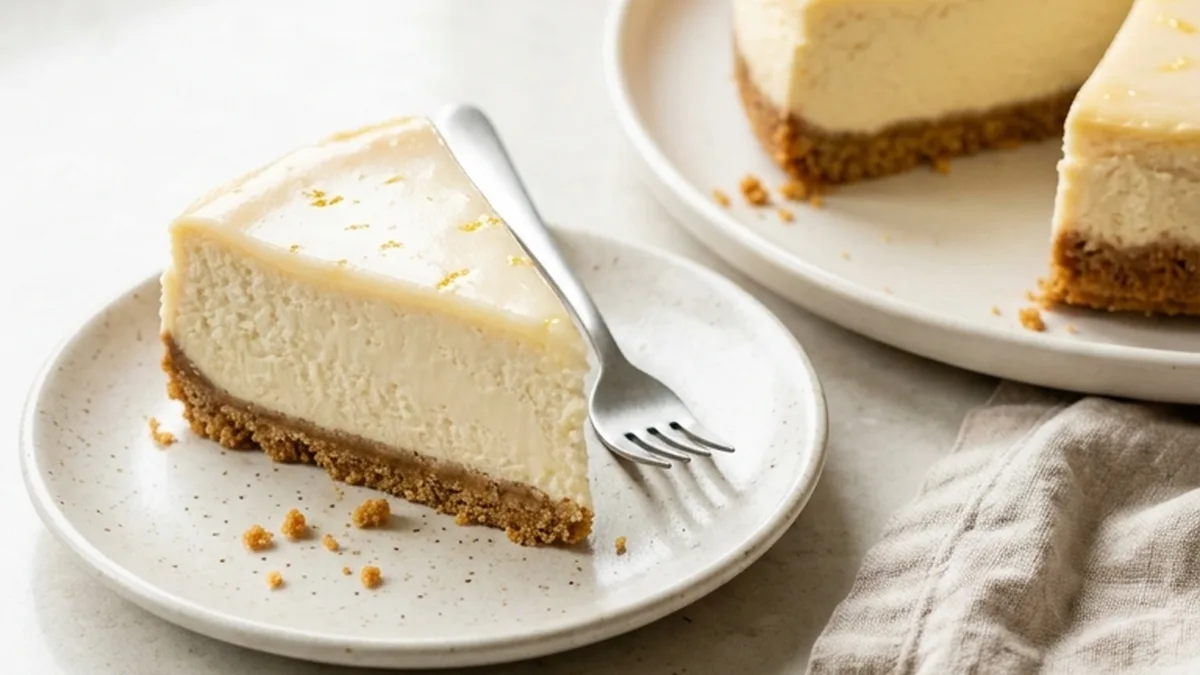
This Lemon Cheesecake combines a buttery graham cracker crust with a rich, silky cream cheese filling flavored with fresh lemon juice and zest. The lemon brings a bright, refreshing tang that balances the sweetness, while sour cream gives the filling a smooth, velvety texture. Each slice has a firm yet creamy center and a lightly crisp, golden crust.
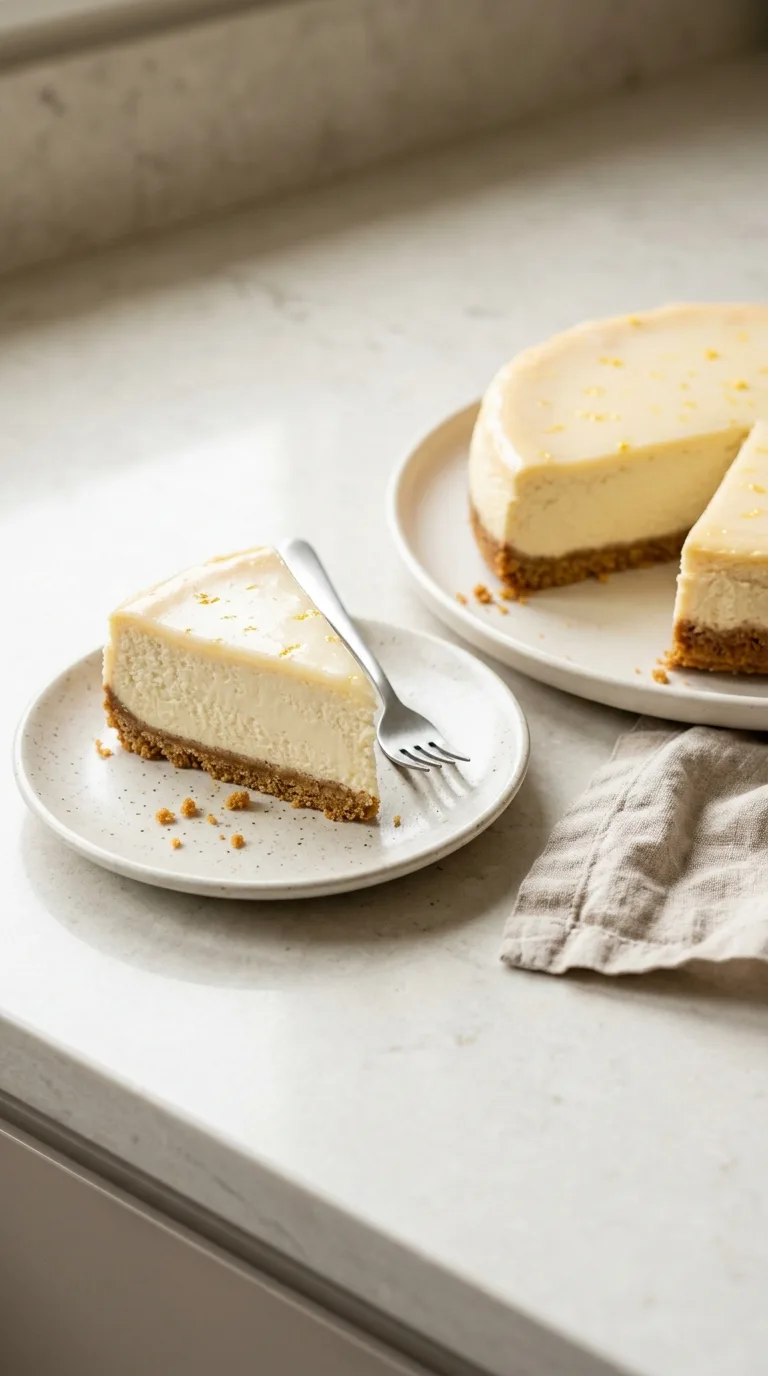
This baked Lemon Cheesecake uses a gentle water bath to encourage even cooking and reduce the chance of cracks. It requires several hours of chilling, making it a convenient make-ahead dessert for spring gatherings, summer celebrations, holidays, or any occasion that calls for a fresh citrus dessert.
Recipe at a Glance
Prep Time
25 minutes
Cook Time
1 hour 10 minutes
Additional Time
8 hours
Total Time
9 hours 35 minutes
Yield
One 9-inch cheesecake, 12 slices
Servings
12
Category
Dessert
Cuisine
American
Cooking Method
Baking
Difficulty
Intermediate
Calories Per Serving
Not calculated
Why This Recipe Works
- Fresh lemon juice and zest create balanced citrus flavor. Lemon juice provides tartness, while the zest contributes aromatic lemon oils without adding excess liquid to the filling.
- Full-fat cream cheese produces a rich, stable texture. Its fat content helps the cheesecake stay creamy while holding its shape after chilling.
- Sour cream softens the filling. It adds gentle tanginess and moisture, keeping the cheesecake from tasting overly dense or heavy.
- A water bath encourages gentle, even baking. Moist heat helps protect the edges from overcooking before the center sets.
- Slow cooling and overnight chilling improve the finished texture. Gradual cooling reduces sudden temperature changes, while refrigeration allows the filling to firm up for neat slices.
Equipment Needed
- 9-inch (23 cm) springform pan, approximately 2¾ to 3 inches deep
- Large roasting pan, deep enough to hold about 1 inch (2.5 cm) of hot water around the cheesecake pan
- Electric hand mixer or stand mixer with paddle attachment
- Large mixing bowl
- Medium mixing bowl
- Rubber spatula
- Microplane or fine citrus zester
- Citrus juicer
- Heavy-duty aluminum foil or a larger solid cake pan to protect the springform pan from water
- Wire cooling rack
- Instant-read kitchen thermometer, optional but helpful for checking doneness
Ingredients List
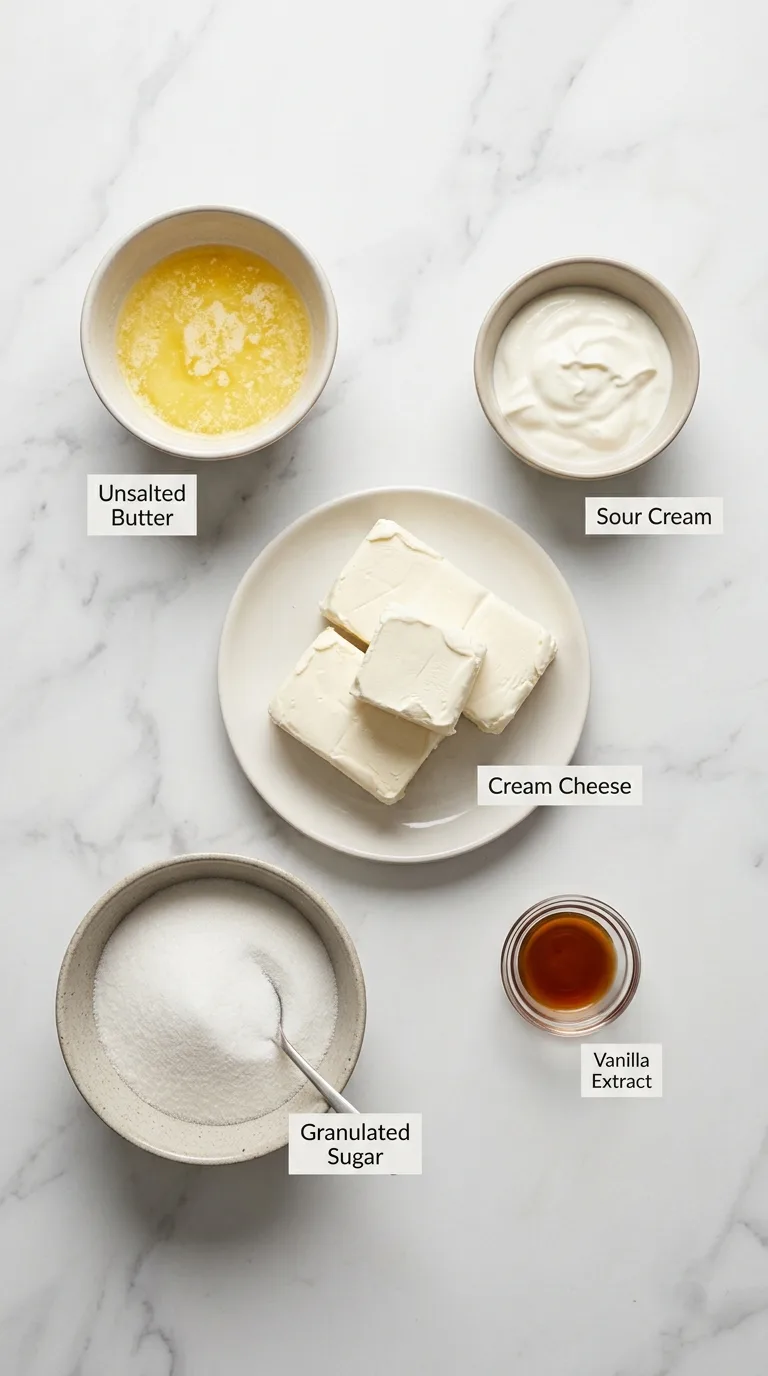
For the Graham Cracker Crust:
- 1 1/2 cups (150 g) graham cracker crumbs, finely crushed
- 1/4 cup (50 g) granulated sugar
- 6 tablespoons (85 g) unsalted butter, melted and slightly cooled
For the Lemon Cheesecake Filling:
- 24 ounces (680 g) full-fat brick-style cream cheese, softened to room temperature
- 1 cup (200 g) granulated sugar
- 1 cup (240 g) full-fat sour cream, at room temperature
- 3 large eggs (approximately 150 g without shells), at room temperature
- 1/4 cup (60 ml) freshly squeezed lemon juice, strained to remove seeds
- 2 tablespoons (approximately 12 g) finely grated fresh lemon zest, avoiding the white pith
- 1 teaspoon (5 ml) pure vanilla extract
- 2 tablespoons (16 g) all-purpose flour, spooned and leveled
Optional Garnish:
- 1/2 cup (120 ml) heavy whipping cream, cold, optional
- 1 tablespoon (8 g) powdered sugar, sifted, optional
- 1 teaspoon (2 g) finely grated lemon zest, optional
Ingredient Notes and Substitutions
Full-Fat Cream Cheese
Cream cheese forms the structure of the cheesecake and gives it its rich, smooth consistency.
Use full-fat brick-style cream cheese rather than whipped or spreadable cream cheese from a tub. Tub varieties may contain additional moisture or stabilizers that affect the finished texture.
Reduced-fat cream cheese can produce a softer, less rich filling, so it is not a direct substitute when a firm, creamy result is the goal.
Fresh Lemon Juice and Zest
Fresh lemon juice adds acidity, while lemon zest provides concentrated citrus aroma.
Bottled lemon juice can replace the fresh juice in the same quantity, but the flavor may be less vibrant. Keep the fresh zest if possible.
For a different citrus variation, lime juice and zest can replace the lemon juice and zest in equal measured quantities. The finished cheesecake will have a noticeably different citrus flavor.
Sour Cream
Sour cream adds moisture, acidity, and a gentle tang that complements the lemon.
Plain full-fat Greek yogurt can replace sour cream in an equal quantity. The filling may taste slightly tangier and set a little firmer.
Avoid thin, watery yogurt, which can introduce excess moisture.
Graham Cracker Crumbs
Graham cracker crumbs create a lightly sweet crust that contrasts with the smooth cheesecake filling.
Finely crushed digestive biscuits can be used in an equal weight. They produce a similar texture but may taste slightly less sweet.
Vanilla wafer crumbs are another option, although their sweeter flavor changes the balance of the dessert.
Eggs
Eggs help the filling set during baking and contribute to its smooth, custard-like texture.
Large eggs provide the intended ratio of moisture, fat, and protein. There is no reliable direct egg-free substitution for this particular baked cheesecake without changing the recipe's structure and baking behavior.
Step-by-Step Instructions
Prepare the Oven and Pan
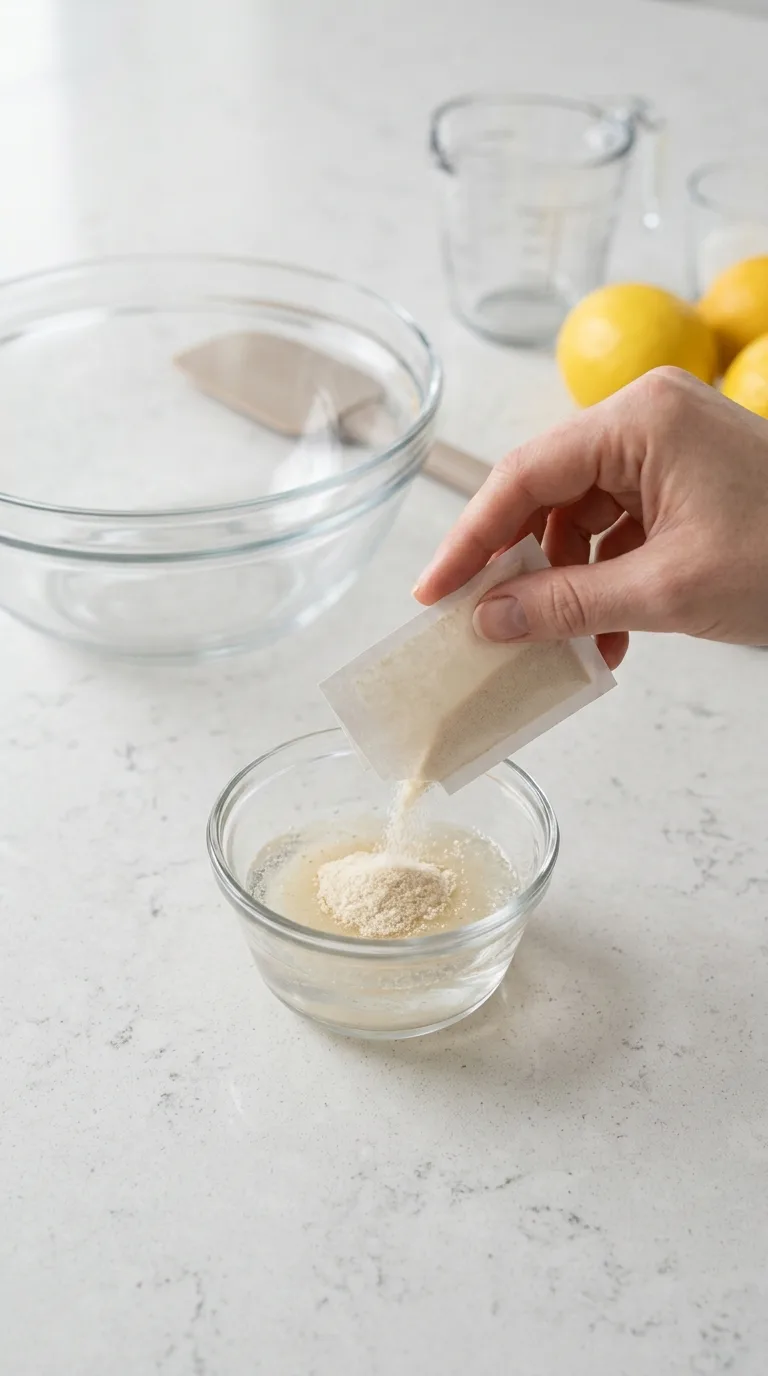
Preheat the oven to 325°F (163°C). Position a rack in the lower-middle section of the oven. Lightly grease the bottom and sides of a 9-inch (23 cm) springform pan. To prevent water from entering during baking, wrap the outside bottom and sides with several layers of heavy-duty aluminum foil. For more reliable protection, place the springform pan inside a slightly larger solid cake pan that fits within the roasting pan. Set a kettle or pot of water to heat for the water bath.
Make the Graham Cracker Crust
In a medium mixing bowl, combine: 1½ cups (150 g) graham cracker crumbs ¼ cup (50 g) granulated sugar 6 tablespoons (85 g) melted unsalted butter Stir until the crumbs are evenly moistened. The mixture should resemble damp sand and hold together when squeezed between your fingers. If some crumbs remain dry, continue mixing until the butter is evenly distributed.
Press and Bake the Crust
Transfer the crumb mixture to the prepared springform pan. Press it firmly and evenly across the bottom using the flat base of a measuring cup. Bake for 10 minutes, until the crust looks slightly darker and smells lightly toasted. Remove from the oven and allow it to cool while preparing the filling. Keep the oven at 325°F (163°C).
Beat the Cream Cheese and Sugar
Place 24 ounces (680 g) softened cream cheese in a large mixing bowl. Beat on medium-low speed for about 2 minutes, until smooth and free of visible lumps. Add 1 cup (200 g) granulated sugar and continue mixing for another 1 to 2 minutes. Scrape down the sides and bottom of the bowl with a rubber spatula. The mixture should look thick, creamy, and smooth rather than fluffy. Avoid whipping excessive air into the filling, which can cause the cheesecake to rise too much and crack as it cools.
Add the Sour Cream, Lemon, and Vanilla
Add the following ingredients: 1 cup (240 g) full-fat sour cream ¼ cup (60 ml) fresh lemon juice 2 tablespoons (12 g) fresh lemon zest 1 teaspoon (5 ml) vanilla extract Mix on low speed until evenly combined. The filling should become slightly looser while remaining thick and creamy. Scrape the bowl to ensure the lemon zest and sour cream are evenly distributed.
Incorporate the Flour and Eggs
Sprinkle 2 tablespoons (16 g) all-purpose flour over the filling and mix on low speed until no dry streaks remain. Add the 3 large eggs, one at a time, mixing briefly after each addition. Stop mixing as soon as each egg is incorporated. Use a spatula to fold the batter gently a few times, checking for any unmixed cream cheese along the bottom of the bowl. The finished batter should be smooth, glossy, and thick but pourable.
Fill the Springform Pan
Pour the cheesecake filling over the cooled graham cracker crust. Smooth the surface gently with an offset spatula or the back of a spoon. Tap the pan lightly on the counter two or three times to release larger trapped air bubbles. Avoid vigorous tapping, which may disturb the crust.
Prepare the Water Bath
Place the protected springform pan inside a large roasting pan. Transfer the roasting pan to the oven rack, then carefully pour hot water into the roasting pan until it reaches approximately 1 inch (2.5 cm) up the outside of the protected cheesecake pan. Make sure no water enters the cheesecake. The water bath helps the filling cook gradually and reduces the likelihood of dry, overbaked edges.
Bake the Lemon Cheesecake
Bake at 325°F (163°C) for approximately 55 to 65 minutes. The cheesecake is ready when: The outer 2 to 3 inches look set. The surface appears mostly matte rather than wet. The center still has a gentle wobble when the pan is nudged. The center moves as one soft unit rather than rippling like liquid. For an additional doneness check, an instant-read thermometer inserted near the center should register approximately 150–155°F (66–68°C). Avoid waiting until the entire cheesecake is firm. The center continues to set as it cools. The total cook time, including the 10-minute crust bake, is approximately 1 hour 10 minutes.
Cool Gradually in the Oven
Turn off the oven. Carefully remove the roasting pan's hot water if it can be done safely without moving the cheesecake, or leave the water bath undisturbed. Crack the oven door open slightly and let the cheesecake cool inside for 1 hour. This gradual temperature change helps reduce surface cracking and sudden shrinking.
Cool to Room Temperature
Carefully remove the cheesecake from the oven and water bath. Remove the protective foil and place the springform pan on a wire rack. Allow the cheesecake to cool for approximately 1 hour, until it is no longer warm. Refrigerate promptly and do not leave it at room temperature for more than 2 hours total. Do not release the springform ring yet. If the surface has a small crack, it will not affect the flavor and can be covered with the optional garnish.
Refrigerate Until Firm
Cover the pan loosely, taking care not to touch the cheesecake surface. Refrigerate for at least 6 hours, preferably overnight. The cheesecake should feel firm and thoroughly chilled before slicing. This chilling period allows the filling to settle and develop a dense, creamy texture.
Remove from the Pan
Once fully chilled, run a thin knife around the inside edge of the springform pan. Carefully release and remove the outer ring. Transfer the cheesecake to a serving plate, leaving it on the pan base if moving it would risk breaking the crust. For cleaner slices, use a sharp knife dipped in hot water and wiped dry between cuts.
Add the Optional Garnish and Serve
If using the optional whipped cream garnish, combine: ½ cup (120 ml) cold heavy whipping cream 1 tablespoon (8 g) powdered sugar Whip until medium-stiff peaks form. Pipe or spoon the whipped cream around the cheesecake's edge. Sprinkle with 1 teaspoon (2 g) finely grated lemon zest, if desired. Slice into 12 portions and serve chilled.
Tips for Success
- Start with properly softened cream cheese. Cold cream cheese often leaves small lumps that are difficult to remove once the eggs have been added. Let it soften at room temperature, but do not leave it unrefrigerated for an extended period. Avoid overmixing after adding the eggs. Excess air can cause the filling to puff up during baking and collapse as it cools, increasing the risk of cracks. Protect the springform pan carefully. Even heavy-duty foil can develop small leaks. Placing the springform pan inside a larger solid pan is a useful alternative when space allows. Use the wobble test rather than surface color alone. A properly baked cheesecake may remain pale on top. Waiting for a deeply golden surface can lead to an overcooked, grainy filling. Keep lemon zest fine. Finely grated zest disperses evenly and gives the cheesecake a consistent citrus flavor without noticeable pieces of peel. Chill before decorating. Whipped cream holds its shape better on a thoroughly chilled cheesecake. Add the garnish shortly before serving for a neater presentation.
Storage, Freezing, and Make-Ahead Instructions
Refrigerator Storage
Store Lemon Cheesecake in the refrigerator in an airtight cake container or tightly covered with plastic wrap.
It will keep for up to 4 days when properly refrigerated at 40°F (4°C) or below.
For the cleanest appearance, store the cheesecake without whipped cream and add the garnish just before serving.
Keep cut surfaces covered to prevent the filling from drying out or absorbing refrigerator odors.
Freezing Instructions
Lemon Cheesecake can be frozen whole or in individual slices.
For the best texture, freeze it without the whipped cream garnish.
Place the chilled cheesecake or individual slices on a parchment-lined tray and freeze until firm.
Wrap tightly in plastic wrap, followed by aluminum foil, or transfer to a freezer-safe airtight container.
Freeze for up to 2 months for best quality.
Proper wrapping helps prevent freezer burn and protects the creamy filling from absorbing unwanted flavors.
How to Thaw
Transfer the frozen cheesecake to the refrigerator and allow it to thaw slowly.
Individual slices generally need several hours, while a whole cheesecake may require 8 to 12 hours or longer, depending on its thickness.
Keep the cheesecake covered during thawing to reduce condensation on the surface.
Serve chilled rather than warming it.
Make-Ahead Instructions
This recipe is particularly suitable for preparing in advance because the filling requires an extended chilling period.
Bake the cheesecake one day before serving, allow it to cool according to the instructions, and refrigerate overnight.
The graham cracker crust can also be baked a day ahead. Once cooled, cover the pan and store it in a cool, dry place until you are ready to prepare the filling.
Add the optional whipped cream and lemon zest shortly before serving.
FAQ
Can I make Lemon Cheesecake ahead of time?
Yes. Lemon Cheesecake is an excellent make-ahead dessert because it needs at least 6 hours of refrigeration to set properly. Preparing it the day before serving gives the filling plenty of time to become firm and creamy. Keep it covered in the refrigerator and add the optional whipped cream garnish shortly before serving.
How do I know when Lemon Cheesecake is fully baked?
The outer edges should appear set, while the center should still wobble slightly when the pan is gently moved. The center should move together rather than look liquid or ripple. A thermometer reading around 150–155°F (66–68°C) near the center is another useful indicator. Avoid baking until the entire cheesecake is completely firm, as this can lead to a dry or grainy texture.
Why did my Lemon Cheesecake crack on top?
Cracks can develop when the filling is overmixed, overbaked, or cooled too quickly. Excess air expands during baking and can cause the surface to split as the cheesecake settles. Use low mixing speeds after adding the eggs, bake gently in a water bath, and allow the cheesecake to cool gradually. Small cracks are cosmetic and do not mean the dessert is ruined.
Can I use bottled lemon juice instead of fresh lemon juice?
Yes, bottled lemon juice can replace fresh lemon juice in the same ¼ cup (60 ml) quantity. However, fresh juice generally has a brighter citrus flavor. Fresh lemon zest is especially important because it provides aromatic lemon oils that juice alone cannot replace. For a more pronounced lemon flavor, use fresh juice and zest together.
Can I freeze Lemon Cheesecake without affecting its texture?
Yes. Baked cheesecake freezes well when properly wrapped, although the texture may become slightly softer after thawing. Freeze the cheesecake without whipped cream, preferably in individual portions, and use within 2 months for best quality. Thaw it slowly in the refrigerator to help preserve its creamy consistency and reduce moisture collecting on the surface.
Can I make Lemon Cheesecake without a water bath?
Yes, but the risk of cracks and uneven baking increases. Without a water bath, the edges may firm up before the center finishes cooking. Bake at 325°F (163°C), monitor the cheesecake closely, and begin checking for doneness before the end of the suggested baking time. A pan of hot water on a lower oven rack can add moisture, but it does not provide the same gentle heat as a true water bath.
Ingredients
Method
- Preheat the oven to 325°F (163°C). Position a rack in the lower-middle section of the oven. Lightly grease the bottom and sides of a 9-inch (23 cm) springform pan. To prevent water from entering during baking, wrap the outside bottom and sides with several layers of heavy-duty aluminum foil. For more reliable protection, place the springform pan inside a slightly larger solid cake pan that fits within the roasting pan. Set a kettle or pot of water to heat for the water bath.
- In a medium mixing bowl, combine: 1½ cups (150 g) graham cracker crumbs ¼ cup (50 g) granulated sugar 6 tablespoons (85 g) melted unsalted butter Stir until the crumbs are evenly moistened. The mixture should resemble damp sand and hold together when squeezed between your fingers. If some crumbs remain dry, continue mixing until the butter is evenly distributed.
- Transfer the crumb mixture to the prepared springform pan. Press it firmly and evenly across the bottom using the flat base of a measuring cup. Bake for 10 minutes, until the crust looks slightly darker and smells lightly toasted. Remove from the oven and allow it to cool while preparing the filling. Keep the oven at 325°F (163°C).
- Place 24 ounces (680 g) softened cream cheese in a large mixing bowl. Beat on medium-low speed for about 2 minutes, until smooth and free of visible lumps. Add 1 cup (200 g) granulated sugar and continue mixing for another 1 to 2 minutes. Scrape down the sides and bottom of the bowl with a rubber spatula. The mixture should look thick, creamy, and smooth rather than fluffy. Avoid whipping excessive air into the filling, which can cause the cheesecake to rise too much and crack as it cools.
- Add the following ingredients: 1 cup (240 g) full-fat sour cream ¼ cup (60 ml) fresh lemon juice 2 tablespoons (12 g) fresh lemon zest 1 teaspoon (5 ml) vanilla extract Mix on low speed until evenly combined. The filling should become slightly looser while remaining thick and creamy. Scrape the bowl to ensure the lemon zest and sour cream are evenly distributed.
- Sprinkle 2 tablespoons (16 g) all-purpose flour over the filling and mix on low speed until no dry streaks remain. Add the 3 large eggs, one at a time, mixing briefly after each addition. Stop mixing as soon as each egg is incorporated. Use a spatula to fold the batter gently a few times, checking for any unmixed cream cheese along the bottom of the bowl. The finished batter should be smooth, glossy, and thick but pourable.
- Pour the cheesecake filling over the cooled graham cracker crust. Smooth the surface gently with an offset spatula or the back of a spoon. Tap the pan lightly on the counter two or three times to release larger trapped air bubbles. Avoid vigorous tapping, which may disturb the crust.
- Place the protected springform pan inside a large roasting pan. Transfer the roasting pan to the oven rack, then carefully pour hot water into the roasting pan until it reaches approximately 1 inch (2.5 cm) up the outside of the protected cheesecake pan. Make sure no water enters the cheesecake. The water bath helps the filling cook gradually and reduces the likelihood of dry, overbaked edges.
- Bake at 325°F (163°C) for approximately 55 to 65 minutes. The cheesecake is ready when: The outer 2 to 3 inches look set. The surface appears mostly matte rather than wet. The center still has a gentle wobble when the pan is nudged. The center moves as one soft unit rather than rippling like liquid. For an additional doneness check, an instant-read thermometer inserted near the center should register approximately 150–155°F (66–68°C). Avoid waiting until the entire cheesecake is firm. The center continues to set as it cools. The total cook time, including the 10-minute crust bake, is approximately 1 hour 10 minutes.
- Turn off the oven: Carefully remove the roasting pan's hot water if it can be done safely without moving the cheesecake, or leave the water bath undisturbed. Crack the oven door open slightly and let the cheesecake cool inside for 1 hour. This gradual temperature change helps reduce surface cracking and sudden shrinking.
- Carefully remove the cheesecake from the oven and water bath. Remove the protective foil and place the springform pan on a wire rack. Allow the cheesecake to cool for approximately 1 hour, until it is no longer warm. Refrigerate promptly and do not leave it at room temperature for more than 2 hours total. Do not release the springform ring yet. If the surface has a small crack, it will not affect the flavor and can be covered with the optional garnish.
- Once fully chilled, run a thin knife around the inside edge of the springform pan. Carefully release and remove the outer ring. Transfer the cheesecake to a serving plate, leaving it on the pan base if moving it would risk breaking the crust. For cleaner slices, use a sharp knife dipped in hot water and wiped dry between cuts.
- If using the optional whipped cream garnish, combine: ½ cup (120 ml) cold heavy whipping cream 1 tablespoon (8 g) powdered sugar Whip until medium-stiff peaks form. Pipe or spoon the whipped cream around the cheesecake's edge. Sprinkle with 1 teaspoon (2 g) finely grated lemon zest, if desired. Slice into 12 portions and serve chilled.